
You know you should be posting. You also have six client sessions, an invoice chase and a proposal due, and content is the thing that keeps sliding to Sunday night and then off the edge of the week entirely.
It is not that you have nothing to say. You say good things every day, to clients, on calls, in the follow-up email you write at eleven at night. The problem is that saying it once, to one person, leaves no trace. And the fix that everyone recommends – batch your content, use AI – usually produces a week of posts that sound like a LinkedIn account run by a committee.
This is a working session, not a theory. Three to four hours, one idea, and a week of content that still sounds like you at the end. The reason most AI content creation for coaches collapses is not the tool. It is that people prompt before they have given the model anything of themselves to work with.
What AI content creation for coaches actually gets done in one afternoon
In a focused three to four hour session, a solo coach can realistically produce one long-form piece, three to five short social posts, one email and a set of talking points – all from a single idea. AI drafts the structure and the variations. You supply the idea, the story and the final edit. Volume comes from the machine; judgement stays with you.
Be honest about the arithmetic before you start. If you try to invent seven unrelated ideas on a Saturday, you will burn the afternoon on the blank page and produce nothing you'd sign your name to.
One idea, expanded properly, is a week. That is the whole trick. A single argument you actually believe, broken into the angles it naturally contains, then written in the shapes each channel needs.
What you will have at the end of the session:
| Asset | Roughly | Where it goes |
|---|---|---|
| One long-form piece | 900–1,400 words | Blog, newsletter, LinkedIn article |
| Three to five short posts | 80–200 words each | LinkedIn, Instagram, wherever you already are |
| One email | 200–350 words | Your list, however small |
| A set of talking points | Half a page | Your next call, podcast, or video |
That is a week. Not a content empire. A week, done, with your name on it.
Before you prompt: build the voice file
A voice file is a one-page document you paste at the top of every prompt. It holds five or six samples of your own writing or speech, a short list of words you never use, your typical sentence rhythm, and who you are talking to. Without it, AI writes the statistical average of the internet. With it, AI writes a rough approximation of you.
This is the step everyone skips, and it is the only one that determines whether the afternoon is worth doing. It takes about thirty minutes, once. You will reuse it for years.
Do not write the voice file by describing yourself. "Warm, professional, approachable" is a description of nine million coaches. Instead, feed the model evidence.
Open your sent folder and find three emails where you explained something well to a client. Find a transcript of you talking – a recorded call, a webinar, a voice note. Paste all of it into your AI tool and ask it to do the analysis for you:
Here are six samples of how I actually write and talk. Describe my voice back to me as a set of concrete rules a writer could follow: sentence length, how I open, how I handle disagreement, words and constructions I use often, words I never use, how formal I am, whether I use questions, how I close. Quote me where it helps. Do not compliment me.
Then read what it gives you and correct it. It will get two or three things wrong, and correcting them is what makes the file yours. Add a ban list at the bottom – the words that make you wince. Mine has leverage, unlock, game-changer, in today's landscape, dive in.
Save it. Every prompt from now on starts with that file.
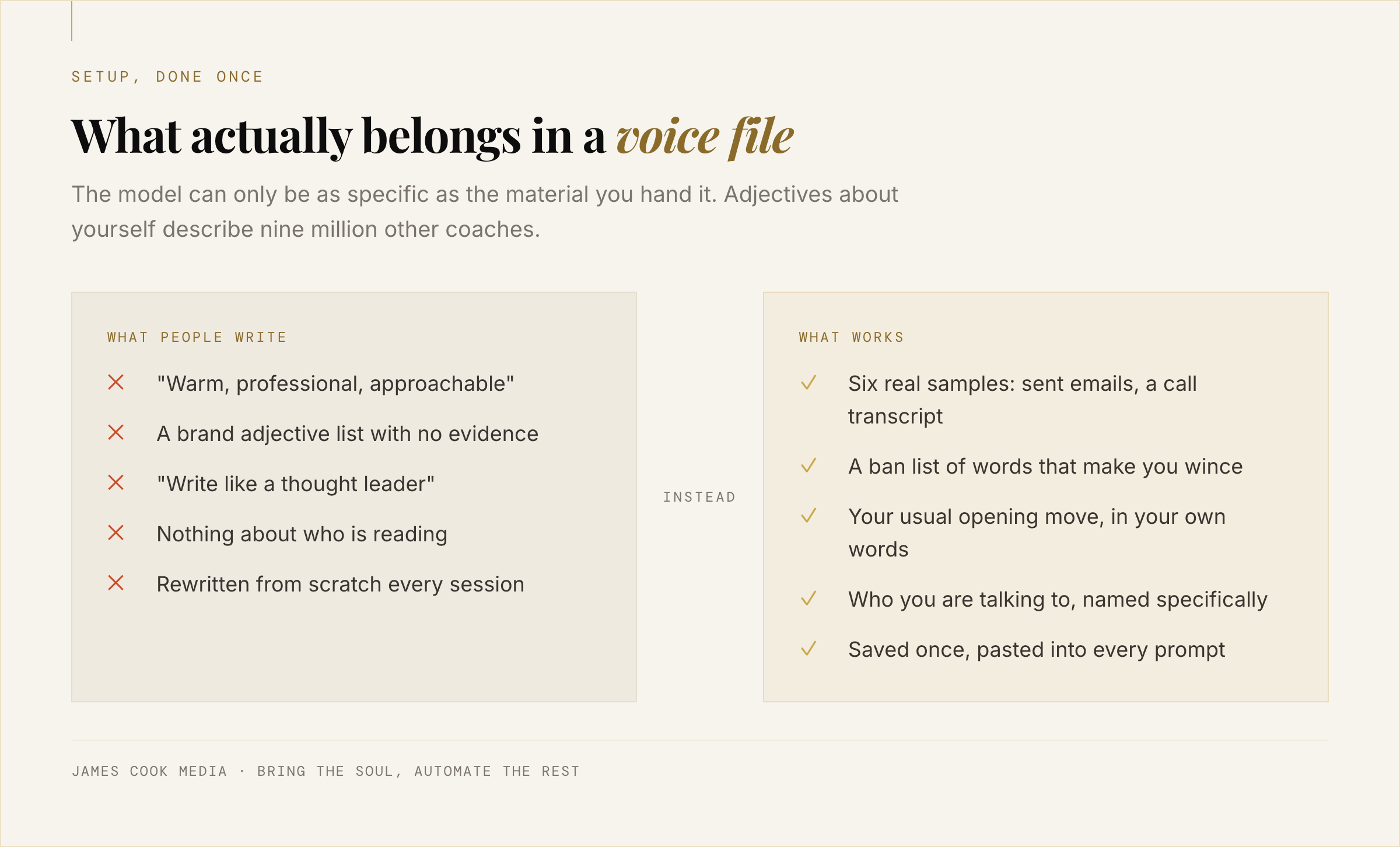
The uncomfortable truth is that the model can only be as specific as the material you give it. Your raw material already exists, in your calls and your inbox. You are not creating a voice. You are handing over the evidence of one you already have.
The one idea: pick something you already say out loud
The best idea for a batch session is something you have already explained to a client three times this month. It is proven, you can defend it, and you can tell the story that goes with it. Do not brainstorm twenty new topics. Pick the one you are slightly tired of repeating, because that repetition is the signal it matters.
Give this thirty minutes, no more. Write two or three sentences by hand, in your own words, before you touch the AI:
- The thing I believe: "Most people don't need another framework, they need to stop changing frameworks every six weeks."
- Who is wrong about it and why.
- The one story or example that proves it.
That third line is the whole article. AI cannot produce it, cannot guess it, and will paper over its absence with generalities if you leave the space blank.
Now let the model split the idea, not invent it:
Here is my voice file. Here is one thing I believe, plus who's wrong about it and a real example. Break this into five distinct angles that each stand alone. For each: the specific claim, who it's aimed at, and the objection it answers. No overlap between them. Do not add ideas I did not give you.
Five angles from one belief. That is your week.
The afternoon session, block by block
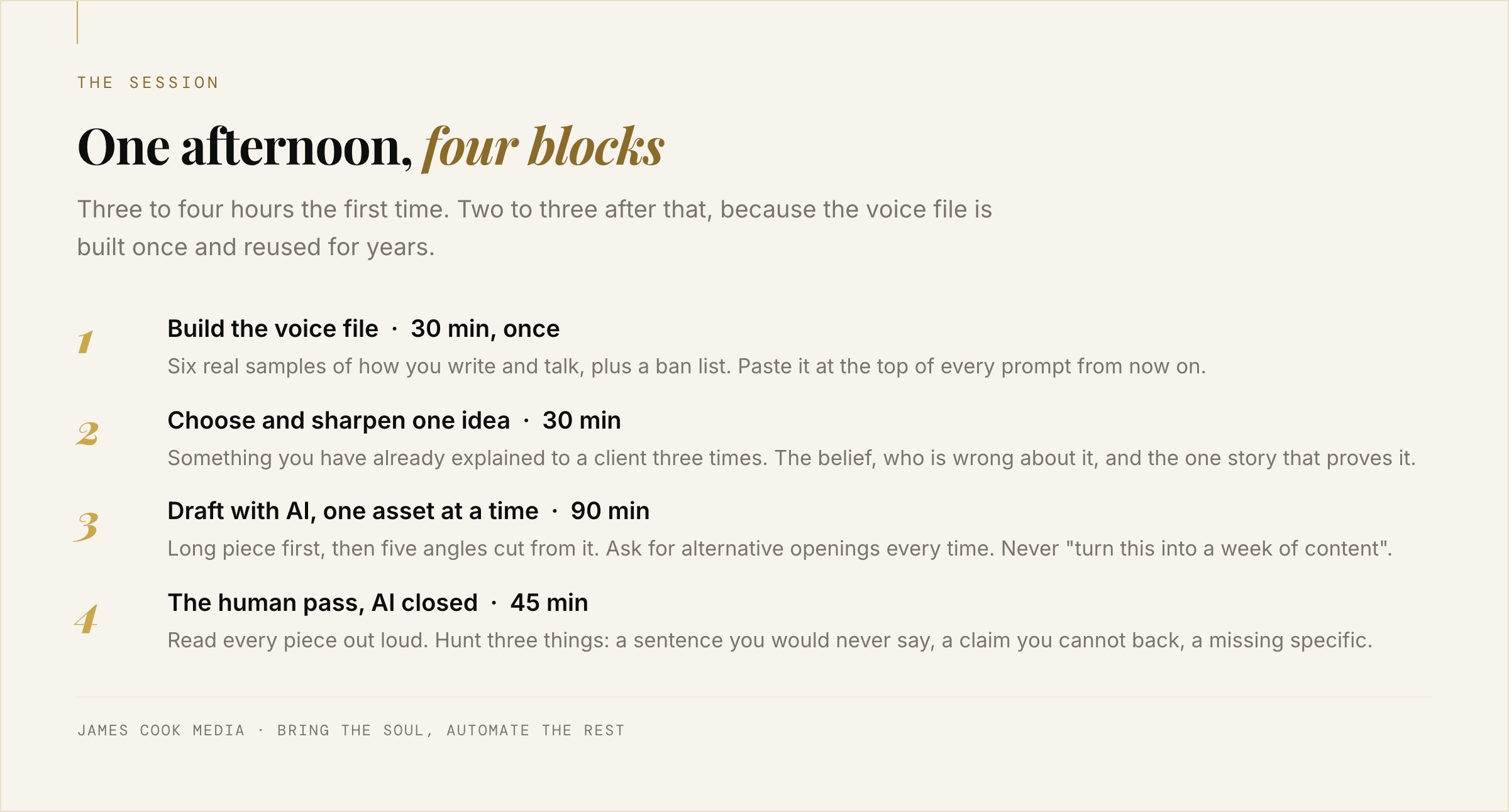
The session runs in four blocks: thirty minutes on the voice file (once, then reuse), thirty minutes choosing and sharpening the idea, ninety minutes drafting with AI one asset at a time, and forty-five minutes on a human pass with no AI open. Total: three to four hours the first time, two to three once the voice file exists.
The order matters more than the speed. Every block feeds the next one, and skipping ahead is how people end up with a folder of drafts they never publish.
Block one and two: setup (60 minutes)
Voice file and idea, as above. The first time you do this it will feel slow. It is not slow, it is the part that removes the blank page for every future session.
Block three: draft, one asset at a time (90 minutes)
Do not ask for everything at once. A prompt that says "turn this into a week of content" returns seven versions of the same flat paragraph.
Start with the long piece, because everything else is cut from it. Then take each of your five angles and ask for a short post using the long piece as source. One request, one output, one quick read before you move on.
A shape that works:
Using my voice file, write [asset] on angle 3. It must include the example I gave you, in my words, not summarised. Open with the situation the reader is in, not a definition. 200 words. No lists. Then give me two alternative openings.
Ask for alternative openings every time. The first opening a model produces is almost always its safest, and the second or third is where it stops sounding like every other post in the feed.
Block four: the human pass (45 minutes)
Close the AI tool. Read every piece out loud. You are looking for three things: a sentence you would never say, a claim you cannot back, and a missing specific. Fix those and you are done.
Expect to rewrite a fair amount. Most drafts need the opening and closing replaced entirely, because those are the two places where voice lives. If you find yourself rewriting ninety percent, your voice file is too thin – go back and add two more samples.
One small next step
See the whole method before you build anything bigger
The AI MasterClass walks through the same approach we use with clients – voice, prompts, and the workflow around them. About ninety minutes watch when you like.
Take the AI MasterClass → About 90 minutes · Watch at your own pace · No subscriptionWhere the AI stops and you start
AI is reliably good at structure, variation, format conversion and second drafts. It is reliably bad at judgement, specific memory, and the opinion that makes a piece worth reading. Give it the mechanical eighty percent. Keep the story, the stance and the final read for yourself. That split is what keeps a batch from sounding synthetic.
There is a reason a week of AI-written posts starts to feel like wallpaper. The model is producing the most probable next sentence, and the most probable sentence is the one everyone else already wrote. We've written about that failure mode in synthetic sameness and the real story.
The fix is not more prompting. It is putting things in the draft that the model could not have known: a client's exact words, the number you actually charge, the mistake you made in 2019, the thing you changed your mind about.
Two sentences of that per piece is enough. Two sentences only you could have written will carry six paragraphs of competent scaffolding.
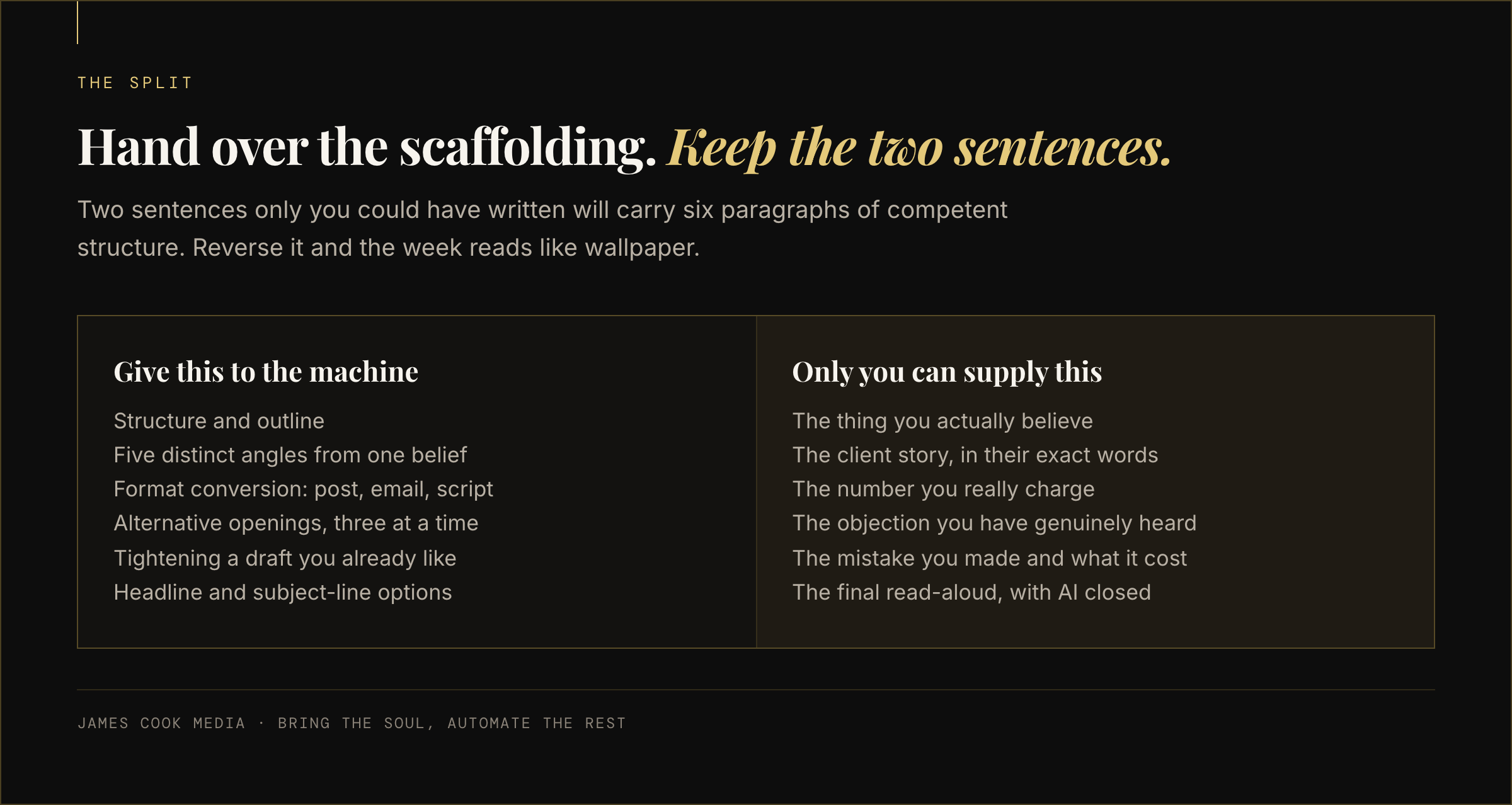
This is the whole thesis of how we work, and it is not a compromise. It is the only version that scales without hollowing out. Bring the soul, automate the rest is the longer argument if you want it.
What happens on Monday
Schedule the week rather than posting it all at once, keep one slot empty for something that happens during the week, and note which piece got a real reply. Two or three sessions in, you will know which of your five angles people actually respond to, and the sixth session gets easier because you are no longer guessing.
Space the posts out. Publishing all five on Monday reads as a dump, and it wastes the week you just bought yourself.
Leave one slot open. Something will happen on Wednesday – a client says something sharp, you read something that annoys you – and that unplanned post will usually outperform the batch. The batch exists so you have room to notice it.
Then keep score in the simplest way available. Not impressions. Replies, saves, and whether anyone mentioned it on a call. Three sessions of that and you have a real signal about which parts of your expertise the market wants more of.
If you want the ongoing system rather than the single afternoon – the repeatable loop that keeps this running month after month – that's laid out in the four-step content machine. This article is the session. That one is the habit.
Is this actually worth an afternoon
For a solo expert with no marketing team, yes, because the alternative is not "better content later" – it is no content at all. The point of batching is not volume for its own sake. It is that a week of published thinking gives search engines, AI assistants and referral sources something to find when someone goes looking for you.
We have generated $10M+ for clients since 2013, and the mechanism underneath most of it is unglamorous: the expert's own thinking, made findable, published consistently enough to be believed. That is an agency number, but it is not an agency mechanism. It works exactly the same with three clients and a laptop.
The thing that stops most solo experts is not skill and not ideas. It is that content is the one task with no deadline attached, so it loses to everything else, every week, forever. An afternoon with a fixed shape beats an intention with no shape.
Block out the time this Saturday. Build the voice file once. Then it is two hours a fortnight for the rest of your career.