Everything online sounds the same, and the tools sold to fix that problem cannot actually tell the difference. Here is what AI content detection really measures, why it keeps getting honest people wrong, and the one signal no model can generate for you.
You scrolled your feed this morning and read nine posts that could have been written by the same person. Then you looked at your own last three drafts and had the uncomfortable thought: mine would sit in that pile without anyone noticing. So you went looking for AI content detection tools, pasted your own writing in, and got a number back that told you nothing useful about whether the piece was any good.
That instinct is right and the tool is wrong. The sameness is real. The detector is not the answer to it, and the sooner you stop trying to pass a machine's test, the sooner you can start writing things only you could have written.
Why everything online started sounding the same
Large language models are trained to predict the most probable next word. Run at scale by millions of people using similar prompts, that produces a narrow, statistically average style: balanced sentence lengths, tidy tricolons, hedged conclusions. The sameness is not a bug in the models. It is what averaging looks like when everybody averages from the same source.
A model does not have taste. It has a distribution. Ask it for a LinkedIn post about resilience and it returns the centre of everything ever written about resilience, lightly reshuffled. Ask ten thousand consultants the same thing on the same morning and you get ten thousand versions of the centre.
This is why the feeling of sameness arrived so fast. It is not that the writing is bad. Most of it is competent. It is that competence is now free, and competence was never your differentiator anyway. Your differentiator was the eleven years you spent watching this problem go wrong in a particular way.
There is a second, quieter cause. Most people are not asking the model to help them say their thing. They are asking it to produce a thing so they do not have to. The output reflects the input. Nothing personal went in, so nothing personal came out.
What AI content detection actually measures
AI content detection tools do not read for meaning. Most estimate statistical properties of the text, chiefly perplexity, or how surprising each word is given the ones before it, and burstiness, or how much sentence length varies. Predictable, evenly paced prose scores as machine-written. That is a proxy for style, not a test of authorship.
Once you know what the number means, the number stops being frightening. A detector is asking one question: does this text sit close to the statistical middle? It is not asking whether a person wrote it, because it has no way to know that.
Which produces an obvious and awkward consequence. Plain, careful, unshowy writing scores as synthetic. Baroque, unpredictable writing scores as human. A clear thinker who writes in short declarative sentences looks more like a machine than someone who writes badly.
The researchers who built the most cited study on this found exactly that pattern, and it is worth being precise about what they found.
The detectors are wrong in a documented, predictable way
In a 2023 study published in Patterns, Weixin Liang and colleagues at Stanford ran 91 TOEFL essays written by non-native English speakers through seven AI detectors. More than half were misclassified as AI-generated, with one detector flagging nearly 98%. The same detectors correctly identified over 90% of essays by US eighth-graders as human.
The paper is GPT detectors are biased against non-native English writers by Liang, Yuksekgonul, Mao, Wu and Zou, published on arXiv and in the journal Patterns. Their explanation for the gap is the perplexity mechanism described above. Non-native writers tend to use a smaller, more predictable vocabulary, which is precisely the fingerprint detectors read as machine-generated.
Then they did the part that should end the argument. They asked ChatGPT to rewrite those same essays with more sophisticated language, and the detectors reclassified the AI-edited text as human. Senior author James Zou put it plainly: "We should be very cautious about using any of these detectors in classroom settings, because there's still a lot of biases, and they're easy to fool with just the minimum amount of prompt design."
So the tool punishes honest simple writing and rewards anyone who spends thirty seconds gaming it. That is not a marginal flaw. That is the detector failing in both directions at once.
The company with the most training data in the world reached the same conclusion about its own product. OpenAI launched an AI Text Classifier in January 2023 and retired it six months later, on 20 July 2023, stating it was "no longer available due to its low rate of accuracy". If the people who built the generator cannot reliably build the detector, no browser extension is going to.
Google is not running a detector on you
Google's published spam policies do not target AI-generated text as such. They target scaled content abuse, defined as pages "generated for the primary purpose of manipulating search rankings and not helping users," which explicitly includes using generative AI to produce many pages "without adding value for users." The test is value and intent, not the tool.
This is the part that quietly changes what you should do on Monday. The Google Search spam policies name the behaviour, not the technology. Publishing forty thin pages a week to farm keywords is the violation whether a model or an intern wrote them.
What Google says it wants instead is in its guidance on creating helpful content: "original information, reporting, research, or analysis" and content that demonstrates "first-hand expertise and a depth of knowledge", the first E in E-E-A-T, which stands for Experience, Expertise, Authoritativeness and Trustworthiness.
Read those two documents together and the strategy writes itself. You are not being scored on whether you used AI. You are being scored on whether you brought something to the page that was not already on the internet. A model, by construction, cannot bring that. You can.
Detection is the wrong question entirely
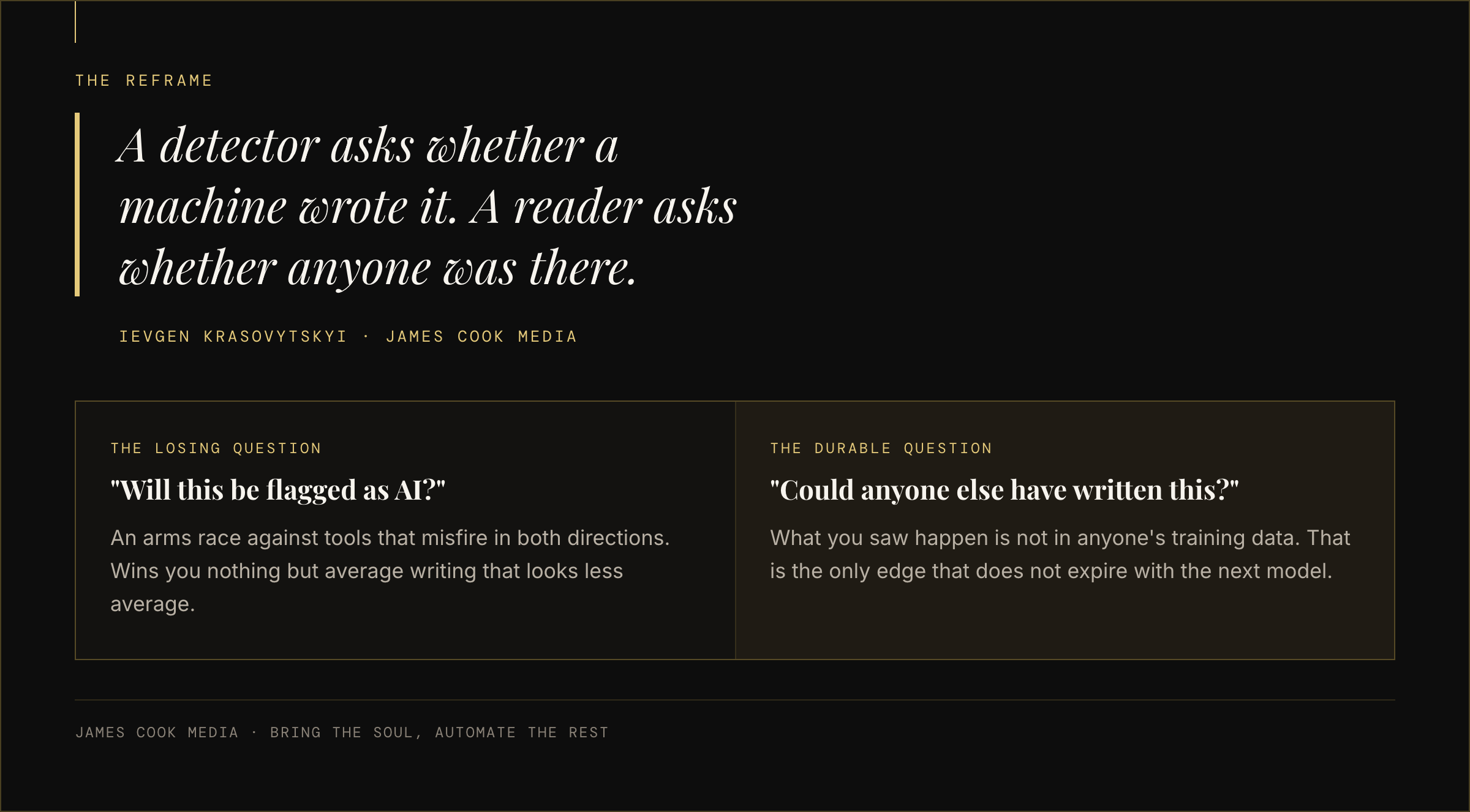
Asking "will this be detected as AI?" optimises for looking human. Asking "could anyone else have written this?" optimises for being useful. The first is a losing arms race against tools that already fail in both directions. The second is a durable advantage, because the specific thing you saw happen is not in anyone's training data.
Spend an afternoon on detector forums and you will find an entire industry devoted to the first question. Humanizer tools, prompt tricks, paid rewriting services. All of it is effort spent making average writing look less average, which leaves you exactly where you started: average, with extra steps.
The second question costs nothing and changes everything. Hold your last article up and ask whether a competent competitor with the same prompt would have produced roughly the same piece. If yes, the problem was never the AI. The problem is that you left yourself out.
The one signal a model cannot generate
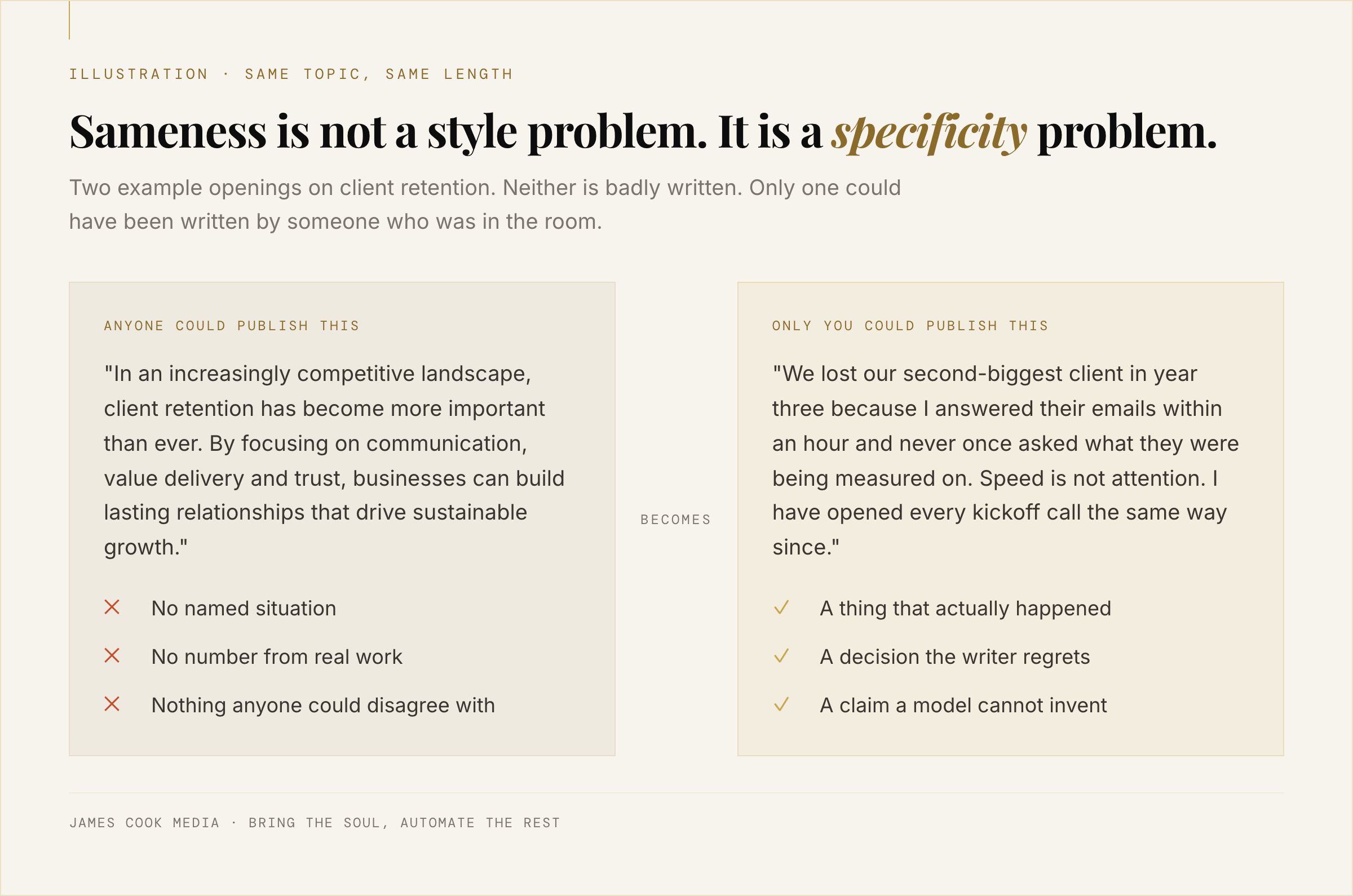
The durable signal is specificity that only comes from having been present: the client who said the surprising thing, the approach you abandoned and why, the number you were embarrassed by. A model can imitate the shape of a story. It cannot supply a detail it has never encountered, and it cannot know which detail matters to you.
Think about what actually persuades you when you read an expert. It is almost never the framework. It is the aside. "We tried that for a year and it quietly destroyed our margins." Nine words, and now you trust the person.
That is the asset you already own and are not spending. You have a decade of asides. Most of them are sitting in call recordings, in the answers you give the same three objections every week, in the thing you say at minute forty of a workshop when you finally relax. That material is not findable because it was never written down, not because it isn't good.
This is the whole of our thesis at James Cook Media, and it is not a slogan about creativity. It is a division of labour. You bring the soul, you automate the rest. The full argument is here, and the practical version is simpler than it sounds: the model handles structure, transitions, headline variants, formatting, repurposing. You handle every sentence that contains a fact about your actual life.
We have used that split across client work that has generated $10M+ since 2013, and I want to be clear that the number is not the point. The mechanism underneath it is the same one that works with three clients and a laptop, because the scarce input was never budget. It was a person willing to say the specific thing.
One small next step
Learn the method before you buy anything bigger
The masterclasses walk through how we turn what an expert already knows into content that sounds like them and gets found. About ninety minutes, watched at your own pace.
See the masterclasses → Watch at your own pace · Start with the one that fitsHow to put the specific back in
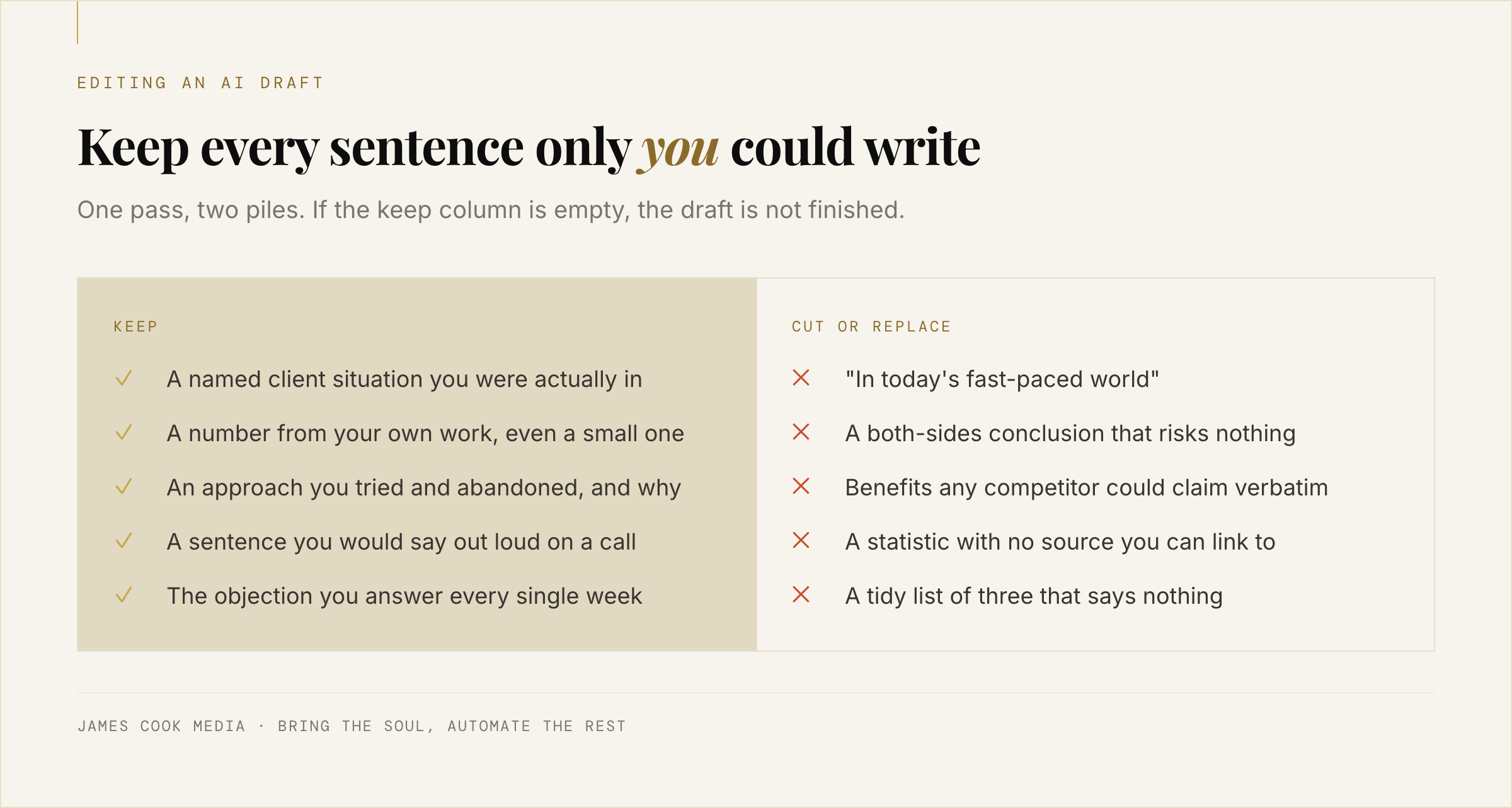
Start from your own material, not from a blank prompt. Record yourself answering a real client question, hand the transcript to the model as raw material rather than as a topic, and then read the draft hunting for any sentence that could have appeared on a competitor's site. Cut or replace each one with something that happened to you.
The order matters more than the tools. Most people prompt first and edit second, which means the model sets the frame and they spend an hour making generic text slightly less generic. Reverse it. Speak first, then let the model organise what you said.
A practical version of this fits in an afternoon rather than a quarter, and we have written the step-by-step workflow separately so you can run it without reading another strategy piece.
One more thing worth naming, because it sits underneath all of this. Plenty of experts are quietly worried that the models are coming for the work itself, which is a different question and worth its own answer. This piece is narrower. It is about why your writing stopped sounding like you, and how to get that back.
Where this leaves your next draft
Stop running your work through AI content detection tools. They measure predictability, they misfire on plain writing, and their verdict has no bearing on how you rank or whether anyone trusts you. Replace that check with a harder one: name three things in the piece that only you could know. If you cannot, the draft is not finished.
The synthetic-sameness problem is going to get worse before it settles, and that is genuinely good news for you. When competent writing is free, the market reprices toward the thing that is not free. Presence. Judgement. The willingness to be specific in public.
You already have the material. You have been giving it away in conversations for years. The work now is not to sound more human than a machine. It is to sound more like yourself than anyone else can manage.