You opened ChatGPT, described what you do, and read the result with a sinking feeling. It was competent, it was tidy, and it could have been written about literally any consultant in your field.
That is the fear underneath most experts' relationship with AI: not that it will fail, but that it will work, and the thing it produces will be indistinguishable from everyone else's. You have spent years earning a point of view. Watching a model flatten it into "leveraging strategic insights to drive meaningful outcomes" is genuinely demoralising.
Here is the part most guides skip. Producing AI content that doesn't sound like AI is not a prompting problem. It is a division-of-labour problem. You handed the machine the one job it cannot do and kept the jobs it does better than you.
Why your AI content sounds like everyone else's
AI writing sounds generic because language models generate the statistical average of everything they were trained on. Given thin input, a model returns the middle of the internet. It sounds like everyone because it is made of everyone. The fix is not a better prompt or a humanizer tool; it is putting something into the request that does not already exist online.
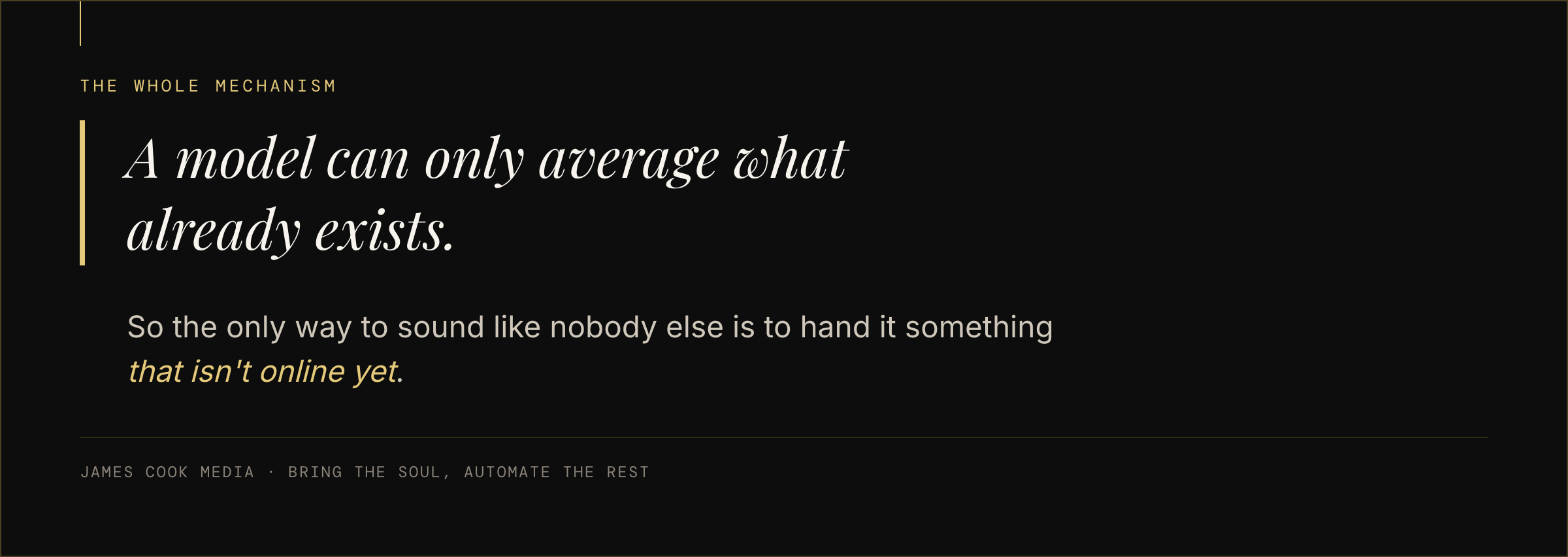
A model predicts what usually comes next. That is the whole mechanism. Ask it about executive coaching and it will produce the consensus view of executive coaching, assembled from a million pages that all say roughly the same thing.
This is why the standard advice underdelivers. Ban lists, "act as a world-class strategist", tone sliders, humanizer apps. All of it operates on the output, after the flattening has already happened. You are sanding down a shape that was wrong when it was cast.
Nothing you do to the text afterwards can put back a perspective that was never in the input. The interesting question is not how do I make this sound like me. It is what did I fail to give it.
The line between the soul and the rest
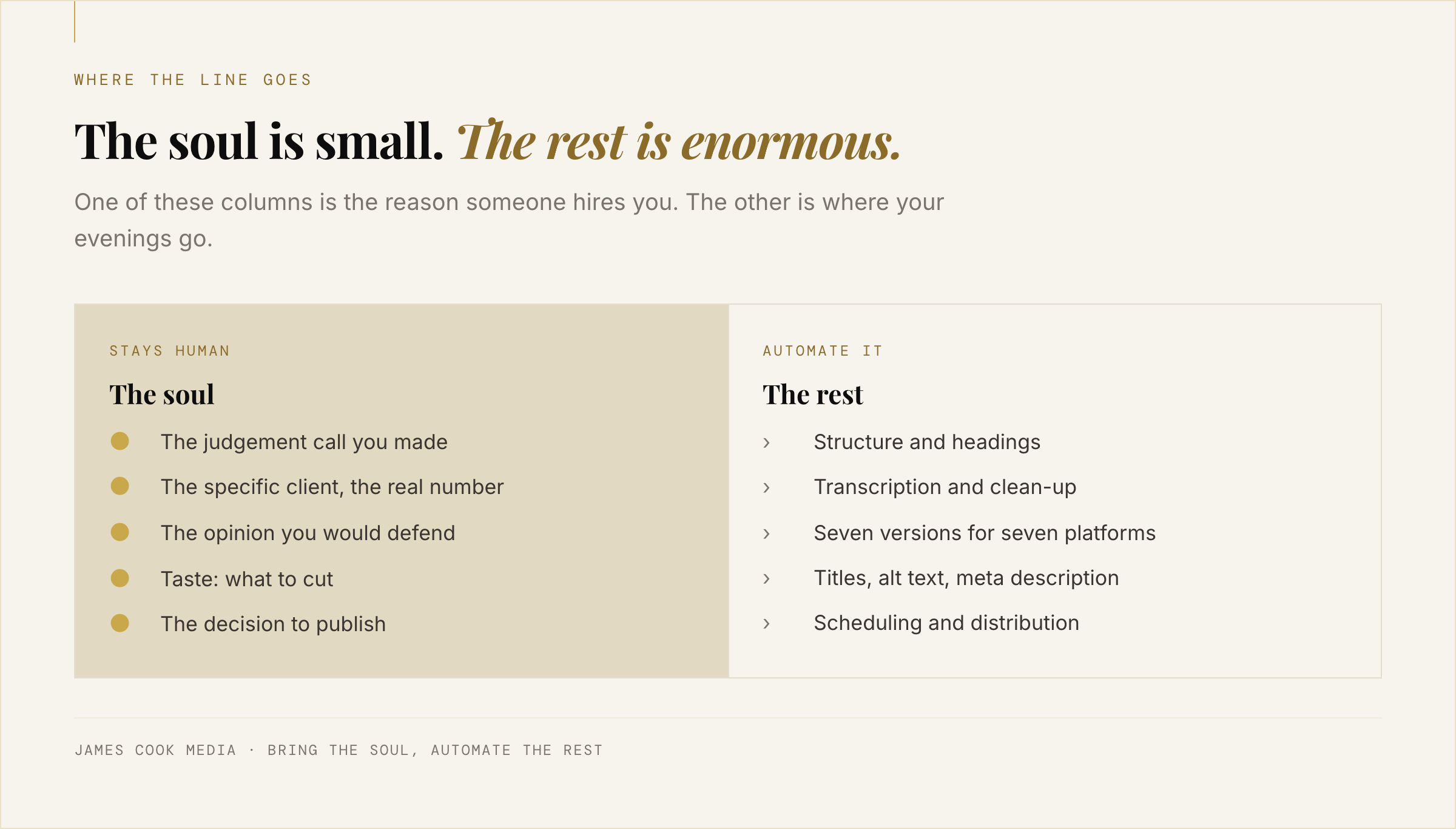
The soul is everything only you could have said: your judgement, your specific client stories, your taste, the opinion you would defend in a room. The rest is everything mechanical around it: structure, formatting, variants, scheduling, transcription, metadata. Automate the second category ruthlessly. Never let a machine near the first.
Draw the line once and most of the anxiety dissolves. You are not deciding whether to use AI. You are deciding which half of the work it touches.
The soul is small. It is a handful of things: the moment you realised the client's problem was not the one they described, the number you actually saw, the thing you believe that half your industry would argue with. On a good day that is maybe four hundred words. It is the only part of your content that cannot be produced by anyone else, and it is the reason someone hires you instead of the person one search result above you.
The rest is enormous and boring. Turning four hundred words into a structured article. Producing seven versions for seven platforms. Writing the meta description. Chapter markers, transcripts, alt text, the email that points at the post. This is where your evenings go, and none of it carries a trace of you.
Most experts get this exactly inverted. They ask the model for the idea and then spend an hour hand-polishing the sentences. That is paying a craftsman's price for a labourer's output.
AI content that doesn't sound like AI is an input problem
AI content that doesn't sound like AI is produced by feeding the model raw material it could not have found on its own, your transcripts and notes and actual client cases, and asking it to organise rather than invent. When the substance is yours, the sentences read as yours, without any humanizing step at the end.
Test it yourself. Give a model a two-line brief and it will hand back the average. Give it a rough, unedited fifteen-minute transcript of you explaining the same idea to a client and ask it to shape that into an article, adding nothing, and the result will sound uncannily like you. Because it is you, reorganised.
The trap is training the model on your published work. By the time something is on your website you have edited the life out of it. You removed the aside, smoothed the rhythm, deleted the sentence your compliance-minded self flinched at. The model learns to write polished. Polished is another word for average.
Feed it the messy version instead.
There is a second-order benefit. Content built from real client conversations answers questions people are genuinely asking, in the words they genuinely use. That is also, not coincidentally, what makes a page worth citing. We wrote about the detector arms race and why sameness is the real risk in synthetic sameness and the real story.
Your spoken record is the raw material
Solo experts think they have no content library. They do. It is spoken. Sales calls, discovery sessions, the answer you have given forty times, voice notes on the drive home. Recorded and transcribed, that becomes the highest-quality training material you own, because it is unedited, specific and impossible for anyone else to produce.
You are not short of ideas. You are short of ideas in written form. Those are different problems and the second one is mechanical.
Start with the three questions every prospect asks in the first ten minutes. You have answered them so many times the answer has become good. Say each one into your phone for four minutes, unscripted, the way you would say it to a person. Do not perform. Stumbling is fine; stumbling is data about how you actually talk.
That is twelve minutes of recording and roughly two thousand words of transcript, all of it yours, none of it findable anywhere else. It is more distinctive raw material than most agencies extract from a client in a month. If recording feels awkward, turning what you already say on calls into content walks through the least self-conscious way to start.
The reason this works is boring and structural: the machine is doing retrieval and arrangement, which it is excellent at, instead of invention, which it is not.
Three passes that put you back in
Work in three passes. First, capture your thinking in raw form with no editing. Second, let the model structure and expand it, with an explicit instruction to add no claims of its own. Third, read it aloud and reinsert what got smoothed away: the aside, the number, the sentence with an edge. The third pass is short and it is the whole difference.
The first pass is voice. Talk, do not type. Typing invites you to self-edit, and self-editing is where your voice goes to die.
The second pass is arrangement. Hand over the transcript with a plain instruction: organise this, keep my phrasing, invent nothing, mark anywhere I have made a claim I have not supported. That last clause is worth more than any ban list, because it turns the model into an editor rather than an author.
The third pass is the one people skip, and it takes eleven minutes. Read the draft out loud. Every place you hear yourself flatten into a stranger, stop and write the sentence you would actually say. Put back the specific client. Put back the number. Put back the opinion you softened.
The reluctant experts we work with tend to arrive at some version of the same line: "I'd rather not sell than sell myself." The third pass is what makes that trade-off unnecessary. You are not selling yourself. You are refusing to let a machine speak on your behalf about things it does not understand.
One small next step
See the method before you buy anything bigger
The AI MasterClass walks through the same soul-and-machine split we run for clients, including the prompts and the capture routine. About ninety minutes, at your own pace.
Take the AI MasterClass → About 90 minutes · Watch at your own pace · No subscriptionWhat automation is genuinely for
Automation belongs on everything downstream of the idea: transcription, reformatting, platform variants, scheduling, internal linking, metadata, repurposing one recording into a month of assets. These tasks have a correct answer and no personality. Automating them is what buys you the time to keep the upstream work human.
This is the half of the thesis that gets ignored, because "keep it human" is the flattering part. But if you only do the human half you will publish twice and stop, exactly as you did last time.
One recorded conversation can legitimately become an article, a newsletter, five short posts and a set of clips. Not because you are stretching thin material, but because you said something once and it deserves more than one shape. The mechanics of that are covered in turning one recording into a month of content.
Nothing in that list requires taste. All of it requires time you do not have. James Cook Media has trained over 100,000 experts since 2018, and the pattern is remarkably consistent: the ones who keep publishing are not the ones with more discipline, they are the ones who stopped doing the mechanical part by hand. That is not an agency-scale advantage. It works the same with three clients and a laptop.
The test before you publish
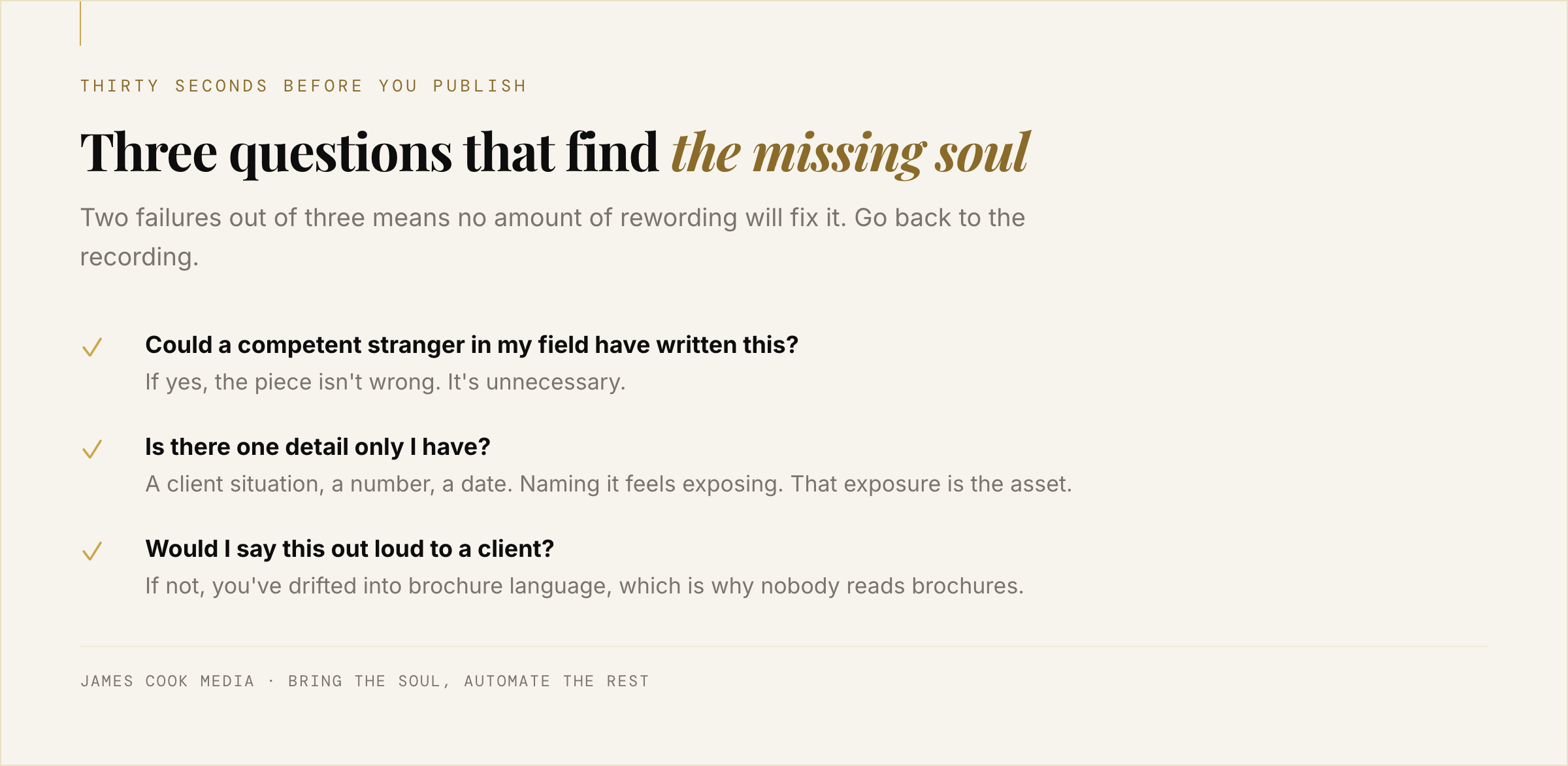
Before publishing, check three things. Could a competent stranger in your field have written this? Is there at least one specific detail, a client situation or a number or a date, that only you have? Would you say this sentence out loud to a client? Two failures out of three means the draft has no soul in it yet, and no amount of rewording will add one.
It is a thirty-second check and it catches almost everything.
The first question is the harshest. If the answer is yes, the piece is not wrong, it is just unnecessary. There is already a version of it online and yours will not be the one that gets found or remembered.
The second question is the fixable one. Usually the specific detail exists, you just left it out because naming a real situation felt exposing. That exposure is the entire asset.
The third is the tone check. Read the opening paragraph aloud. If you would not say it to a person sitting across from you, you have drifted into brochure language, which is where most expert websites already live and why nobody reads them.
Run those three questions on your last five posts. The result tends to be uncomfortable and clarifying in equal measure. The uncomfortable part is the point: it is the first honest signal you have had about whether your content carries you in it.