
You have accounts on more AI tools than you have published posts. The workflow you are missing is four steps long, and none of them require you to buy anything.
You have a tab open for ChatGPT, a Canva login, a scheduling tool you paid for in January and opened twice, and a Notion template someone in a Facebook group swore by. You have also published nothing in eleven weeks. Somewhere between the third tutorial and the second free trial, content stopped being a thing you do and became a thing you research.
That is not a discipline problem. It is what happens when every guide to building an AI content workflow answers the question "which tools?" when the question you actually have is "in what order?"
The order is four steps: capture, shape, multiply, publish. The tools inside those steps are close to interchangeable, and the whole thing runs on the ugliest possible first version of everything.
Why more tools made your content slower
Adding AI tools does not add output, because software is never the bottleneck for a solo expert. The bottleneck is the gap between having a thought and having that thought written down anywhere. Each new tool adds a login, a decision and a learning curve to a process that was already stalling before the first word.
Count the last five things you bought or signed up for. Now count how many of them help with step one, which is getting an idea out of your head and into text. Almost none of them do. They help with step two onwards, which is the half that was never the hard part.
This is why the stack keeps growing and the calendar keeps not filling. You are optimising the fast half of a process that is jammed at the slow half. A better drafting tool cannot help you if nothing ever gets to the drafting stage.
There is a second cost that nobody mentions. Every tool you add is one more place your material lives, which means one more thing to check before you can start. Three half-used systems is worse than one boring folder.
The four-step AI content workflow, on one page
An AI content workflow for a solo expert has four steps. Capture: get raw thinking out of your head, unedited. Shape: let a model arrange what you said without inventing anything. Multiply: turn the one piece into the two or three formats you actually use. Publish: put the imperfect version out on a fixed day. Everything else is optional.
Each step has exactly one job and exactly one output, which is what makes it possible to run when you are tired. You never have to decide what happens next.
The sequence also splits the work honestly. Steps one and four are yours and cannot be delegated to anything. Steps two and three are mechanical and should barely involve you. That split is the whole thesis behind bring the soul, automate the rest, and this is what it looks like as a routine rather than an idea.
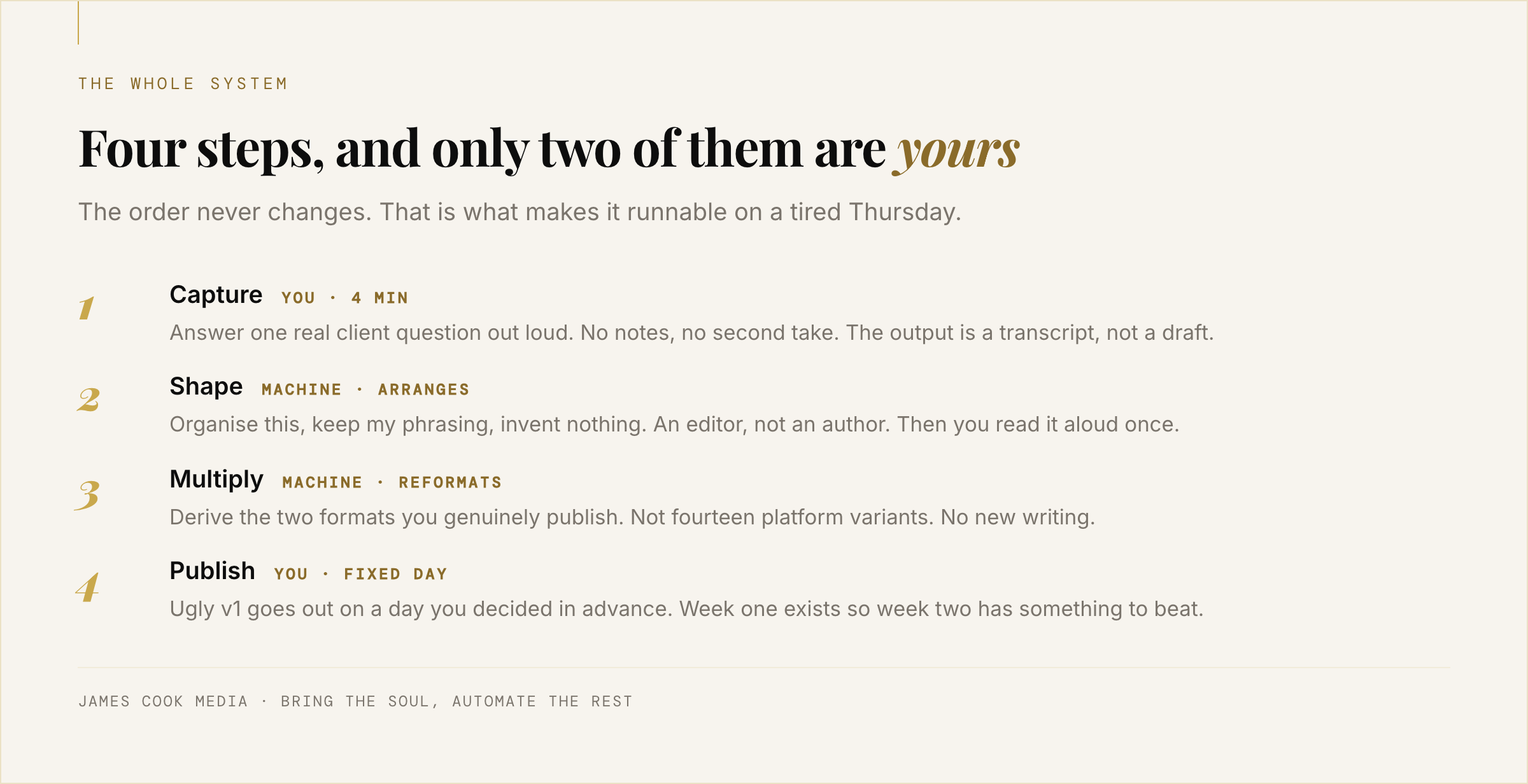
Run it once a week and you have a content habit. Run it three times in an afternoon and you have a month of material, which is the batching variant covered in a week of content in an afternoon. Same four steps, different rhythm.
Step 1: capture the thought before it is any good
Capture means recording yourself answering one real client question, out loud, for about four minutes, with no notes and no second take. The output is a transcript, not a draft. Speaking bypasses the self-editing that stops most experts from ever starting, and a stumbling four-minute answer contains more of your actual expertise than an hour of careful typing.
Pick a question a prospect asked you this month. Open the voice recorder on your phone. Answer it the way you would answer it on a call, including the aside, the caveat and the example you always reach for.
Do not write bullet points first. Bullet points are where you start performing. The value of this step comes entirely from the fact that you are talking rather than composing, and the moment you plan it you are composing again.
Four minutes of you talking is roughly six hundred words of transcript. It will read badly. That is the point: it is raw material, and raw material is supposed to look raw. If recording yourself feels absurd, start by talking to one person on a call and hitting record with their permission.
One rule keeps this step from rotting: everything goes to the same place. One folder, one note, one recording app. Not the app that transcribes best. The one you will actually open at 6pm.
Step 2: shape it, and let the machine arrange rather than invent
Shaping is handing the transcript to a language model with one instruction: organise this, keep my phrasing, invent nothing. You are asking for an editor, not an author. The model finds the structure that was already in what you said, cuts the repetition, and flags anything you claimed without support. You then spend ten minutes putting your voice back where it got smoothed.
The instruction matters more than the model. "Write me a post about client onboarding" produces the average of the internet. "Here is a transcript of me explaining client onboarding. Organise it into an article. Use my words. Add no claims of your own. Mark anywhere I asserted something I did not back up" produces you, tidied.
That last clause is the one people skip and it does most of the work. It turns the model into a fact-checker of your own thinking, which is a genuinely useful role, instead of a ghostwriter, which is a role it is bad at.
Then read the draft out loud once. Every place you hear a stranger, replace the sentence with the one you would actually say. This takes about ten minutes and it is the difference between content that sounds like you and content that sounds like a category.
Nothing in this step requires the newest model or a subscription tier. It requires the transcript to exist, which is why step one is the only one worth protecting.
Step 3: multiply one idea into the formats you actually use
Multiplying means deriving the two or three formats you genuinely publish from the piece you already shaped. Not fourteen platform variants. One article can yield a newsletter, a short post and a set of talking points without stretching the material, because you said something once and it deserves more than one shape. Pick the formats where your clients actually are and ignore the rest.
The mistake here is ambition. Every repurposing guide shows a diagram with one blob exploding into eleven channels, which is a workflow for a marketing team, not for a person who also has clients to serve.
Choose two. For most solo experts that is a LinkedIn post and an email, or a podcast note and a blog post. Two formats you will maintain beats seven you will abandon in March.
This step is pure machine work. There is no judgement in reformatting an article into an email, and the quality ceiling is set entirely by the source material rather than the prompt. If you want the fuller version of this, one recording into a month of content covers how far a single conversation actually stretches.
Keep the derived pieces derived. The moment you start writing a fresh LinkedIn post from scratch, you have quietly added a fifth step and the system stops being four steps long.
Step 4: publish the ugly v1 on a fixed day
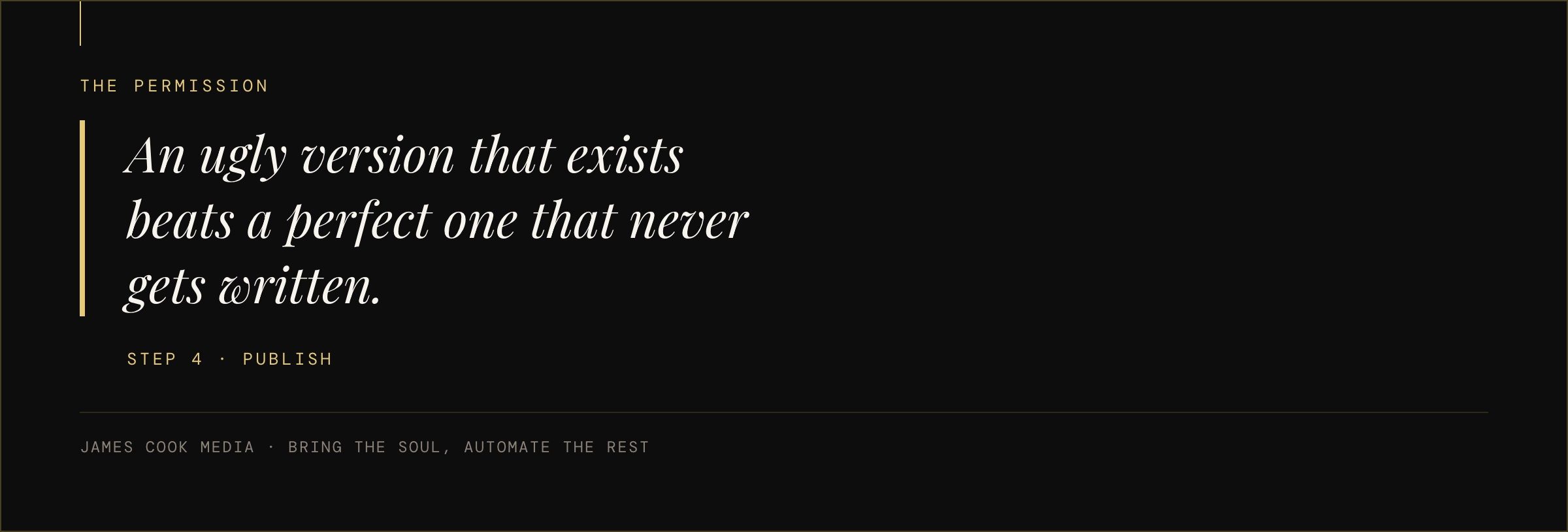
Publishing means putting the imperfect version out on a day you decided in advance. The version that goes live in week one is not meant to be your best work. It is meant to exist, so that week two has something to be better than. Most solo experts do not have a content problem, they have a drafts folder, and the fixed day is what empties it.
Pick a day. Thursday. It does not matter which, it matters that you stop deciding.
Here is the part that actually blocks people, and it is not time. It is the fear of putting something out that is less than your best, under your own name, in front of people who know you. That fear is reasonable and it is also the thing keeping you invisible.
One of the experts we work with put the underlying resistance plainly: "I'd rather not sell than sell myself." Ugly v1 is the answer to that, because a rough post that answers a real question is not self-promotion. It is your expertise made findable. Nobody reading it is grading your prose.
James Cook Media has trained more than 100,000 experts since 2018, and the pattern separating the people who publish from the people who plan is not talent or budget. It is that one group lowered the bar for version one. That works exactly the same with three clients and a laptop as it does with a team.
One small next step
See the method before you buy another tool
The AI MasterClass walks through the same capture-shape-multiply-publish routine we run for clients, including the prompts and the weekly rhythm. About ninety minutes, at your own pace.
Take the AI MasterClass → About 90 minutes · Watch at your own pace · No subscriptionThe tools barely matter, and here is how to pick the few you need
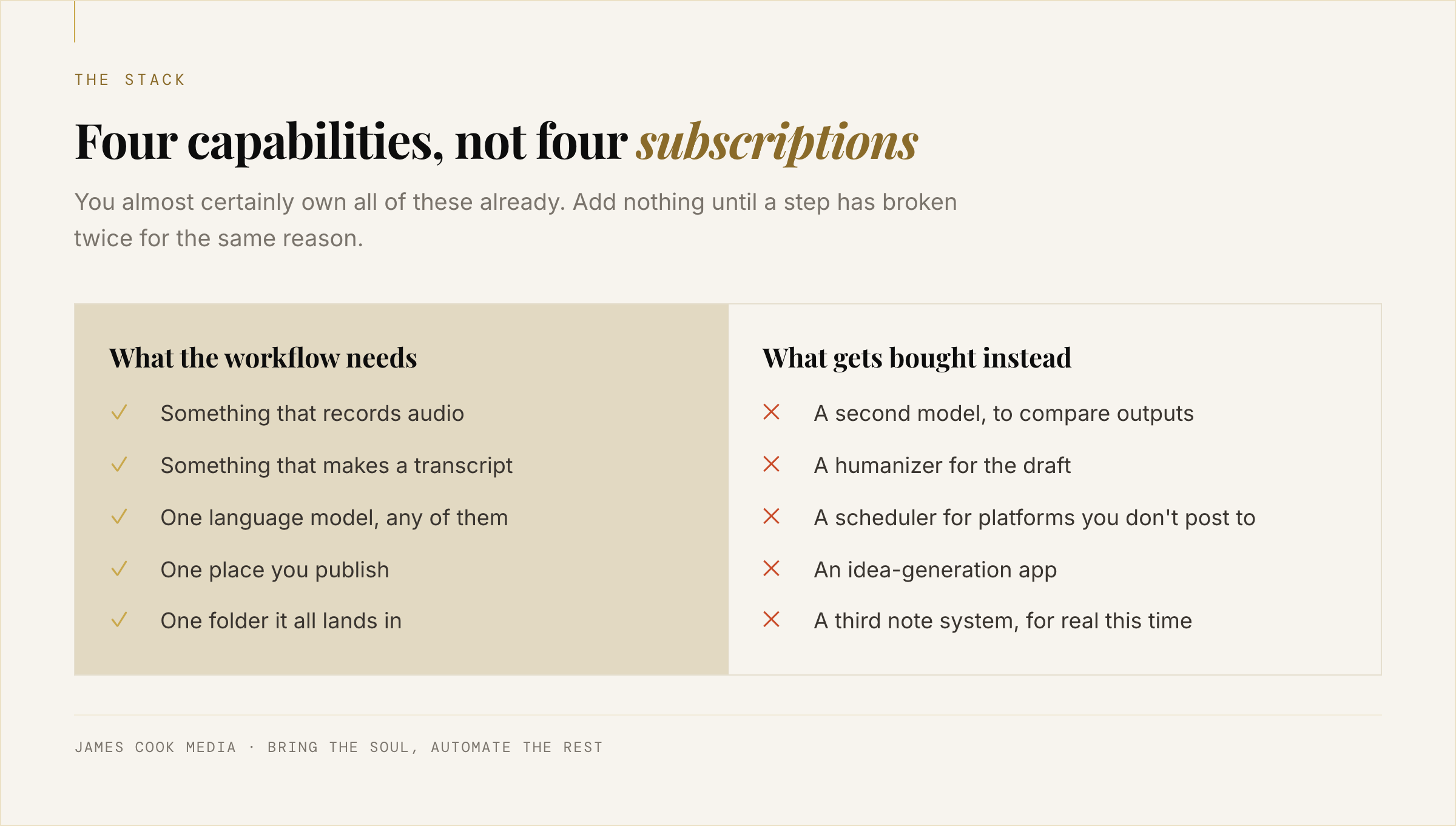
A working AI content workflow needs four capabilities, not four subscriptions: something that records, something that transcribes, one language model, and one place to publish. Most people already own all four. Only add a tool when a specific step has failed twice for the same reason, and never add one to a step that is working.
Your phone records. Your phone or your laptop transcribes. One chat model shapes. Your website or your newsletter platform publishes. That is the entire stack, and none of it is a recommendation you need to research.
The rule for adding anything: it has to fix a step that has broken twice, for the same reason, in the last month. "This would be cool" is not a reason. "I keep losing recordings because they are in three places" is a reason, and the fix is a folder, not a purchase.
The exception is the point where the mechanical half genuinely outgrows manual work. When multiplying and publishing start eating an evening a week, that is worth automating properly, and it is the problem StoryOS exists to solve. Until then, a folder and one model is not a compromise. It is the correct setup.
Run the four steps eight times before you change anything. By then you will know precisely which step is your weak one, and that is the only useful basis for buying software.