Every week you give away your sharpest thinking on a discovery call, and every week it disappears with the Zoom recording. This is how to keep it, without turning into someone who markets himself.
You are brilliant on calls. In a session, in a discovery conversation, on the phone with someone who is stuck, you say things that land, and the person on the other end goes quiet for a second and then says "nobody has ever put it like that." Then the call ends, the recording sits in a folder nobody opens, and online you are still invisible.
That is the whole problem. Not that you have nothing to say. You produce more genuinely useful material in a week than most people who call themselves content creators produce in a month. It just evaporates.
A podcast for coaches is not a marketing project you have to bolt onto an already full week. It is a way of catching what you already say, so it stops being spoken once and starts being findable by the people who needed to hear it.
Why the best thing you say all week disappears
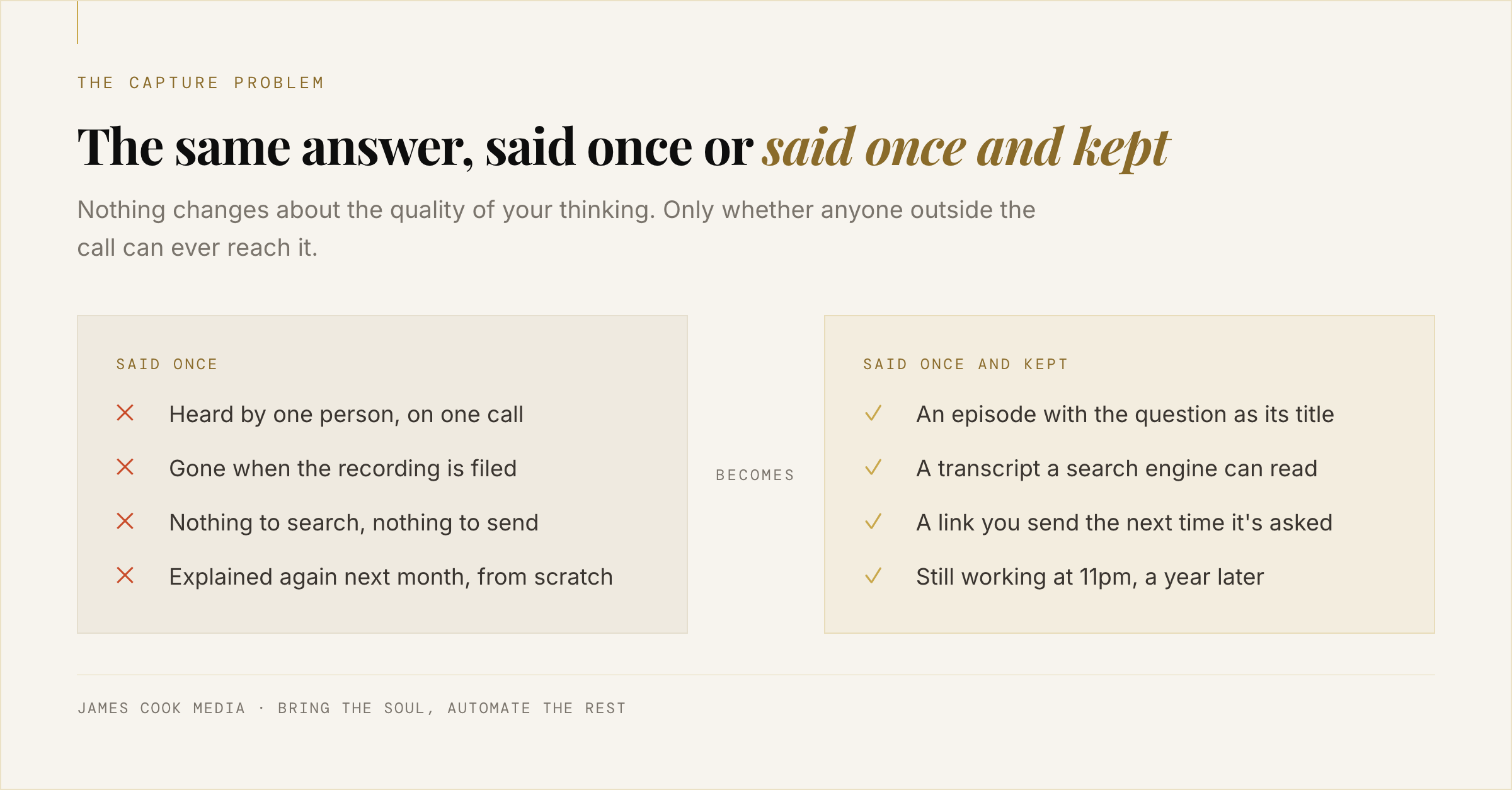
Expert knowledge lives in conversation. A coach explains, diagnoses and reframes in real time, in response to a real person's problem. That output is high quality and completely unrecorded. Nothing about a private call is searchable, shareable or repeatable, so a decade of genuinely good thinking leaves no trace anyone can find.
Count the sessions in your last month. Call it twenty conversations, forty-five minutes each. Somewhere in there is the answer to the question your ideal client is typing into a search box right now, phrased better than any blog post they will actually find.
The reason it never becomes content is not laziness. It is that the format is wrong. Writing asks you to sit down, face a blank page, and perform a skill that has nothing to do with the skill you were hired for. Speaking asks you to do the thing you are already good at.
Most experts do not have a content problem. They have a capture problem.
A podcast for coaches is not self-promotion
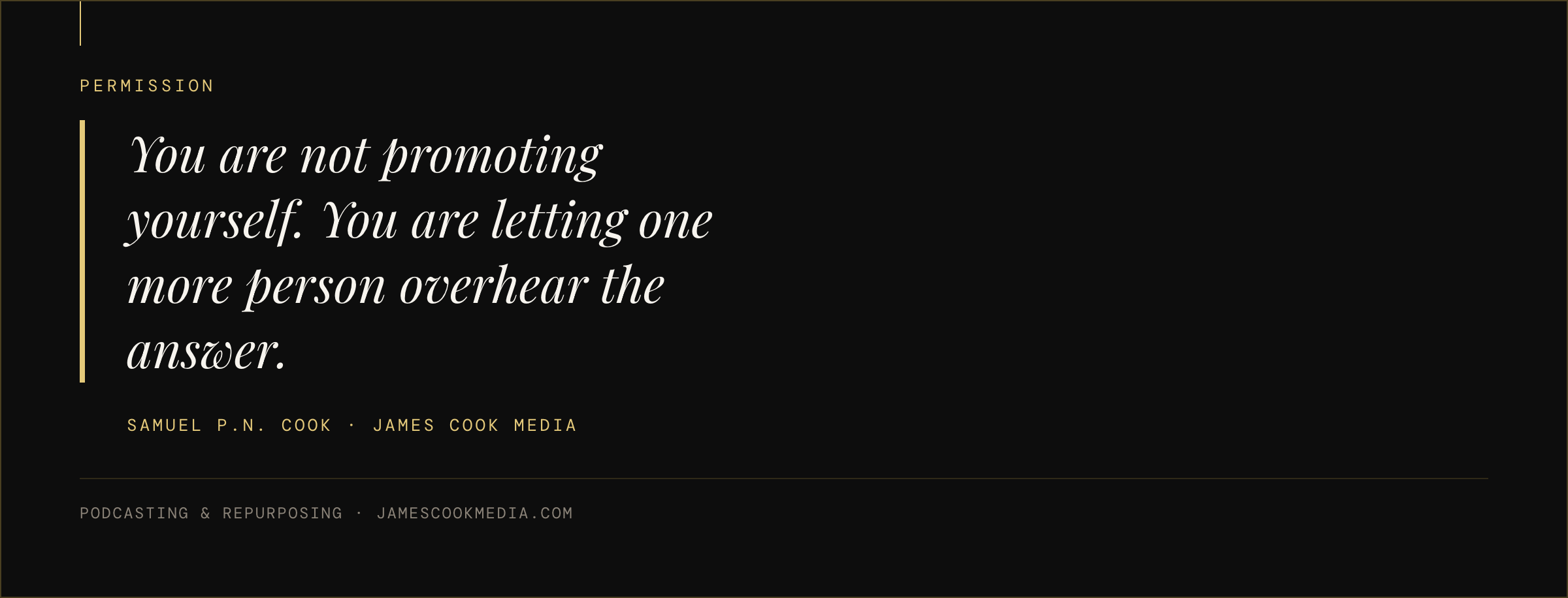
Publishing what you already tell clients is not selling yourself. It is showing the work. Self-promotion is claiming you are good. A podcast is letting someone hear you think through a problem for twenty minutes and decide for themselves. For a reluctant expert, that is the least salesy form of marketing available.
This is the objection I hear most, and it usually arrives in almost the same words: "I'd rather not sell than sell myself." It comes from people who are extremely good at their craft and have watched louder, thinner operators out-market them for years. The resistance is not vanity. It is taste.
So take the pressure off. You are not building a personality brand. You are answering, out loud, the questions people already pay you to answer, and letting the answer sit somewhere a stranger can find it at 11pm when the problem is keeping them awake.
The difference matters in practice, because it changes what you record. You are not producing a show about you. You are producing a public record of your thinking, one question at a time.
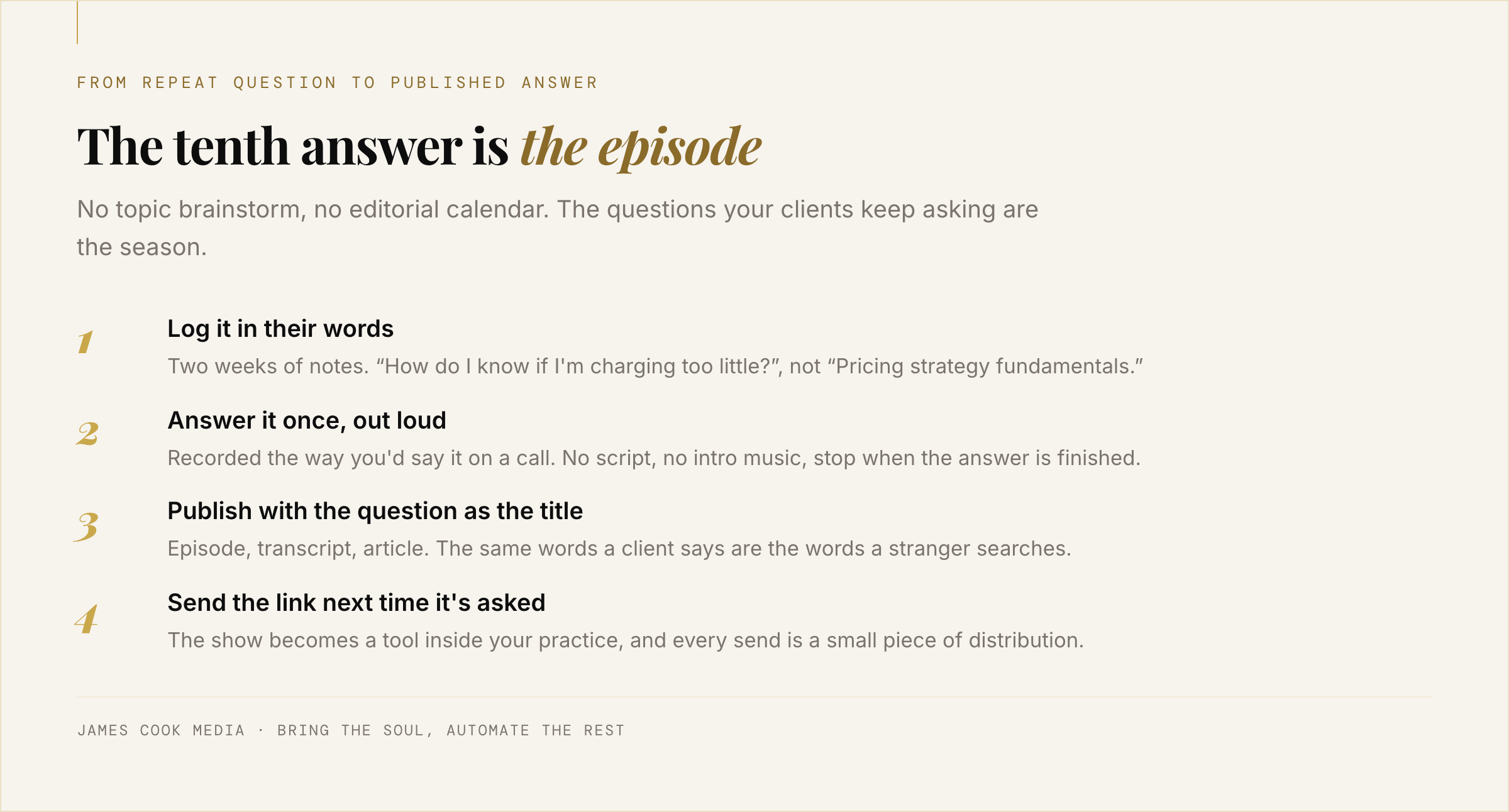
The tenth answer is the episode
The best podcast topics are the questions you have already answered nine times. Repetition is the signal. If a question recurs across different clients, it is a real market question, phrased in real language, with a proven answer you can deliver without preparation. That is an episode, and you already have twenty of them.
Keep a note on your phone for two weeks. Every time a client asks something you have answered before, write the question down in their words, not yours. Do not tidy it up. "How do I know if I'm charging too little?" is a better title than "Pricing strategy fundamentals."
At the end of two weeks you will have somewhere between fifteen and thirty questions. That is a season. It is also, incidentally, an excellent map of what people search for, because the language a paying client uses on a call is the same language a stranger types into Google or asks an AI assistant.
The part most guides skip is that this list is worth more than the recording gear. Sequence matters less than you think. Record the one you are most tired of answering first.
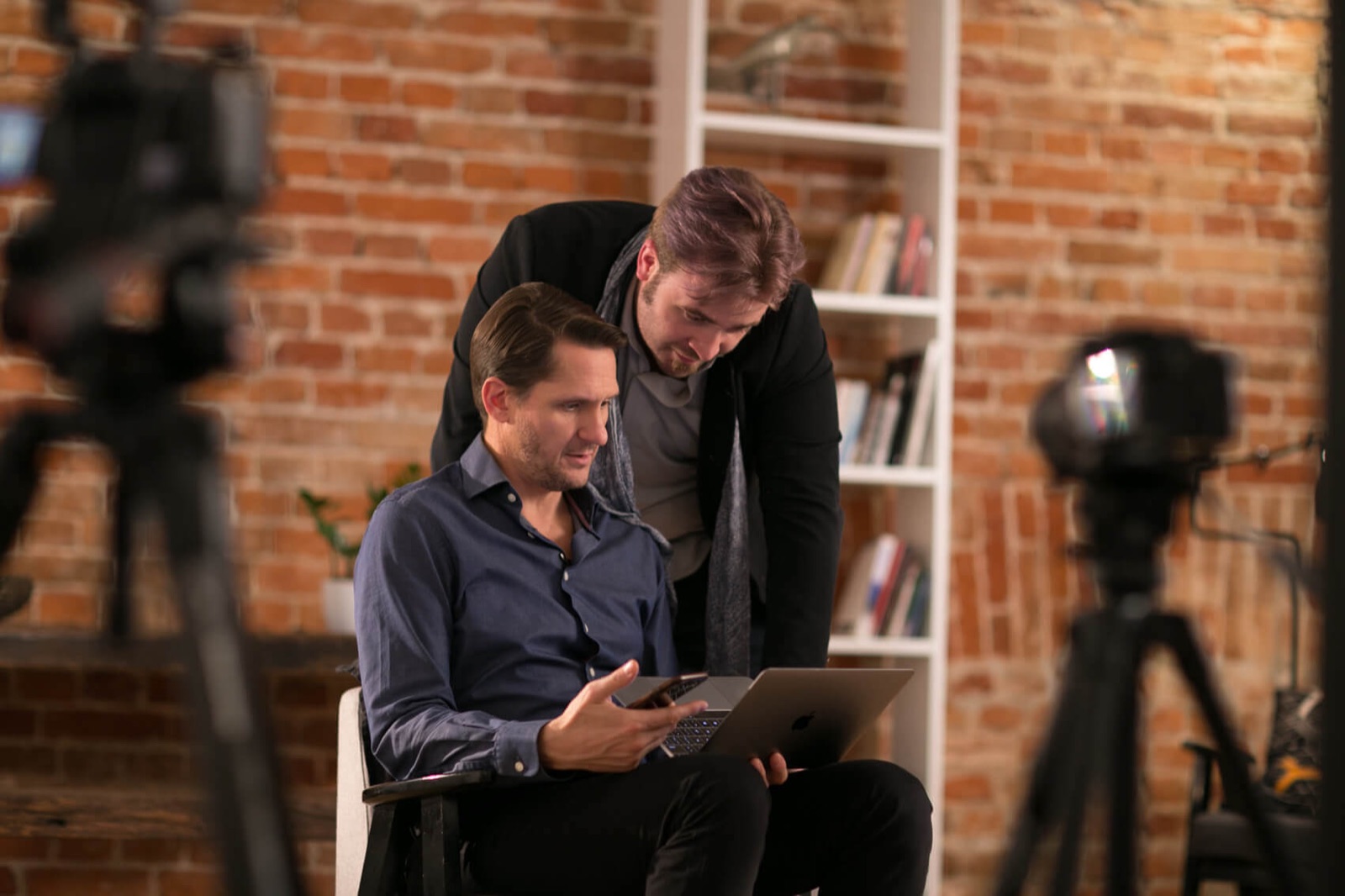
What recording actually looks like in a busy week
A workable coaching podcast needs one hour a fortnight, not a production schedule. Batch three or four short episodes in a single sitting, answer one question per episode, and stop when the answer is finished. Fifteen honest minutes beats forty padded ones. The constraint that kills most shows is not equipment, it is trying to publish weekly forever.
Set the bar where you can clear it on a bad week. Two episodes a month, published on a day you choose, is a show. Four a week for six weeks and then silence is not.
Record the way you talk on a call. No intro music you have to commission, no co-host you have to schedule, no script. If you catch yourself writing a script, you have quietly turned it back into a writing project and it will stall.
The gear question is the most common form of procrastination in this whole category. A decent USB microphone in a room with soft furnishings is enough to start. If and when it matters enough to upgrade, our Podcast Studio exists for exactly that, and the show should earn its way there rather than start there.
One recording, then the automation
The recording is the raw material, not the deliverable. One twenty-minute episode contains a transcript, an article, several short clips, a newsletter and a week of posts. Producing those by hand is what burns people out. Producing them from a single recording, with tooling doing the mechanical part, is what makes the habit survivable.
This is the half that has nothing to do with talent, and it is the half you should hand off or automate. You bring the soul: the judgement, the story, the way you explain the thing. Everything downstream of the recording is mechanical, and mechanical work should be built once and then run without you.
Transcription gives you a searchable page. The transcript, edited lightly, becomes the article version for people who read rather than listen. Three or four moments in the episode become clips. One idea becomes the email. None of that requires a second conversation with you.
If you want the detailed version of that pipeline, it is the whole subject of turning one recording into a month of content. And if you are worried that using AI in the process will make you sound like everyone else, that is a fair worry, and it is answered in bring the soul, automate the rest.
Why speaking is the format that gets you found
Search engines and AI assistants can only recommend what they can read. A published transcript is text: indexable, quotable, attributable. It also carries something written content usually lacks, which is a specific person answering a specific question in their own voice, which is exactly the material AI answer engines lean on when they cite a source.
For years, the argument for a coaching podcast was intimacy. Someone listens to you for twenty minutes and arrives at a call already trusting you. That is still true, and it is still the strongest conversion mechanism a solo expert has.
What is newer is that the same recording, transcribed, makes you legible to machines. A search engine cannot tell that you are the best strategist in your city. It can tell that a page on your site answers a specific question thoroughly, in a real voice, with a name and a face attached.
Both things run off one act: you, saying the thing out loud, once, with the recorder on.
One small next step
Learn the method before you buy a microphone
The Podcasting MasterClass walks through how we turn spoken expertise into a show that brings clients in, including the question ledger, the batching setup and what happens to the recording afterwards. About ninety minutes
Take the Podcasting MasterClass → About 90 minutes · Watch at your own pace · No subscriptionWhat it looks like when it holds
A working expert podcast changes the shape of the sales conversation before it starts. Prospects arrive having already heard you think, so the call is about fit rather than credibility. That shift is what turns a handful of referral clients into a steady inbound flow, without the expert becoming a different person to get it.
We have trained over 100,000 experts since 2018, and the pattern is consistent enough to be boring. The ones who get traction are almost never the most confident on camera. They are the ones who found a format that matched how they already work, and then kept going for longer than felt reasonable.
That number is an agency-scale number, and it should reassure you rather than intimidate you. The mechanism underneath it is the same one that works with three clients and a laptop: say the true thing clearly, put it somewhere it can be found, repeat.
The reluctant expert stories at the centre of how we work, Bobby McGee's and Rory's, both turn on the same hinge. Not becoming louder. Becoming findable while staying exactly who they are.
Start with the questions. Record the tenth answer. The rest is machinery, and machinery can be built.