An honest look at what AI genuinely takes from solo experts, what it cannot touch, and why the difference is smaller than the reassurance articles claim and bigger than the doom ones admit.
You have spent fifteen or twenty years getting good at something, and now a chatbot answers in four seconds the question a client used to book a call to ask you. You have probably typed one of your own signature questions into it late at night, read the answer, and felt something go cold. That is not paranoia. That is pattern recognition, and it is the same instinct that made you good at your work.
So let's do this properly. Ask the internet will AI replace coaches and almost every answer you get back is useless in one of two ways. Half are doom: adapt or die, here is my course. Half are dismissal: "AI can't do empathy, relax." Both are written by people who need you to feel a particular way. What follows is the version I would want if I were you: what actually goes, what actually stays, and what the difference asks of you.
What AI genuinely replaces, said plainly
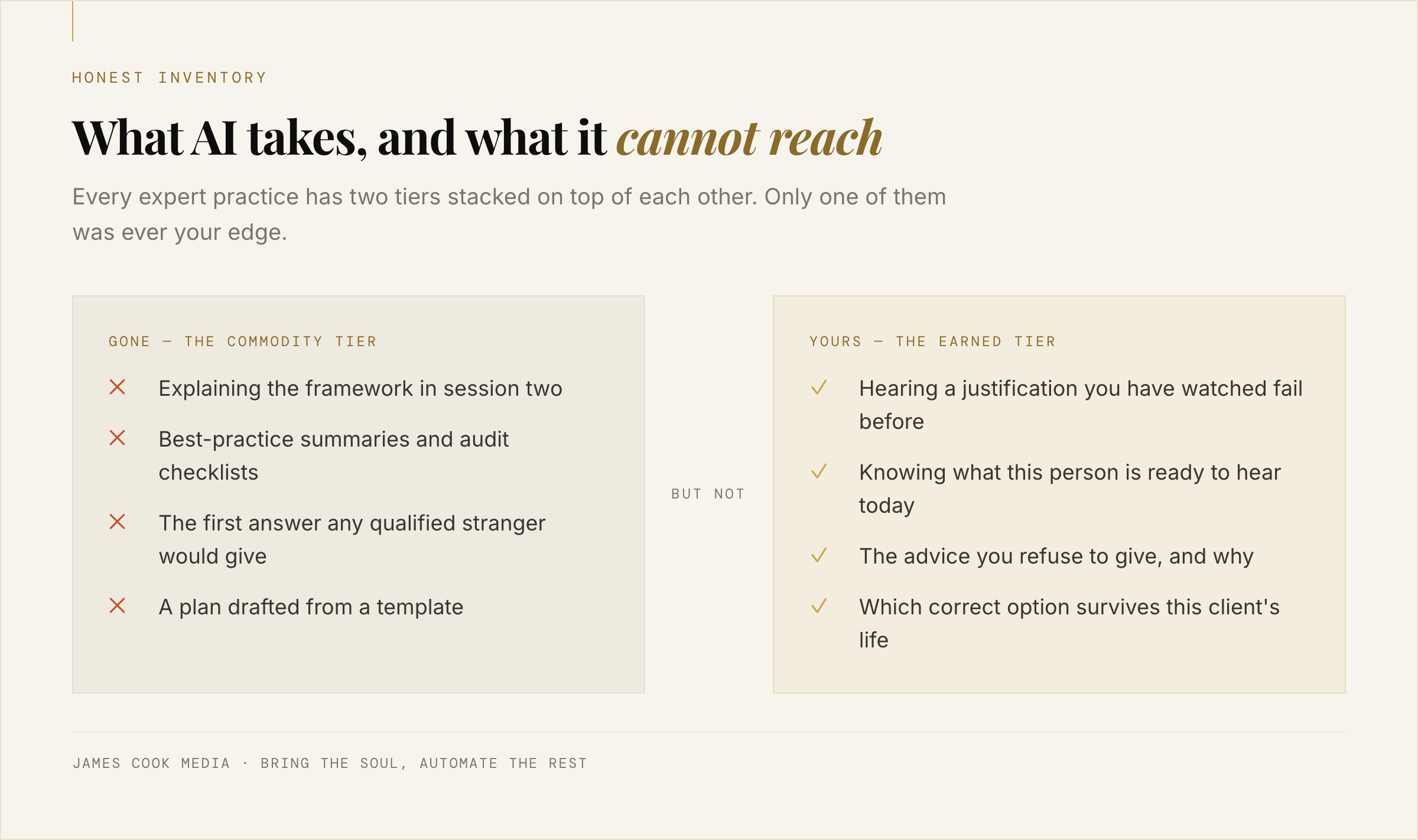
AI reliably replaces generic information delivery: explaining a framework, summarising best practice, drafting a plan from a template, answering the question anyone in your field would answer the same way. If a competent stranger with your credentials would give the same answer, that answer is now free, instant, and available at 2am. That tier of your work is gone.
Look at what you actually sell across a year and you will find two tiers stacked on top of each other. The bottom tier is transmission: the model you explain in session two, the audit checklist, the onboarding email that explains how the process works, the answer to "what should I focus on first?" asked by someone you have never met.
That tier was never your edge. It felt like your edge because you were the only one nearby who had it. Proximity was the moat, not knowledge. AI drained the moat.
The top tier is different. It is the moment you interrupt a client mid-sentence because you have heard that exact justification before, from someone who then lost two years to it. It is the recommendation you refuse to give because you can see the person in front of you is not ready for it. It is knowing which of the four textbook-correct options will actually survive contact with this specific human's life.
Do not let anyone tell you the bottom tier is still safe. It isn't. Pretending otherwise is how people get caught out. But notice what it means: what you lost is the part of your work you were probably bored of anyway.
Will AI replace coaches? The research is more uncomfortable than the reassurance articles admit
No, but not for the reason most articles give. The comforting claim is that AI cannot build a relationship. The research does not support that comfortably. What AI cannot do is have been present for anything. It can hold a warm, competent conversation about your field. It cannot have watched a specific client fail in a specific way and carried the lesson forward.
Here is the finding that should be in every one of these articles and is in almost none of them. A randomized controlled trial of 52 coaching clients, published on PubMed Central, compared a single 60-minute session with a human coach against a session participants believed was delivered by an AI. The researchers expected the human coaches to produce a stronger working alliance. They did not. The scores were 74.50 for human coaches and 72.73 for the AI condition, a difference the study reports as not statistically significant.
Sit with that for a second rather than arguing with it. Fifty-two people is a small study and a single session is a shallow test, but the direction is clear enough: "AI can't build rapport" is not the moat you were told it was.
The reassurance you have been reading leans almost entirely on that moat. The International Coaching Federation's own position is that AI is likely to augment rather than replace the profession, and the limitations it names are human connection, contextual nuance and nonverbal cues. Those are real limitations. They are also the ones closing fastest.
The more durable version comes from INSEAD's Graham Ward, who makes the distinction between the correct answer and the needed answer: AI can offer the right answer, while the work is helping a person reach the answer they are ready for. That holds up better, because readiness is not information. It is a read on a specific person at a specific moment, and you build that read from cases, not from training data.
The moat is not warmth. It is the room you were in.
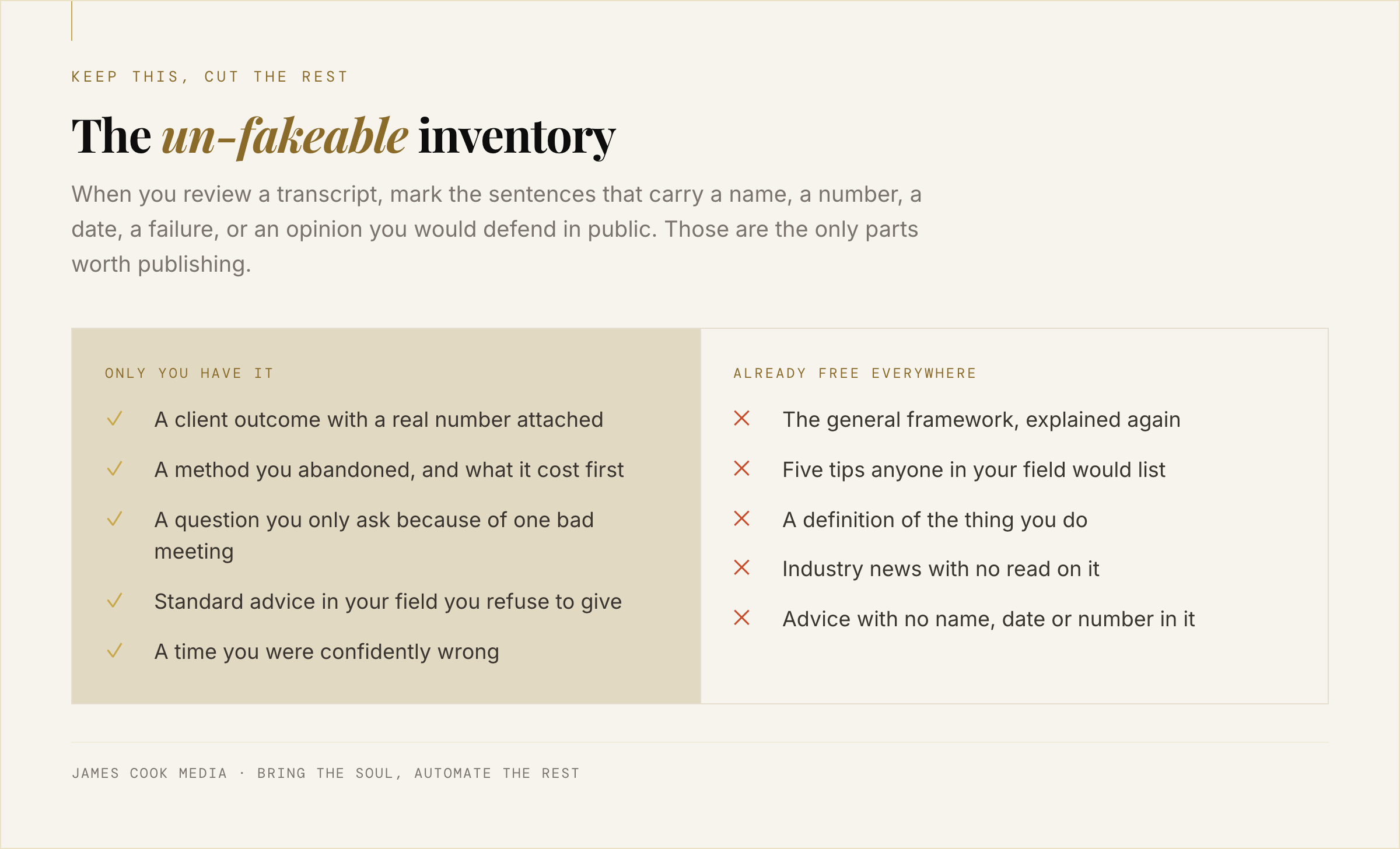
The un-fakeable asset is lived specificity: the client you took on who should have been a no, the method you abandoned after it failed twice, the industry detail you only know because you were there in 2016. AI is trained on the consensus of your field. It cannot produce the exception you personally paid for. That is your moat, and it compounds.
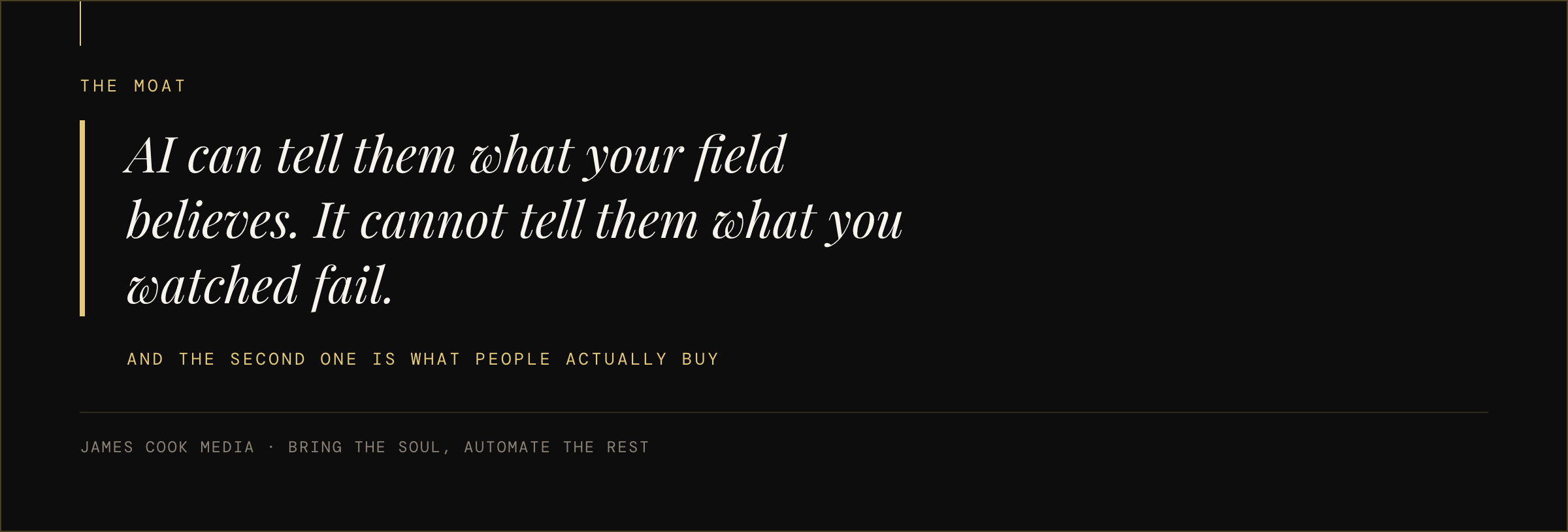
An AI can tell someone what your field believes. It cannot tell them what you watched go wrong.
That distinction is not sentimental. It is structural. A language model is built to produce the most probable answer, which by definition is the field's centre of gravity. Your value has always been where you diverge from that centre and can say why. The one time the standard advice would have wrecked a client. The shortcut everyone recommends that you stopped recommending. The question you now ask in the first ten minutes because of one meeting in 2019 that still bothers you.
Here is the part most guides skip. That material is not stored anywhere. It lives in your calls, your head, and the three sentences you say to a client that make them go quiet. It has never been written down, which means it has never been findable, which means as far as the internet is concerned it does not exist.
That is the real exposure. Not that AI is better than you. That AI is legible and you are not.
Being un-fakeable is worthless if you are also invisible
The threat to solo experts is not replacement, it is substitution at the point of discovery. People now ask an AI assistant first. It answers from what has been published and can be verified. If your judgement has never left your calls, the assistant recommends someone whose has, and you never learn the conversation happened.
Ten years ago a prospect googled, landed on a few sites, and made a shortlist. Now they ask an assistant and get an answer with two or three names in it. There is no page two to be on. You are either in the answer or you are not in the conversation.
What goes into that answer is what has been written, said publicly, and corroborated across places. Not credentials. Not how good you are with the clients you already have. Published, specific, attributable thinking.
Which means the expert who loses is not the worst expert. It is the best expert who published nothing. I have watched this happen to people who were plainly the strongest practitioner in their category, out-recommended by someone with a third of the skill and four years of blog posts.
The flip side is that the fix is not a personality transplant. You do not have to become a loud marketer. You have to make what you already know findable, in your own words, at a volume you can sustain. That is the whole argument behind bringing the soul and automating the rest: the judgement stays yours, the mechanical part around it stops eating your week.
What to do about it this month, without becoming someone you're not
Stop generating content and start extracting it. Record the calls you already have, pull out the moments where you said something only you would say, and publish those. AI is useful for the transcription, structuring and formatting. It should never supply the opinion, the example, or the thing you got wrong.
The order matters, so here it is concretely.
Capture what you already say. You explain your best thinking out loud several times a week and then it evaporates. One recorded call, one voice memo after a session, one honest answer to a client question. Almost everything you need is already inside a single recording if you stop treating it as disposable.
Keep the parts a model could not have written. When you review a transcript, mark the sentences containing a name, a number, a date, a failure, or a strong opinion you would defend in public. Those are the only parts worth keeping. Everything else is the commodity tier, and the machine already has it.
Let AI do the shape, never the substance. Structure, headings, tightening, turning one recording into five formats. That is real leverage and it costs you nothing that matters. The moment it starts supplying the examples, you have handed over the only thing you own. That failure mode has a shape and it is easy to spot once you know it, which is what synthetic sameness is about.
Publish at a rhythm you can hold for a year. Two useful pieces a month beats twelve in one burst followed by silence. The engines reward corroboration over time, and so do humans.
None of that requires you to post your face on camera daily or write a hook that starts with the word "Most". It requires you to stop letting the best thing you say all week disappear into a Zoom recording nobody opens.
Where AI is actually on your side
AI removes the exact obstacle that kept solo experts invisible: the labour between having a thought and having it published. Research, transcription, structure, repurposing, and the second draft used to require a team or a budget. A one-person business can now run the mechanical half of a content operation alone, which was not true three years ago.
The reason you never cracked this before was not laziness and it was not lack of insight. It was that the distance between knowing something and having it live on the internet, in a decent shape, was about six hours of work you did not have. That distance is now closer to forty minutes.
Which is a strange thing to say out loud: the technology you are worried about is the first one that ever made your position winnable. The generic tier got commoditised, yes. But the generic tier was where the well-funded competitors beat you, because they could out-produce you. Now nobody wins on production. The only remaining variable is whether the thinking is real, and that is the one contest you were always going to win.
That is not a promise that it will feel comfortable. It is a claim about where the advantage sits, and I would rather be on your side of it than on the side of an agency that can only produce volume.
If you'd rather think this through with people in the same position
The AI-First Circle
Our mastermind for experts working this out in the open: where AI genuinely helps, and where it quietly flattens you. Have a look at what it involves before deciding anything. Looking costs nothing.
See what the Circle is → Have a read first · Nothing to commit to today