You recorded something good. A podcast episode, a webinar, forty minutes of you explaining the thing you explain better than anyone you know. Then it went up once, a handful of people saw it, and the week swallowed you again.
That is not a content problem. You have already done the hard part, the part nobody can do for you. What is missing is the boring machinery that takes one recording and turns it into a month of visibility, and that machinery is the same whether you have a marketing department or a laptop and four clients.
Most content repurposing advice is written for a team. It assumes a calendar, a designer, someone who cuts clips, and a weekly publishing cadence. Run that as a one-person business and you will quit in three weeks. The version below is built for someone with no spare evenings.
You are not short of content. You are short of copies
Solo experts rarely have a content shortage. They have a distribution shortage. One forty-minute recording contains enough distinct ideas for a month of posts, but it was published once, in one format, on one platform, and then abandoned. Repurposing is not stretching thin material. It is giving something you already said more than one chance to be found.
Think about what actually happened when you recorded. You spoke for forty minutes. Somewhere in there you made maybe six separate points, told two stories, and said three sentences you would be happy to have quoted back to you.
Then all six points went out as a single audio file, to the people who already follow you, on a day most of them were busy. The ideas did not fail. They were shown once, to a small room, and never shown again.
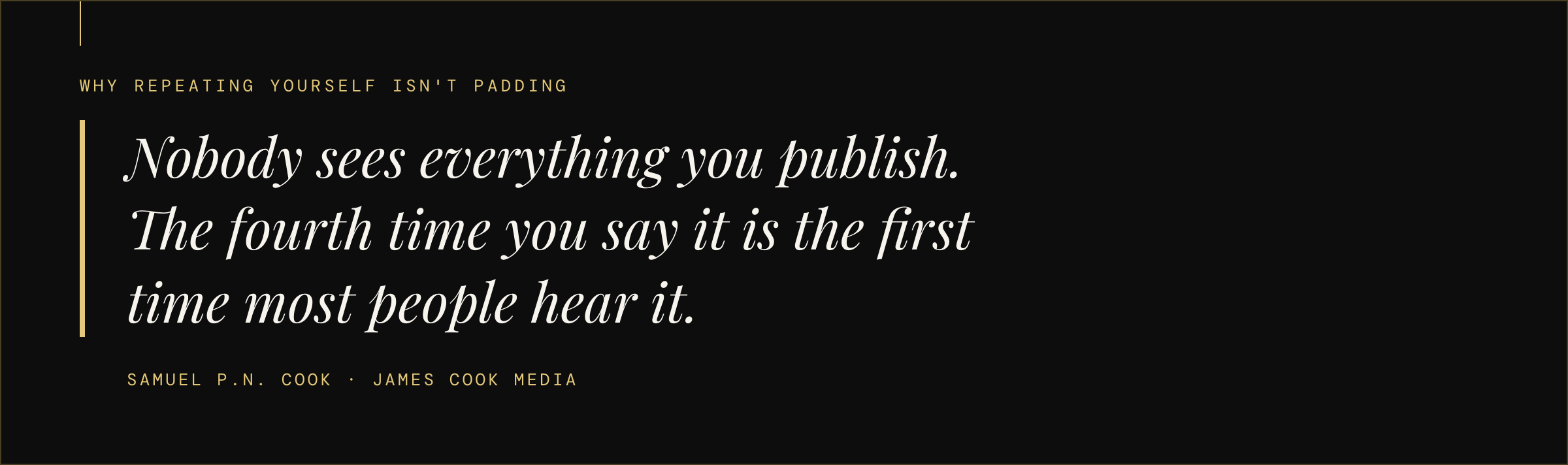
Every serious content operation you have ever admired is doing one thing you are not: publishing the same thinking repeatedly, in different shapes, over weeks. That is not manipulation. Nobody sees everything you post. Most of your audience has never encountered your best idea at all.
The reason this feels dishonest to a lot of experts is worth naming. Saying something twice can feel like padding, or like you have run out of things to say. You have not. You have run out of formats, which is a completely different and entirely mechanical problem.
What one recording actually becomes
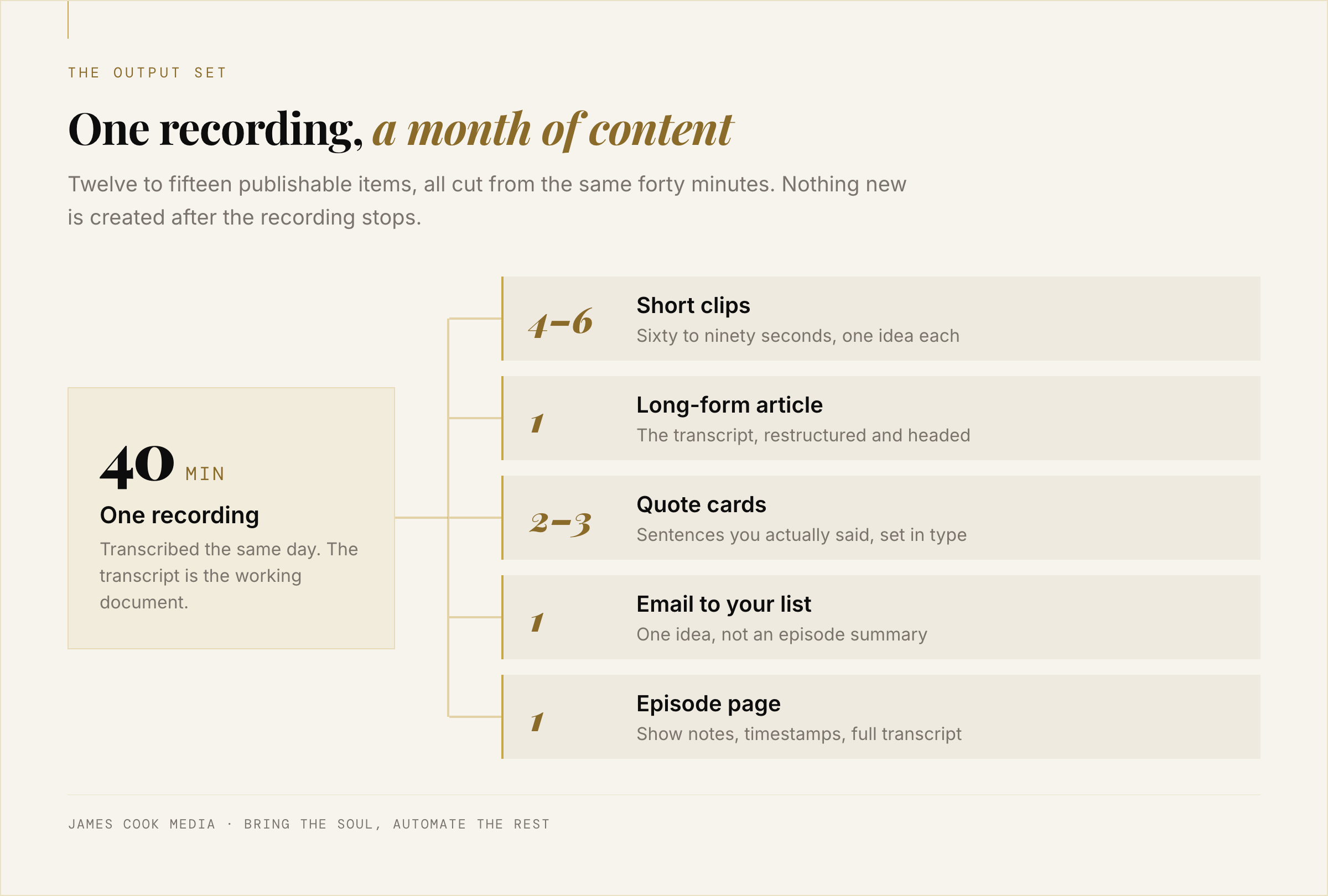
One forty-minute recording reliably produces five outputs: four to six short vertical clips, one long-form article built from the transcript, two or three quote cards, one email to your list, and a proper episode page with show notes and the full transcript. That is roughly twelve to fifteen publishable items, which is a month of visibility from a single afternoon.
Be specific about the list, because vagueness is what kills this. Here is the whole output set, and nothing else goes on it.
Four to six clips, sixty to ninety seconds each. One idea per clip, captioned, cut on a complete thought so it does not feel amputated. You find them by reading the transcript, not by rewatching the video.
One article. The transcript restructured into headed sections with an answer near the top of each. This is the asset that keeps working after the social posts have scrolled away, because it is the one search engines and AI assistants can actually read and cite.
Two or three quote cards. Single sentences you said, set in type. These take minutes and they travel further than almost anything else you post.
One email. Not a summary of the episode. The single best idea from it, written as if you were telling one client, with a link at the bottom.
One episode page with show notes, timestamps and the full transcript. Unglamorous, and it is the thing that makes the recording findable a year from now.
That is twelve to fifteen items. Spread over four weeks it is three or four touches a week, which is more than most solo experts manage in a quarter, from one afternoon of actual work.
The content repurposing system, step by step
The system has four steps: transcribe the recording the same day, mine the transcript for clips and quotes before touching any editing software, build the article from the transcript rather than from a blank page, then schedule the whole batch at once. Doing all four in one sitting is what stops the recording from quietly dying in a folder.
Step one is transcription, and it happens the same day. Not because speed matters, but because a recording that sits untranscribed for a week never gets used. The transcript is the working document for everything downstream.
Step two is mining, and it is the only part that needs your judgement. Read the transcript and mark two things: timestamps where you made one self-contained point in under ninety seconds, and single sentences worth setting in type. Fifteen minutes with a highlighter. You are looking for six marks, not sixty.
Step three is the article. You are not writing it. You are reorganising a transcript you already produced into sections with headings, which is arrangement work, not authorship, and it is exactly the kind of work worth handing to a machine with a strict instruction to invent nothing. We wrote about where that line sits in bring the soul, automate the rest.
Step four is scheduling the entire batch in one sitting. This is the step people skip and it is the one that decides whether any of it gets published. If the clips are sitting in a folder waiting for you to feel like posting, they will sit there.
The whole sequence, once you have done it twice, is an afternoon. The first time it will take longer and feel clumsy, and that is normal for anything you are building rather than doing.
One small next step
Learn the recording that makes all of this easy
The Podcasting MasterClass covers how to record something worth repurposing in the first place, including the question structure that produces clean, self-contained answers. About ninety minutes, at your own pace.
Take the Podcasting MasterClass → About 90 minutes · Watch at your own pace · No subscriptionWhat not to try
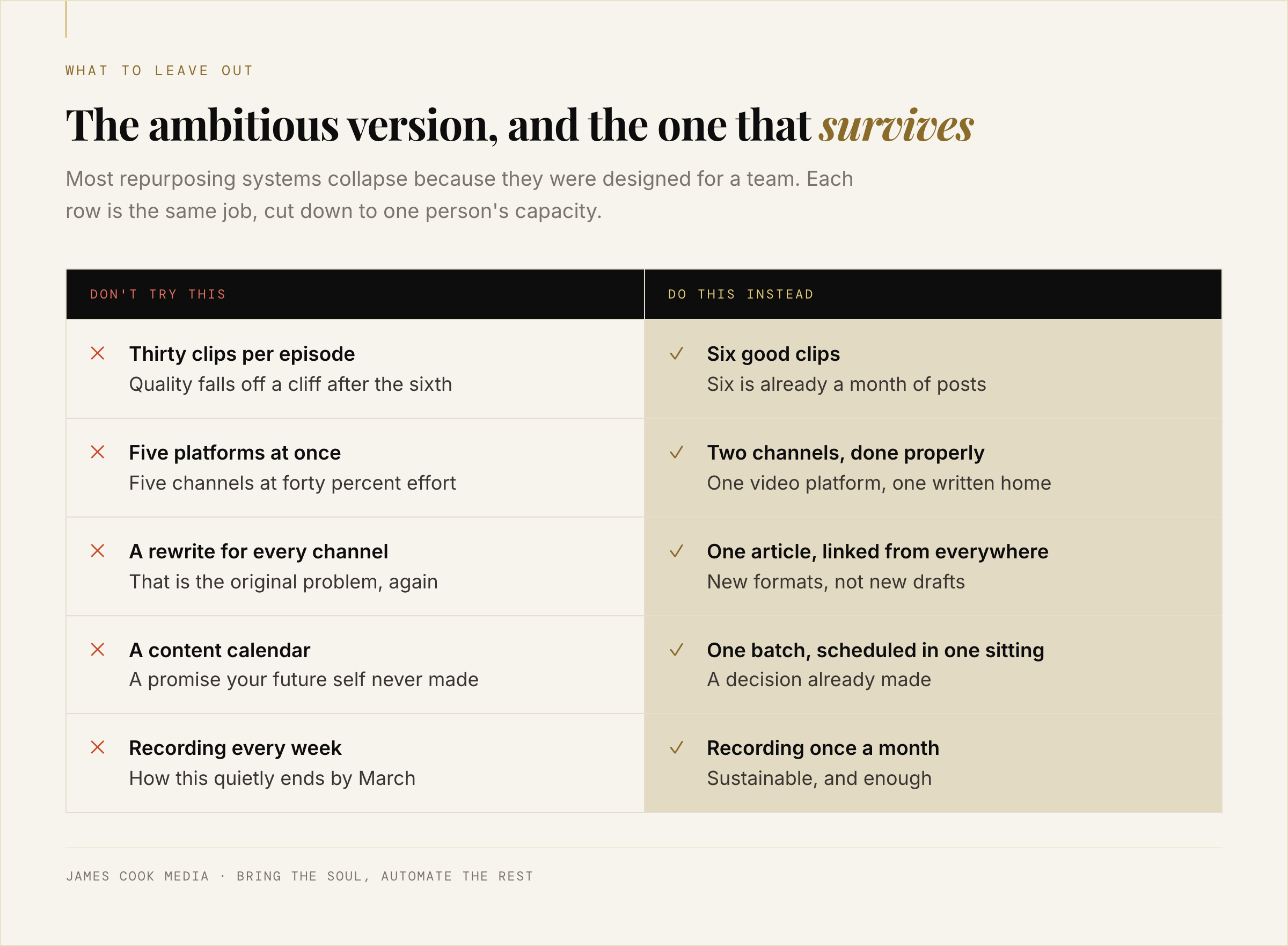
Most repurposing systems fail because they are too ambitious. Do not cut thirty clips, do not publish on five platforms, do not rewrite the article for each channel, do not build a content calendar, and do not commit to a weekly recording. Pick one video platform, one written home, one monthly recording, and let the smallness of the system be the reason it survives.
The advice you will find elsewhere is not wrong. It is written for someone with help.
Do not chase thirty clips from one episode. After the sixth, the quality falls off a cliff and you are publishing filler under your own name. Six good ones is a month.
Do not publish everywhere. One video platform where your clients actually are, and one written home you own. Two channels done properly beat five done at forty percent.
Do not rewrite the article five ways. Repurposing means new formats, not new drafts. If you are writing a fresh version for each platform, you have reinvented the original problem.
Do not build a content calendar. A calendar is a promise to your future self that your future self did not agree to. A batch of scheduled posts is a decision already made.
Do not commit to recording weekly. Monthly is sustainable and monthly is enough. Weekly is how this ends by March.
I want to be honest about the trade-off here, because the smaller version does cost you something. You will reach fewer people in month one than someone running the full machine with a team. You will also still be doing it in month twelve, which is the only variable that has ever mattered.
How a month actually lands
Release the batch in a fixed order rather than by inspiration. Week one, the episode plus the email. Week two, the first two clips and a quote card. Week three, the article, pointing back to the episode. Week four, the remaining clips and the strongest quote. The order matters less than the fact that it is decided in advance.
Sequence it once and never think about it again. The point of a fixed order is that it removes every daily decision about what to post, and daily decisions are what exhaust you.
Week one carries the recording itself and the email, because your list is the audience most likely to act and least likely to see a social post. Week two is the first clips, which pull new people towards something that already exists. Week three is the article, which is the durable asset and the one worth linking to from everywhere else. Week four is the remainder, plus the quote that got the strongest reaction, posted again in a different shape.
Notice what is not in that schedule: creating anything. By week one it is all already made.
James Cook Media has trained more than 100,000 experts since 2018, and the difference between the ones who keep publishing and the ones who stop is almost never talent or discipline. It is whether the mechanical part was built or improvised. That is not an agency-scale observation. It applies precisely to someone with three clients and no spare evening.
Keeping your voice in the copies
Repurposing goes wrong when the copies stop sounding like the original. Clips should be cut, never re-recorded to be smoother. Articles should keep your actual phrasing, including the aside and the specific client situation. Quote cards should use sentences you genuinely said. If a copy sounds more polished than you do, it is worth less, not more.
The temptation, every time, is to tidy. You listen back, hear yourself hesitate, and want to re-record it cleanly. Resist that. The hesitation is why it sounds like a person.
The same applies to the article. If the transcript says "most of them are solving the wrong problem, and they've been solving it beautifully for two years", do not let that become "many organisations misallocate effort." One of those is you. The other is every consultant.
The reluctant experts we work with usually arrive at a version of the same objection: "I'd rather not sell than sell myself." Repurposing is the part of marketing that answers that most directly, because you are not selling anything. You said something true once. All you are doing is making sure it is available in the places people actually look.
If you have not made the first recording yet, that is the real bottleneck, and turning what you already say on calls into content is the gentler starting point. The Podcast Studio exists for the same reason. And if you would rather start from ideas than from a recording, a week of content in an afternoon covers that route instead.