
You have put off rebuilding your site for two years because the quotes were four figures and the DIY builders ate your weekends. That constraint has genuinely changed, and the marketing around the change is mostly lying to you.
The last agency quote had four digits in it. The one before that was a developer who went quiet in week three. So the site you have is either five years old, or half-finished on a builder you stopped logging into, and every month you tell yourself you'll deal with it.
Then you watch a thirty-second video where someone types a sentence and a website appears. Your reaction is probably the correct one: half "finally", half "there's no way."
Both halves are right. An AI website builder for coaches and consultants will now do in twenty minutes what used to take three weeks and a retainer. It will also, if you let it, produce something that looks competent and says nothing anyone would act on. Knowing exactly where the line falls is the whole skill now, and it's the part nobody selling these tools wants to explain.
What an AI website builder for coaches actually does well
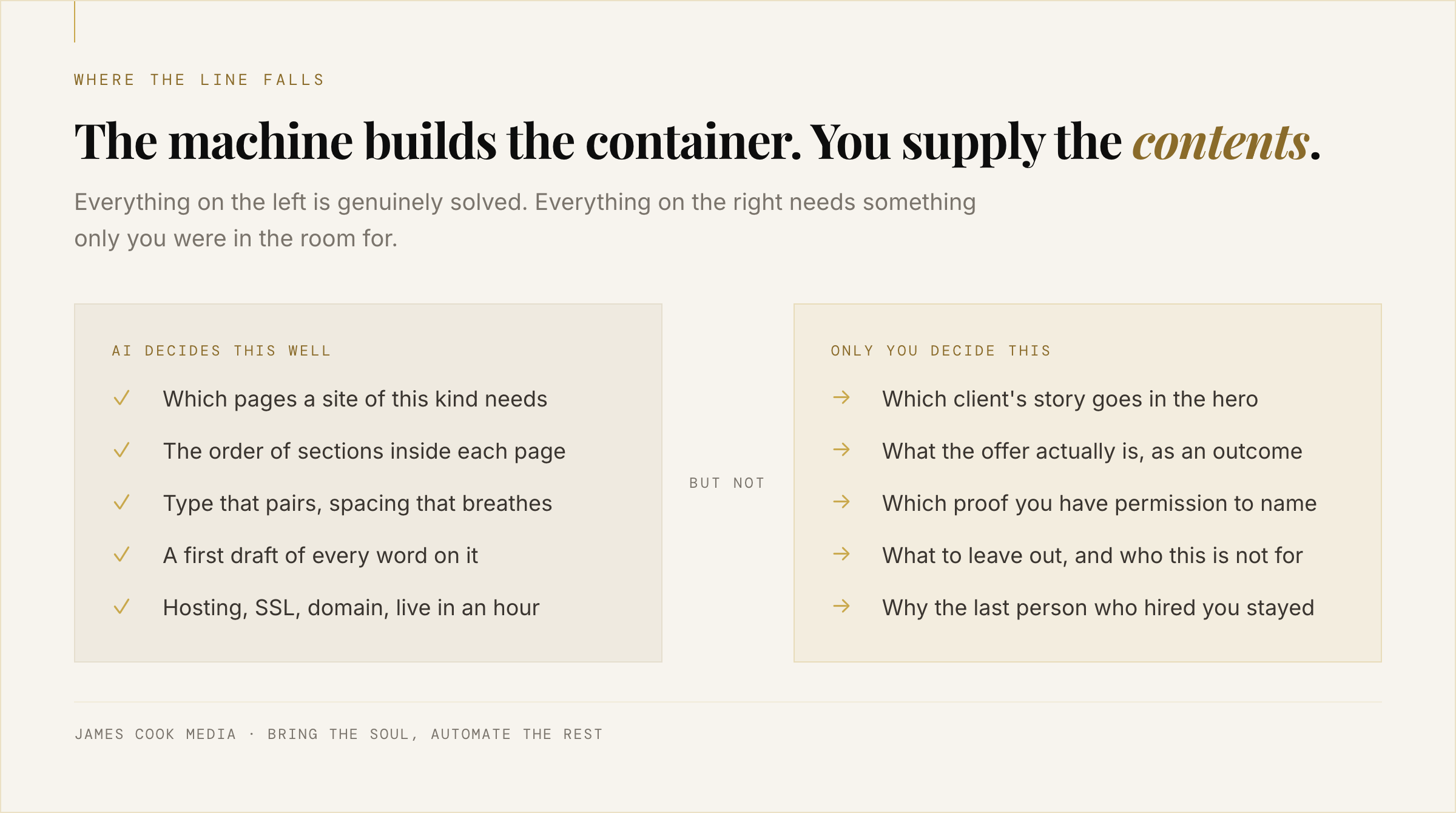
AI is genuinely good at four things: structure, first-draft copy, visual coherence and speed. It can turn a spoken description of your business into a sitemap, a wireframe for each page, a full draft of the words and a live site with hosting and SSL, in under an hour. What it produces is a competent starting point, not a finished argument.
Start with what's real, because it's more than the skeptics admit.
Structure. Give a model a description of what you do and it will propose a sensible set of pages and a sensible order of sections inside each one. Homepage, about, one page per service, proof, contact. Hero, then the problem, then the method, then evidence, then the ask. That's a solved problem now. It used to be the thing you paid a strategist for.
First-draft copy. Not final copy. But a page with a headline, three sections and a call to action, written in something close to your register, in seconds. Editing a strong draft is a fundamentally different task from staring at an empty page, and the empty page is what has stopped you for two years.
Visual coherence. Type that pairs, spacing that breathes, a palette that doesn't fight itself. AI is reliably better at this than a non-designer with a drag-and-drop editor, which is why the DIY attempts felt so bad.
Speed. Yoast tested a builder and got a complete first draft in about 3 minutes, with a basic site online in thirty to ninety minutes. Their own conclusion is the honest one: "AI gives you a head start, not the finish line."
Where "describe it and ship it" quietly stops being true
AI generation fails at differentiation, not at competence. Models are trained on the same web everyone else's model was trained on, so left alone they converge on the same layouts, the same phrasing and the same claims. The site works. It just reads like the five other sites your prospect looked at this week.
The failure mode isn't a broken page. It's a page that is fine.
AXE-WEB puts the mechanism plainly: AI models are prediction engines, so what you get by default is the mathematical average of the internet – the safe sans-serif, the hero-left text-right layout, the gradient everyone had last year. Their point about where that matters is the useful bit. For an ad landing page or an event signup, average is fine. For a homepage, an about page or the page where someone decides whether to trust you with real money, average reads as low effort, and low effort creates doubt.
The copy problem runs the same way. Pagecloud's rundown of where AI builders fall down names it as text that can "sound stiff, overly polished, or just plain off-brand if you don't edit it." Stiff and polished is exactly the register that makes a skeptical buyer bounce.
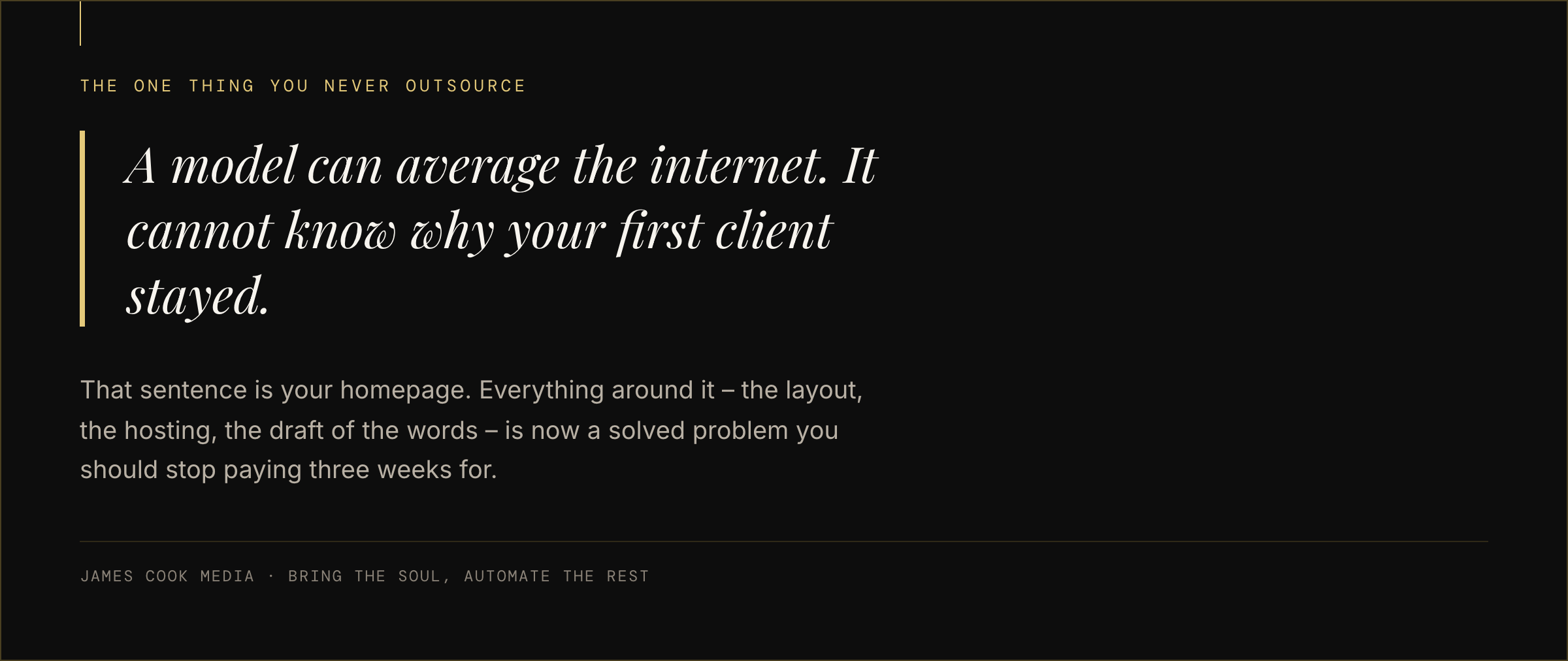
Here's the part most guides skip. The model isn't guessing badly. It's answering the question you asked. You said "I'm an executive coach who helps senior leaders with communication," so it wrote a page about an executive coach who helps senior leaders with communication. There are eleven thousand of those. Nothing in your prompt told it which one you are.
The four decisions a model cannot make for you
Four inputs decide whether an AI-built site produces clients: the story you lead with, the offer you name, the proof you can actually claim, and what you cut. All four require knowledge only you have – which client stayed and why, what you are willing to promise, whose result you have permission to use. No model can infer any of them from a job title.
Each one takes minutes to decide and changes everything downstream.
The story you lead with
Not your biography. One specific moment: the client who arrived in a particular mess, the thing you saw that nobody else had, what changed. A model cannot invent this because it wasn't in the room. Give it that paragraph and the whole site stops sounding like an average, because averages don't have specifics in them.
The offer, named as an outcome
"Executive coaching" is a format. "Six weeks to get your leadership team saying the same thing to the board" is an offer. AI will happily build a beautiful page around a format, and a page around a format asks the visitor to work out what they'd be buying. Almost nobody does that work.
The proof that is genuinely yours
You have a handful of clients and real results from them. That is enough, and it beats a stock-photo trust badge every time. But you have to choose which one, and confirm you can name them. A model does not know what you have permission to publish, and inventing proof is the one mistake that cannot be undone.
What to cut
The strongest edit on any generated site is deletion. The model gives you eight sections because eight sections is the average. Four honest ones convert better. Cutting requires taste, and taste is the thing you actually have.
The shape of the process, not the screenshots
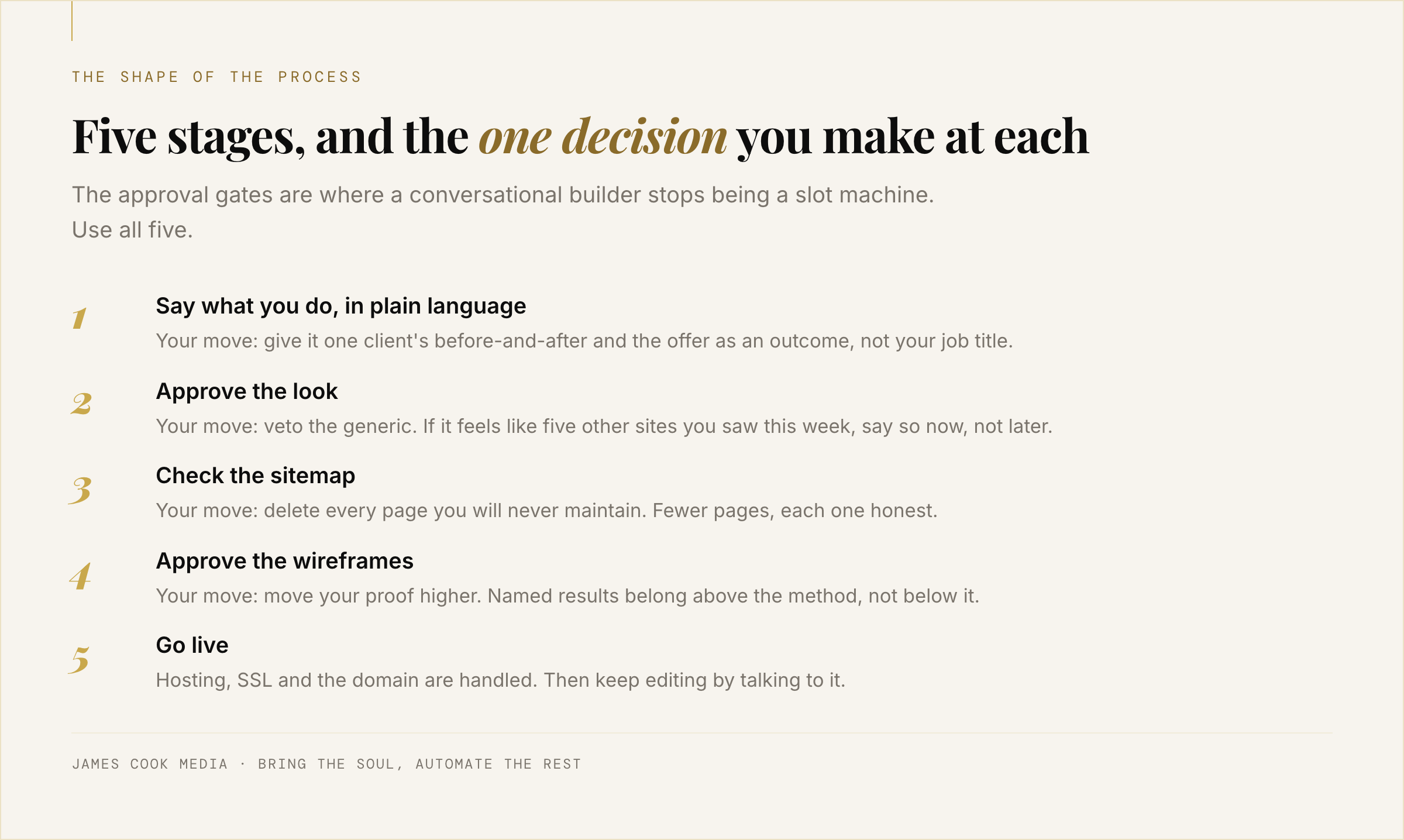
A conversational site builder moves through roughly five stages: you describe the business in plain language, you approve the visual direction, you approve the sitemap, you approve the layout of each page, then it goes live with hosting and domain handled. The approval gates before any copy is written are what separate a usable tool from a slot machine.
I'm not going to walk you through anyone's buttons, because the buttons aren't the point. The sequence is.
What makes this workable rather than a lottery is where the checkpoints sit. If a tool writes the whole site and then shows it to you, you're editing someone else's guess. If it shows you the planned pages before it writes them, and the layout of each page before it fills it, you're steering. Our own sister product StoryPages is built on that order – describe it, approve the look, check the sitemap, approve the wireframes, go live – and then you keep editing by talking to it rather than by dragging boxes.
Use those gates. At the sitemap stage, delete the pages you will never maintain. At the wireframe stage, move your proof higher. Those two interventions take four minutes and do more for the site than a week of tweaking fonts afterwards.
The bit that matters more than looks in 2026
Your buyers increasingly ask an AI assistant before they ask Google, and those systems can only recommend a site they can read and verify. Structured data, semantic HTML, an llms.txt file and genuinely fast pages now decide whether you get quoted in an answer. Most builders leave all of it to you.
Design sameness is a conversion problem. Machine-readability is an existence problem.
When someone asks an assistant for a leadership coach who works with founder-led teams in Europe, the answer is assembled from pages those systems could parse and trust. A site that renders beautifully but ships no structured markup and three seconds of JavaScript before the first paragraph appears is invisible to that process. It is not ranked low. It is absent.
This is worth checking before you pick anything. Ask whether the output is static and fast, whether it emits structured data, whether it produces an llms.txt. StoryPages ships those by default, which is unusual – most builders treat it as your homework. If you want the longer version of why this now matters more than backlinks, findability beats volume covers it properly.
Where an AI-built site stops being enough
A generated site is still a site: pages a visitor must navigate and interpret. It becomes a business asset when at least one path through it runs in a deliberate order toward one decision, with a form, a follow-up and a place for the lead to land. AI can build the pages in minutes. The order is a choice you make.
This is the honest limit, and it's where most of the excitement about conversational builders goes quiet.
You can now have eight well-designed pages by lunchtime. Eight well-designed pages that describe you will produce roughly what your current site produces, which is nothing, just faster and cheaper. Your website is a brochure nobody visits makes the case for the sequence itself – the six moves a page makes, in order, and why the order is the mechanism. This article is about the tooling that builds it. That one is about what you should point the tooling at.
The practical version: generate the site, then decide which single page is the one that converts. Give that page a story, one offer, one proof, one ask, and nothing else. Wire a form to it. Put a follow-up email behind the form. That's the difference between a nice site and a machine.
Funnels built that way are where our +50.4% revenue per visitor came from. That was an agency engagement with real traffic behind it, so read it as reassurance rather than a target. The mechanism underneath is the same one that works with three clients, a laptop and one page that finally says the right thing in the right order.
What to do this week
Before touching any builder, write three paragraphs in a plain document: one client's before-and-after in specifics, your offer stated as an outcome with a timeframe, and the one proof you have permission to publish. That document is the input that stops a generated site from reading like an average. It takes about an hour.
Order matters here, and almost everyone gets it backwards.
They open the tool first, type a job title, get an average site, feel vaguely disappointed, and conclude the technology is overhyped. The technology was fine. The input was a job title.
So: the document first. One hour, no design decisions in it. Then generate, and use the approval gates to delete and to promote your proof. Then pick your one converting page and give it the sequence. You will have spent an afternoon and you will be further along than the four-figure quote would have got you in a month.
One small next step
See what these pages are built to do
StoryFunnels is the platform we run our own story-driven pages on, and the one we build client funnels in – strategy, pages, email and analytics in one place. Have a look at how a page gets assembled before you rebuild anything of your own.
See StoryFunnels → See what it is first · Read at your own pace · No pitchThe tools got good. That's real, and it removes the excuse you have been quietly relying on. What it does not remove is the hour where you decide what your site is actually for. That hour was always the work. We've just stopped charging you three weeks for the parts around it. That is what bring the soul, automate the rest means in practice.