
You posted for three weeks straight and heard almost nothing back. The fix everyone hands you is more – more posts, more platforms, more consistency – and it is the wrong fix, because the problem was never how much you published.
The likes came from four people who already have your phone number. Nothing from a stranger: no enquiry, no reply, no sign that any of it landed anywhere. Then the diagnosis arrives, from a course, a coach, a comment thread. You didn't do it long enough. Post daily. Show up for ninety days. Feed the algorithm.
So you either try again and burn out, or you stop and quietly conclude that this works for other people and not for you.
There is a third explanation, and it has nothing to do with your discipline. Volume and findability are two different machines. You have been running the first one at full speed and the second one not at all. The whole question of content vs findability comes down to one thing: whether what you publish sits in a stream that flows past, or in a place someone can arrive at on purpose.
Content vs findability: two machines, not two amounts
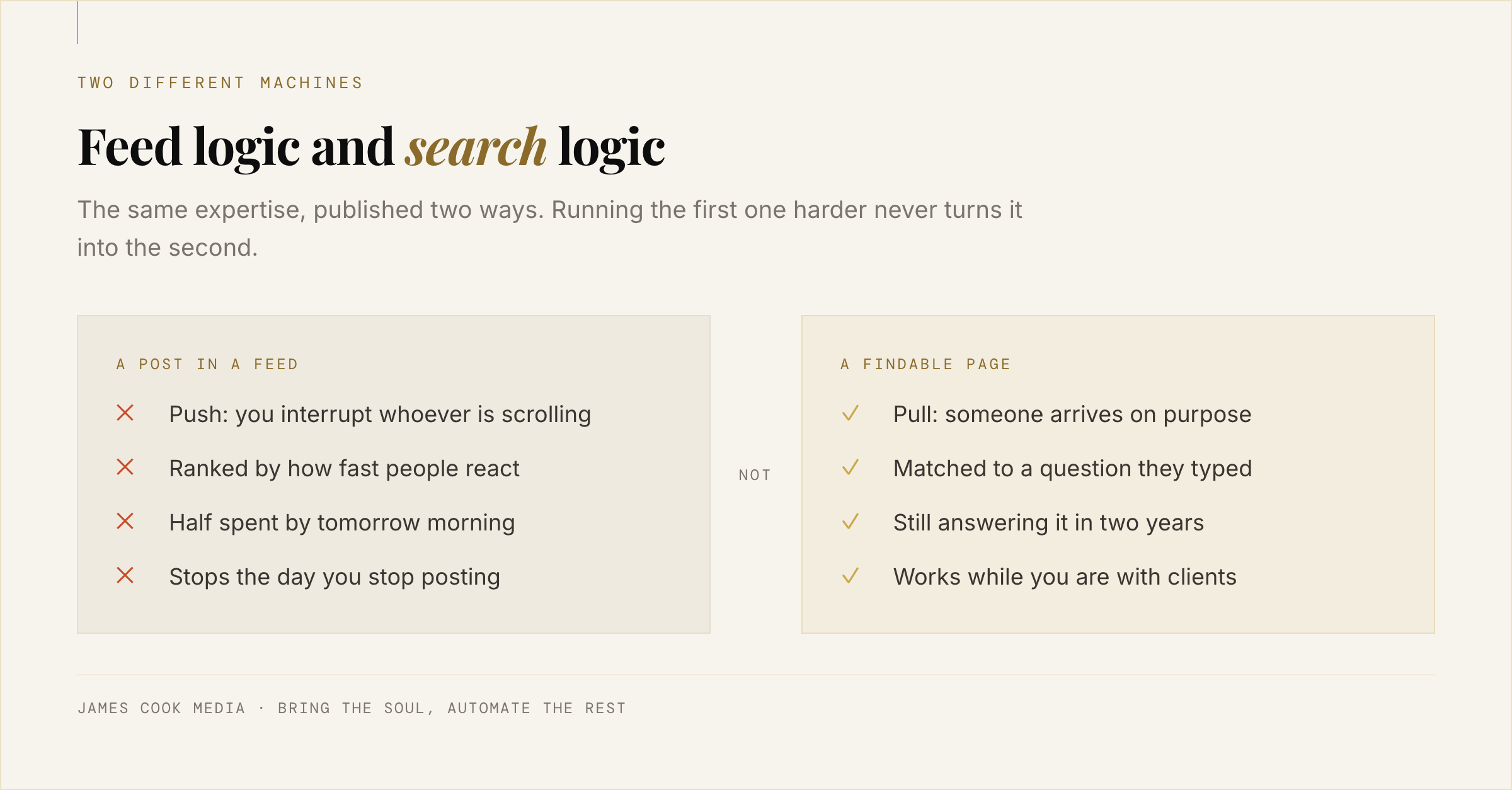
Content volume and findability are not points on the same scale. Volume is broadcast: you push something into a feed and hope the right person happens to be scrolling. Findability is retrieval: you place an answer where someone is already looking for it, so they arrive on purpose. More broadcast does not eventually turn into retrieval.
A feed is a push system. Something is published, an algorithm decides who sees it in the next few hours based on how the first few hundred people react, and then it moves on. Your post competes for a slot in an attention stream that was going to be full whether you showed up or not.
Search is a pull system. Nobody sees your page until somebody wants it. Then a person types a question that is a description of their problem in their own words, and something has to be there to answer it. Same with AI assistants: someone asks "who helps founders rewrite their pitch" and the model reaches for whatever it can read, understand and attribute.
The reason posting more never crosses over into being found is that the two machines take different inputs. A feed rewards frequency and reaction. Retrieval rewards specificity and permanence. You can be excellent at the first and completely absent from the second, which is exactly where most good solo experts are standing.
A post's half-life is measured in hours
A social post's half-life is the time it takes to collect half of all the engagement it will ever get. On X that is under an hour, on Facebook about an hour and a half, on LinkedIn roughly a day. A blog post's half-life runs to about two years. That gap is the entire argument for findability over volume.
Scott Graffius publishes an annual analysis of this, and the 2026 update is drawn from more than 5.6 million posts. Half-life is defined simply: how long until a post has earned half its lifetime engagement.
His numbers: X, 52 minutes. Facebook, 86 minutes. Instagram, a little over 18 hours. LinkedIn, a little over 23 hours. Blogs, 2.03 years.
Read that as a sentence rather than a table. Your LinkedIn post is more than half finished by tomorrow morning. A page that answers a real question is still working two years from now, and the work it does is cumulative: it can be linked to, quoted, cited, updated, and found again by the next person with the same problem.
Which means the arithmetic of "just post more" is brutal. Sixty posts at a one-day half-life is not sixty days of visibility, it is sixty separate one-day flickers that never add up to anything you own. One page that ranks is a small, permanent piece of ground.
What a findable page does that a post cannot
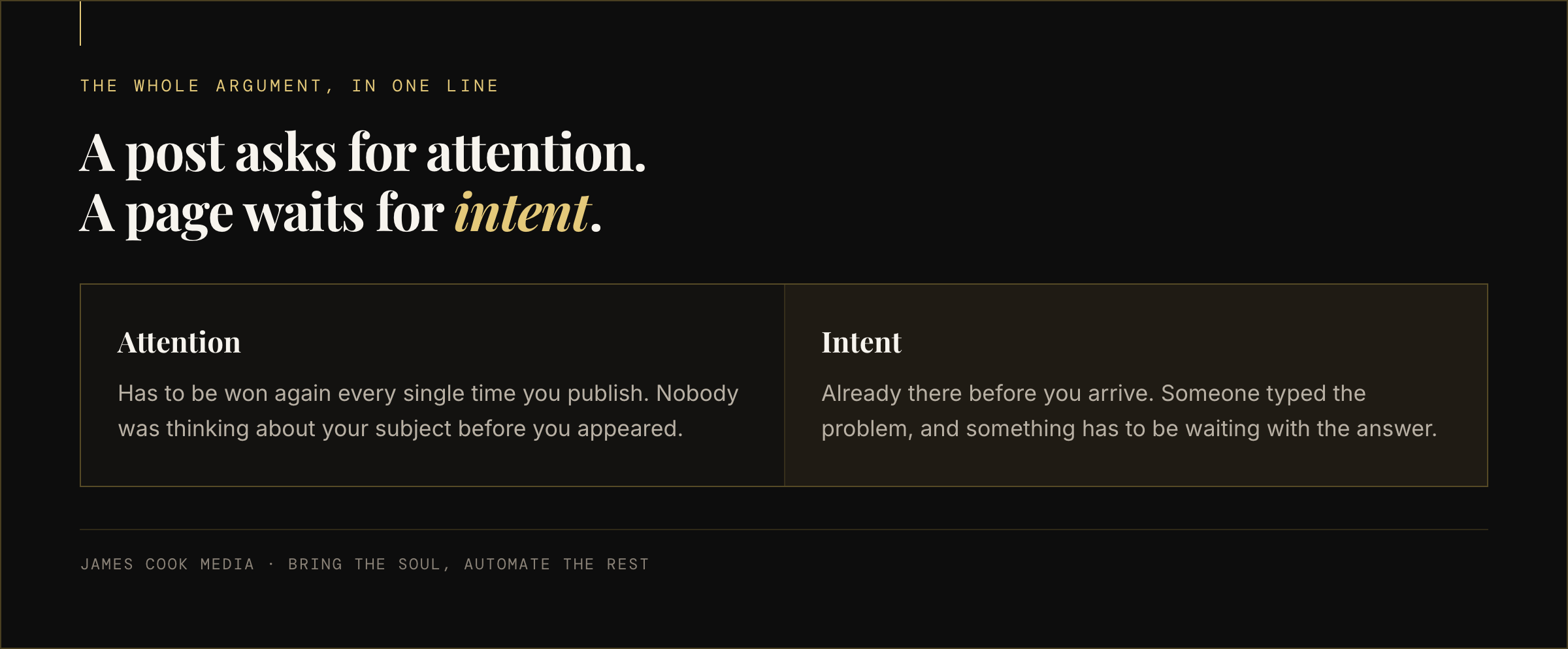
A findable page catches intent. It exists so that when someone describes their problem to a search engine or an AI assistant, your answer is what comes back. Nobody has to already follow you, remember your name, or be online at the right moment. The reader arrives mid-problem, already wanting what you do.
The difference is not just longevity. It is who is on the other end.
A post reaches people who happened to be scrolling. Most of them were not thinking about your subject at all, and the best you can hope for is that a few of them file your name away. A page reaches someone who typed the problem. They are not being interrupted, they are looking.
That changes what a good piece of writing needs to do. In a feed you have to earn attention in the first line. On a findable page the attention is already granted and the job is to be right: specific enough that they recognise their own situation, complete enough that they don't need to open three other tabs.
This is also why the same expertise, written twice, performs completely differently. A post that says "most pitch decks fail on slide two" is a hook. A page called "why investors stop reading your deck on slide two" is an answer to a question thousands of people are actually typing. Same insight. One of them can be found.
Why everyone keeps telling you to post more
Volume advice is popular because it is easy to sell, easy to measure and impossible to fail at for the person selling it. If you post daily for ninety days and nothing happens, the diagnosis is always that you did not do it long enough. Nobody in that chain has an incentive to tell you the mechanism was wrong.
Look at who benefits. Platforms need supply, so every one of them tells creators to post more. Course sellers need a task you can perform on day one, and "publish something" is the only task that qualifies. Agencies bill by the deliverable, and a deliverable is a post.
And it is genuinely hard to argue with, because volume advice is never falsified. It absorbs every bad outcome as insufficient effort.
I went looking at what the "posting every day and getting no engagement" articles actually recommend. One typical guide lists seven reasons: speak to your audience rather than at them, post at peak times, add pattern interrupts, use stronger calls to action, comment on other people's posts first. All reasonable. Not one mention of search, of being found, of anyone arriving from outside the feed. The whole diagnosis stays inside the machine that wasn't working.
Even the pieces that get the principle right tend to be written for someone else. Margaret Johnson's visibility fallacy argument is exactly correct – "discoverability is structural" – but the fix she describes assumes a team coordinating a content architecture across several niches. You are one person with a laptop and a client call at two.
One small next step
See the method before you commit to anything bigger
The AI MasterClass walks through how we turn what you already know into pages that get found, including the prompts we use. Watch it, try one page, decide from there.
Take the AI MasterClass → About 90 minutes · Watch at your own pace · No subscriptionThe honest limit: findable and empty is still nothing
Findability without substance fails just as completely as volume without findability. A page that ranks for a question and then answers it thinly gets a visit, a few seconds, and a back button. Being findable only compounds when there is something on the other side worth finding, which is the part your expertise already covers.
I should be straight about where my own argument stops. If you take "be findable" as permission to generate forty keyword-shaped pages that say nothing, you will end up exactly where the volume crowd ended up, with a slower version of the same silence.
Retrieval systems are getting better at this, not worse. Fractl's 2026 discoverability review reports that brands in the top quartile for web mentions earn roughly ten times more placements in AI results, and that content cited by AI systems tends to be more recently updated than the standard top-ranking results. Both of those reward the same thing: pages a real practitioner stands behind and keeps current.
So the sequence matters. First have something true and specific to say. Then make it findable. In that order it compounds. In the other order it is just tidier noise.
This is the good news for you specifically, because you already have the hard half. You have the judgement, the war stories, the six objections you have answered a hundred times in discovery calls. What you are missing is not insight. It is the plumbing that lets a stranger find the insight.
What findability looks like for one person with a laptop
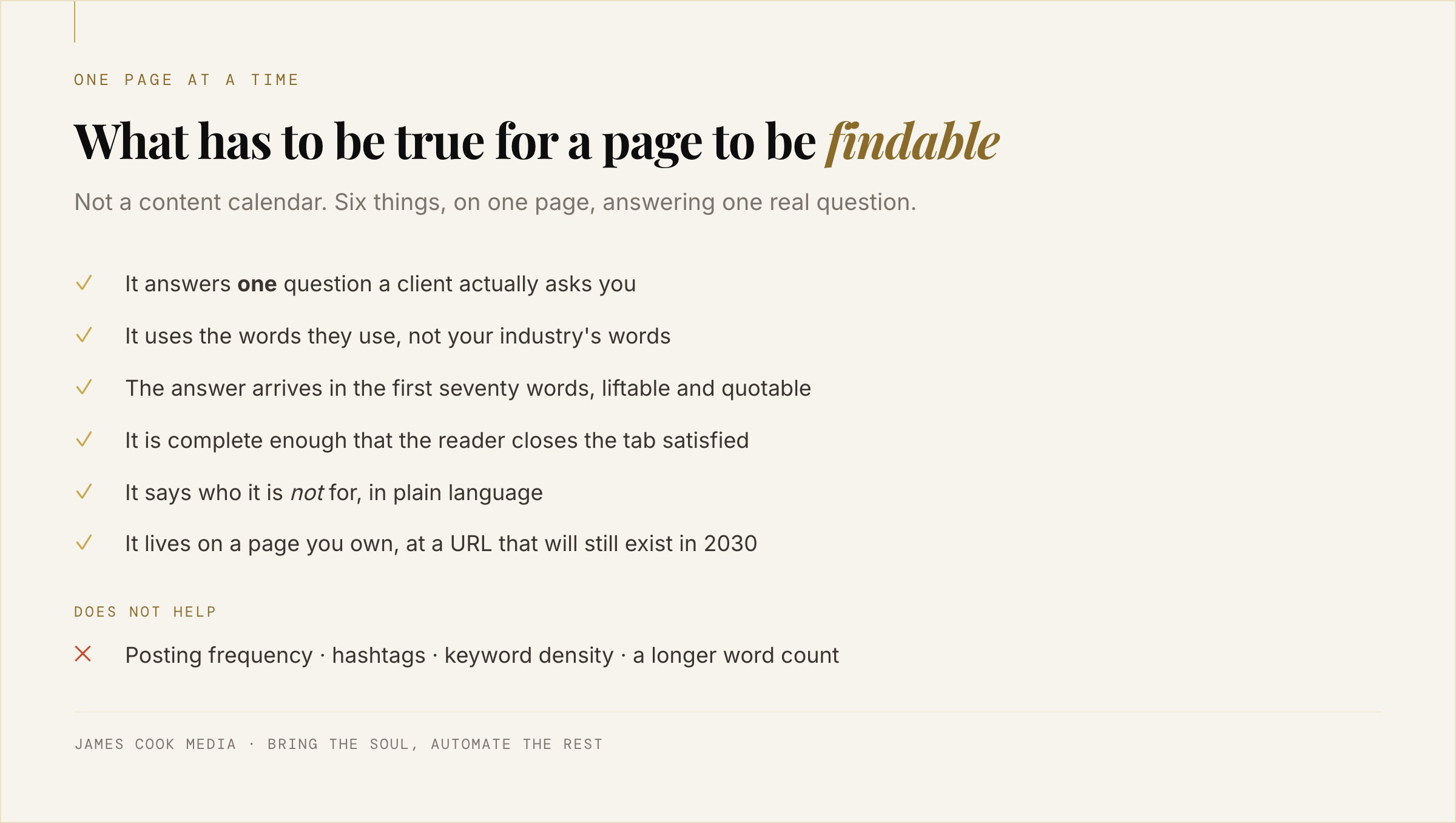
For a solo expert, findability is roughly eight to twelve pages, each answering one question a client actually asks, in the words they use to ask it. Not a content calendar. A small set of permanent answers, published properly, linked to each other, and revisited once a year. That is the whole job.
Start from your own inbox and your own calls. Write down the questions you get asked before someone hires you, and the questions you get asked in the first month after. Those are search queries already. You do not have to guess at keywords; you have been hearing them out loud for years.
Then write one page per question. Answer it completely, including the parts that talk someone out of hiring you. That honesty is what makes a page quotable, and quotable is what makes it findable, because both search engines and AI assistants are looking for passages they can lift and attribute.
This is also where volume finally earns a place, but as a second pass. One recording of you answering a question properly can become the page, the post, the email and the clip. That is not publishing more, it is publishing the same thing in a form each machine can actually use.
Since 2013 we have generated more than $10M for clients working in this order, and I want to be clear about what that number is and is not. It is an aggregate across a lot of businesses, some of them with real budgets. The mechanism underneath it is the same one that works with three clients and a laptop, because retrieval does not care how big you are. It cares whether you answered the question.
Where this sits next to the other pieces
This article makes one argument: that volume and findability are different mechanisms, and that volume alone compounds nothing. It deliberately does not teach the mechanics. If you have accepted the argument and want the how, that is a different read.
If you are still at the stage of "I'm good at this and nobody online can tell", start with best in the room, invisible online. That is the wider piece on the gap between being excellent and being visible, and this article is one slice of it.
If you already agree and want the plain-English mechanics – what actually makes a page rank, what to put in a title, how internal links work – read SEO for coaches and consultants. That one is the manual. This one is the argument for opening it.
And because a growing share of people now ask an assistant instead of a search box, getting cited by AI search covers the newer half of findability: how to be the source a model quotes rather than a page it skims.