
You are excellent in the room and almost nothing online shows it. Story-driven marketing is not decoration on top of your expertise, it is the structure that carries it to people who have never met you.
You got off a call last month where you were genuinely excellent. You explained the thing you have spent fifteen years learning, the person on the other end nodded, said "this is really helpful, let me think about it," and then went quiet.
Meanwhile your website lists the same six services as everyone else in your field, your posts get four likes from people who already know you, and every client you have arrived by referral, which is to say by accident of who you sat next to.
You are not wrong about your expertise. You are right about it. It just is not doing any work for you, because expertise on its own is evidence, and evidence does not move people. A story does. That is the premise of story-driven marketing, and of the method we have been refining at James Cook Media since 2013.
Why being the best in the room does not convert
Expertise is evidence, not motivation. A buyer facing a decision is not weighing how much you know, he is asking whether he can picture himself on the other side of working with you. Credentials, frameworks and service lists give him nothing to picture. A story does, because it puts him in the scene and shows him the change.
Think about the last thing you bought that mattered. You did not choose it because the seller knew the most. You chose it because you saw a version of yourself that you wanted, and buying was the shortest route to it.
Your prospects are doing the same thing. When they say "let me think about it," they usually mean "I understood everything you said and I still cannot see what changes for me." That is not a knowledge gap on their side or a skill gap on yours. It is a narrative gap.
Most advice for experts tries to close that gap with volume. Post more, appear more, explain more. You can publish weekly for a year and still leave the buyer no story to step into.
What story-driven marketing actually is
Story-driven marketing means the story is the load-bearing structure of your business, not the decoration on top of it. The hero, the stakes, the turning point and the transformation get decided first, and then every page, email, ad and episode is derived from them. Channels change. The story is what makes them all say the same thing.
There is no shortage of story frameworks, and most of them are sound. Type and Tale's summary of story-driven marketing lays out five elements that recur everywhere: a customer with a real problem, the tension it creates, you as the guide rather than the hero, a specific transformation, one clear next step. Donald Miller's StoryBrand built a business on a similar spine, and a good round-up of storytelling frameworks for solo businesses will hand you six more in an afternoon.
Here is the honest gap, and it is why I am writing this. All of those resources teach you to write the story. Almost none tell you what to do with it on Tuesday morning. That same round-up admits it offers no guidance on turning narrative into enquiries.
So experts end up with a beautifully articulated story in a Google Doc, and a website that still opens with "welcome to my site." One writer put the failure mode bluntly: businesses have turned storytelling into an excuse to blather on about themselves. The structure was never the hard part. The wiring was.
The StoryMatters method, in four steps
StoryMatters is the four-step method behind every funnel James Cook Media builds: strategy, build, launch, own. Strategy comes first and is non-negotiable, because everything after it is derived from it rather than invented in the moment. The build turns the story into assets, the launch tests it against real traffic, and the fourth step compounds it.
The method has four steps, in this order, always: strategy, build, launch, own. You can see the full version of it on our process page, including what happens inside each stage.
What matters more than the names is the direction the work flows. Most marketing starts at a channel. Someone decides they need a podcast, or ads, or a newsletter, and the message gets reverse-engineered to fit whatever that channel rewards. That is how one business ends up sounding like four.
StoryMatters runs the other way. The story is decided once, deeply, and then every asset is derived from it. That is also why the results are replicable rather than lucky. When something underperforms, you can trace it back to a document and see which link in the chain broke.
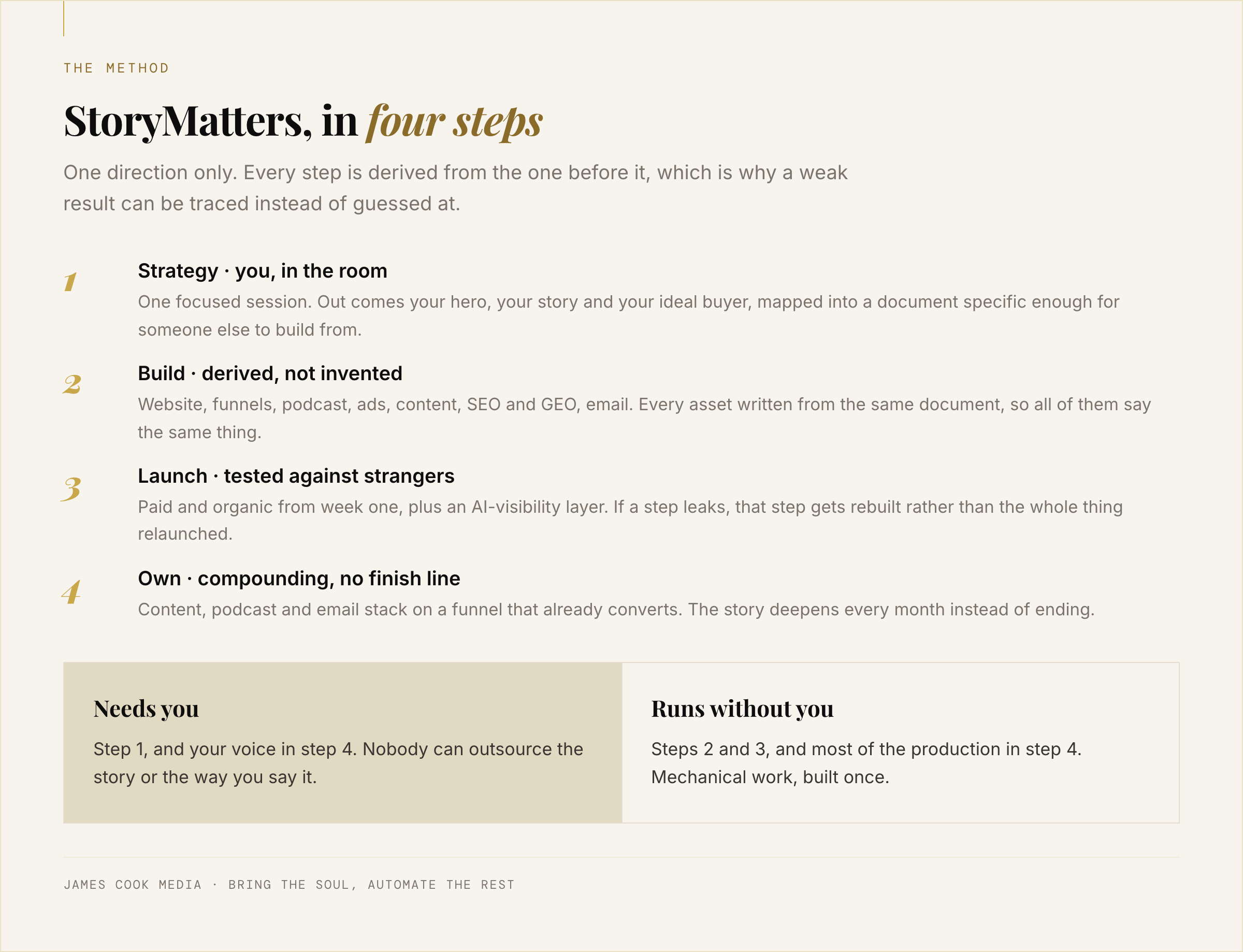
The sequence looks obvious written down. Almost nobody runs it in this order, which is the only reason it is still an advantage.
Step one: strategy, before anything gets built
Step one is a single focused workshop that produces three things: your hero, your story, and your ideal buyer, mapped. It runs as an ICP deep-dive, a hero's journey map and a messaging framework. It takes a few hours rather than a drawn-out engagement, and it produces a document specific enough that someone else could build from it.
The unit of work here is a conversation, not a questionnaire. Someone has to ask you why you do this, which client you would work with for free, and what happens to that person if nothing changes. Those answers are already in you. They are almost never written down.
The output is a blueprint you own whether or not anyone builds it for you. That matters if you have paid an agency before and ended up with assets you could not maintain.
Two things go wrong at this stage. The first is casting yourself as the hero, which the customer is the hero piece takes apart properly. The second is skipping the step because it feels like talking rather than working. It always comes first, and that part genuinely is non-negotiable, because everything downstream is derived from it.
Step two: build the machine from the story
Step two turns the strategy document into assets: website, funnels, podcast, ads, content, SEO and GEO, email. Nothing is templated and nothing is invented in the moment, because the thinking is already done. The test for every asset is whether a stranger who saw only that one thing would come away with the same story.
This is the step people imagine marketing to be, and it is the step that goes fastest when step one exists. There is no debate about what the headline should say. The headline is already decided; someone just has to write it well.
The web and funnel side of our own builds runs on StoryFunnels, which we built because the available tools kept forcing story-shaped businesses into template-shaped pages. That is the practitioner's version of this step. The principle underneath it needs no particular software.
The principle is consistency of derivation. One story, in as many places as you can maintain, saying the same thing every time. Four assets that agree beat fourteen that argue.
Step three: launch it into real traffic
Step three puts the story in front of paid and organic traffic from week one, with an AI-visibility layer so it can be found by search engines and by the AI assistants people now ask. Real traffic is the only honest test of a story. When a step leaks, you rebuild that step rather than relaunching the whole thing.
Opinions about your messaging are worthless, including yours and mine. Traffic settles it. A page either holds a stranger's attention and produces an action, or it does not, and you usually know within a few hundred visitors.
The discipline here is diagnostic rather than dramatic. If the numbers are not there, the answer is not more budget and not a rebrand. It is finding the weak step and rebuilding that one, which is only possible because everything traces back to one document.
A story-based conversion overhaul on one client's funnel lifted revenue per visitor by 50.4%, from the same traffic, simply told better. A different build took a business to $1.8 million in ten months. Those are agency numbers with agency budgets behind the traffic, and I am not pretending otherwise. The mechanism underneath both is the same one that works with three clients, one page and a laptop: say the true thing in the order a human can follow, then check whether it moved anyone.
That is not motivational framing. It is why the method starts with the story instead of the channel: if the telling is what is failing, no amount of distribution fixes it.
Step four: own the category, where it compounds
Step four layers content, a podcast and email on top of a funnel that already converts. Each channel feeds the others, the cost of attention falls as the story spreads, and the position deepens every month instead of ending. This is the step that turns a campaign into a moat, and it is the only step with no finish line.
Most marketing is episodic. You launch, you get a spike, the spike decays, you launch something else. Compounding requires the opposite: the same story, told from more angles, accumulating.
This is where a podcast stops being a vanity project and becomes infrastructure, because a weekly conversation is the cheapest way to produce true material in your own voice. It is also where AI changes the maths in your favour. Anyone can now generate infinite competent content. Nobody can generate your conviction, or the thing you noticed a decade in that changed how you work. Voice is the moat.
Since 2018 we have taught this method to more than 100,000 experts, authors and founders. That number says it has been stress-tested at every scale, not that you need to be at any particular scale to use it. Most people in those rooms had a handful of clients and the same quiet frustration you have.
One small next step
Learn the method before you hire anyone to run it
The MasterClasses teach the same StoryMatters method we run for clients, self-paced, with the worksheets. Start with the one that matches where you are actually stuck.
See the MasterClasses → About 90 minutes · Watch at your own pace · No subscriptionRunning it yourself, at the scale you are actually at
The solo version of StoryMatters keeps all four steps and shrinks each one. Strategy becomes an afternoon and one written page. The build becomes one page and one email sequence. The launch becomes a small budget or a deliberate organic push. Owning it becomes one recurring piece of content. The order is what carries the results, not the size.
Strategy, at your scale, is two hours with a notebook and one rule: write the story as it happened to a specific person, not as a positioning statement. Name the person you want more of. Write what their life looks like before and after. One page, and you are allowed to hate the prose.
The build is one page, not a site: the page that says the true thing to the person you named, with proof a stranger can check and one next step small enough to say yes to. If your current site is a brochure, that is the difference between a website and a funnel.
The launch is deliberate rather than expensive. Send it to twenty people who match the description and watch what they do. Twenty real reactions from the right people teach you more than a thousand impressions from the wrong ones.
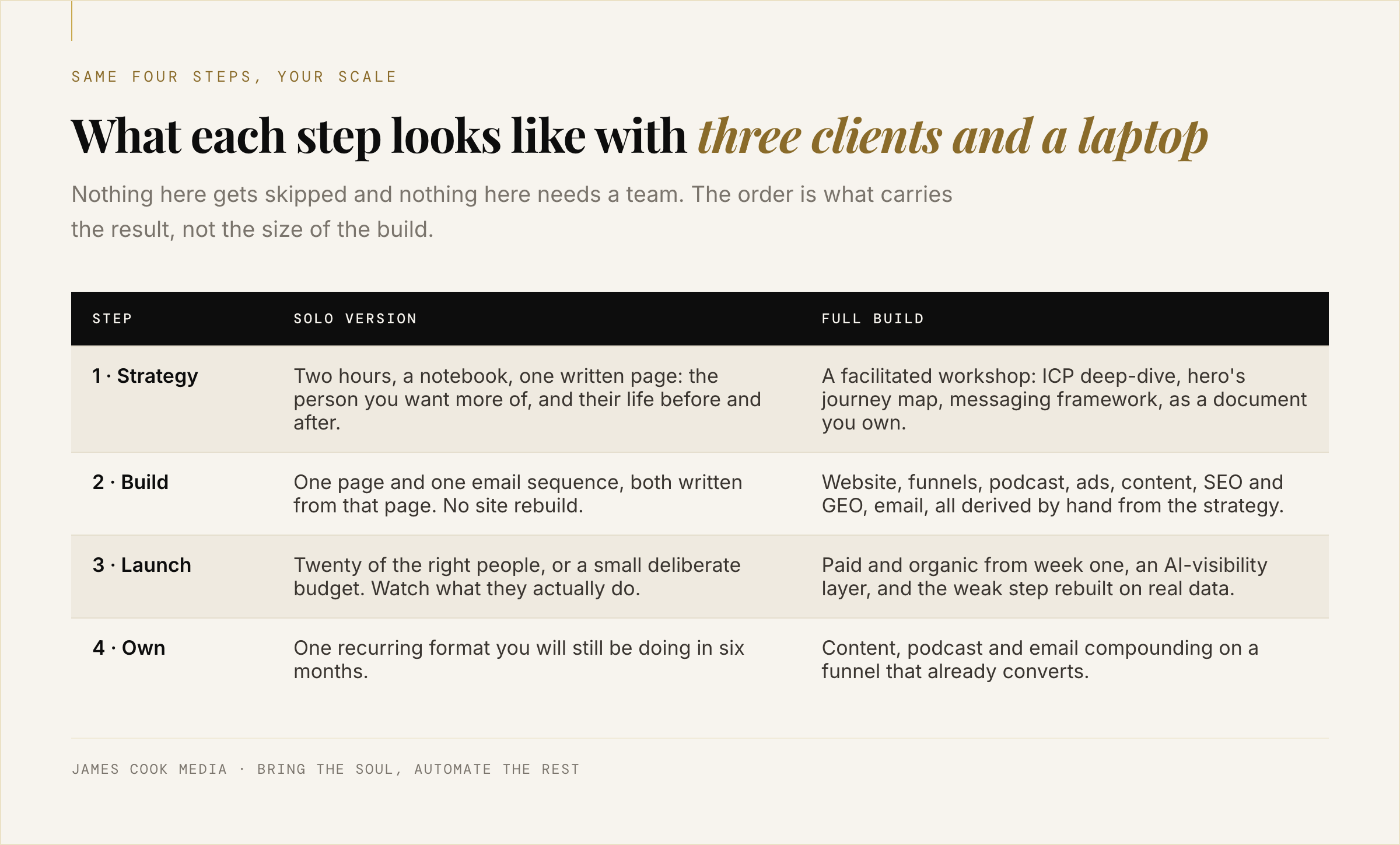
Owning it is the boring step, and the one that decides everything. Pick a format you will still be doing in six months and let it accumulate. This is also where the mechanical half becomes worth automating, so the part only you can do stays the only part you do.
One expert who ran it put the point better than I can: "No matter where you are in your business, the StoryMatters system has something for you. It changed everything." That is Wanda Nowak of Wandalicious. The phrase that matters is where you are.