
Every piece of marketing advice you've been given asks you to step into the spotlight, and something in you refuses. That refusal is not a flaw to be coached out of you, it is a correct instinct about who the story belongs to.
You have read that you need to tell your story, build your personal brand, get on camera and talk about yourself. You probably tried a version of it, felt faintly ill, and quietly stopped. Then you watched someone with half your ability out-market you, and concluded the problem was your character.
The problem was never your character. It was the casting. Customer is the hero marketing is the shift that fixes it, and what makes it matter to you is not that it converts better. It gives you a job in your own marketing you can do without becoming someone you'd dislike.
Why your resistance to self-promotion is the right instinct
Reluctance to self-promote is usually treated as a confidence problem. It is more often an accuracy problem. Experts resist making themselves the hero because they know, correctly, that the client's transformation is the real story. The discomfort is a signal that the casting is wrong, not that you lack nerve.
Look at what your reluctance is actually made of. It is not shyness. You are perfectly happy to be direct, even blunt, with a client in front of you. You'll challenge them, tell them the hard thing, hold a position for an hour.
What you won't do is stand in front of strangers and say "look at me." You have spent years in rooms where the whole point was that it wasn't about you. Every good coach, consultant and adviser learns to get out of the way, and that reflex is the source of your competence.
Then marketing arrives and asks you to invert it. No wonder you stall. You are being asked to violate the exact discipline that makes you good.
I have watched this play out with a great many experts, and the ones who break through almost never do it by getting louder. They do it by finding out they were allowed to stay in the role they already knew how to play.
Customer is the hero marketing, in one sentence
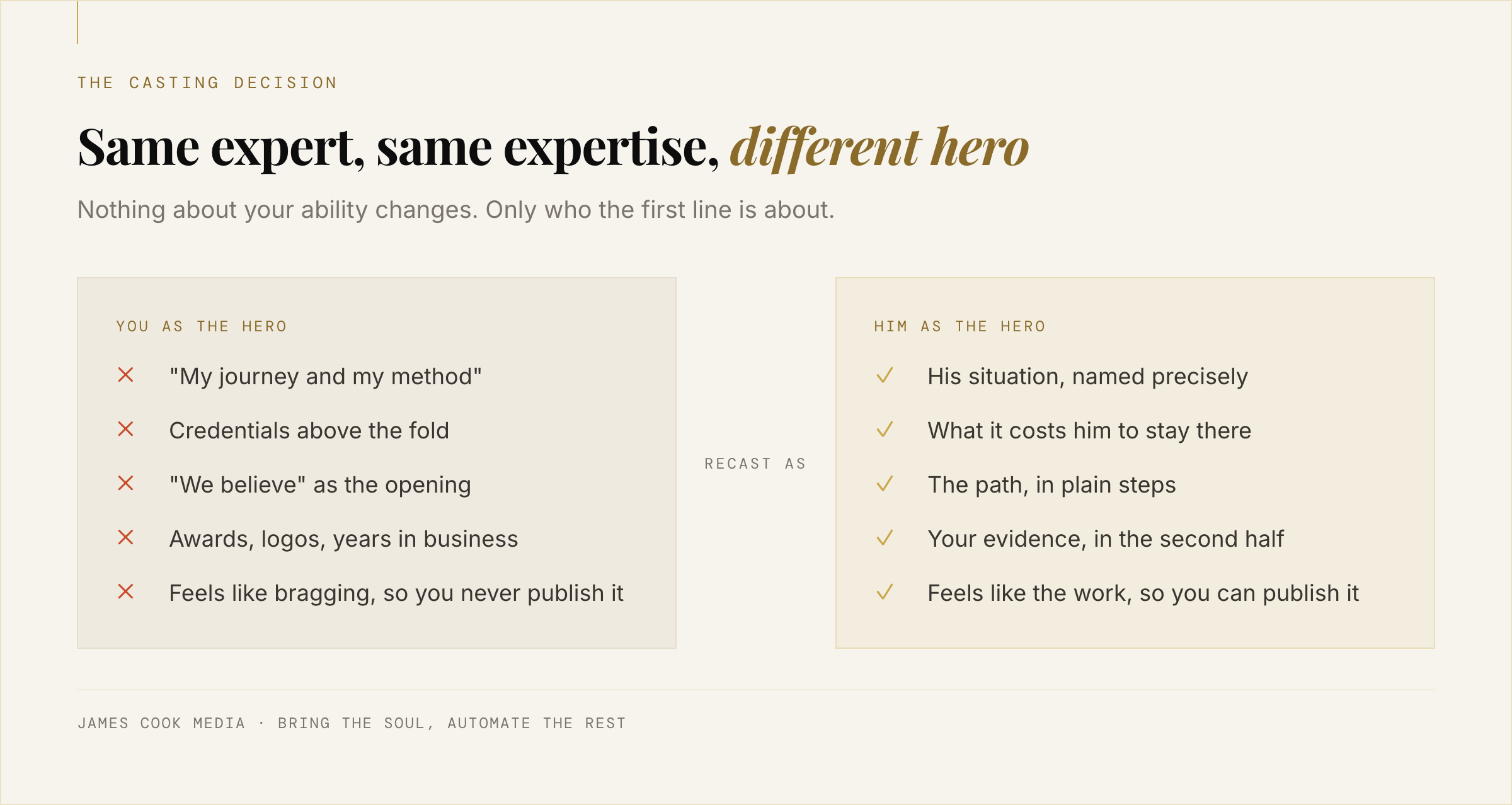
Customer is the hero marketing means your client is the protagonist of the story your marketing tells, and you are the guide who has walked the road before. He carries the want, the risk and the decision. You carry the map, the evidence and the plan. Be Yoda, not Luke.
The clearest shorthand comes from Donald Miller's StoryBrand framework, summarised well by Yu-kai Chou: a character wants something, hits a problem, meets a guide, receives a plan, is called to act, and either succeeds or fails. Notice that the guide is one part of seven. Not the smallest part. Not the star.
Luke has the wound, the destiny and the choice. Yoda has nine hundred years of pattern recognition and a fraction of the screen time. Nobody watching thinks less of Yoda for it.
That distinction is the whole permission slip. The guide is not the humble character. The guide is the authoritative one. He is simply authoritative about the hero's problem rather than about himself.
Most write-ups of this idea stop at the framework and address a marketing team with a campaign to reposition. Skot Waldron's version is a good example of the standard advice: replace "we" language, lead with the problem, put the case study at the end. Sound, as far as it goes. None of them address the reader who is relieved rather than instructed, because the framework has just told him he doesn't have to be the star.
If you want the structural template, the beat-by-beat version lives in our piece on the hero's journey for coaches. This article is not that. This one is only about who occupies which role, because that single decision changes what you're willing to publish.
The guide has scars, and that's where you still appear
Casting the client as hero does not mean disappearing. A guide earns the role two ways: empathy, which proves he understands the problem, and authority, which proves he has solved it before. Both require you on the page. The difference is that your story appears as evidence for his decision, not as the plot.
This is where most reluctant experts overcorrect. They hear "it's not about you," strip every trace of themselves from the site, and end up with a page so selfless it could belong to anyone. Findable but faceless is not an improvement on brilliant but invisible.
A guide has to show two things. First, that he knows what the hero's problem feels like from the inside. Second, that he has taken people through it. Credentials, scars, the years, the failures, the client who came out the other side.
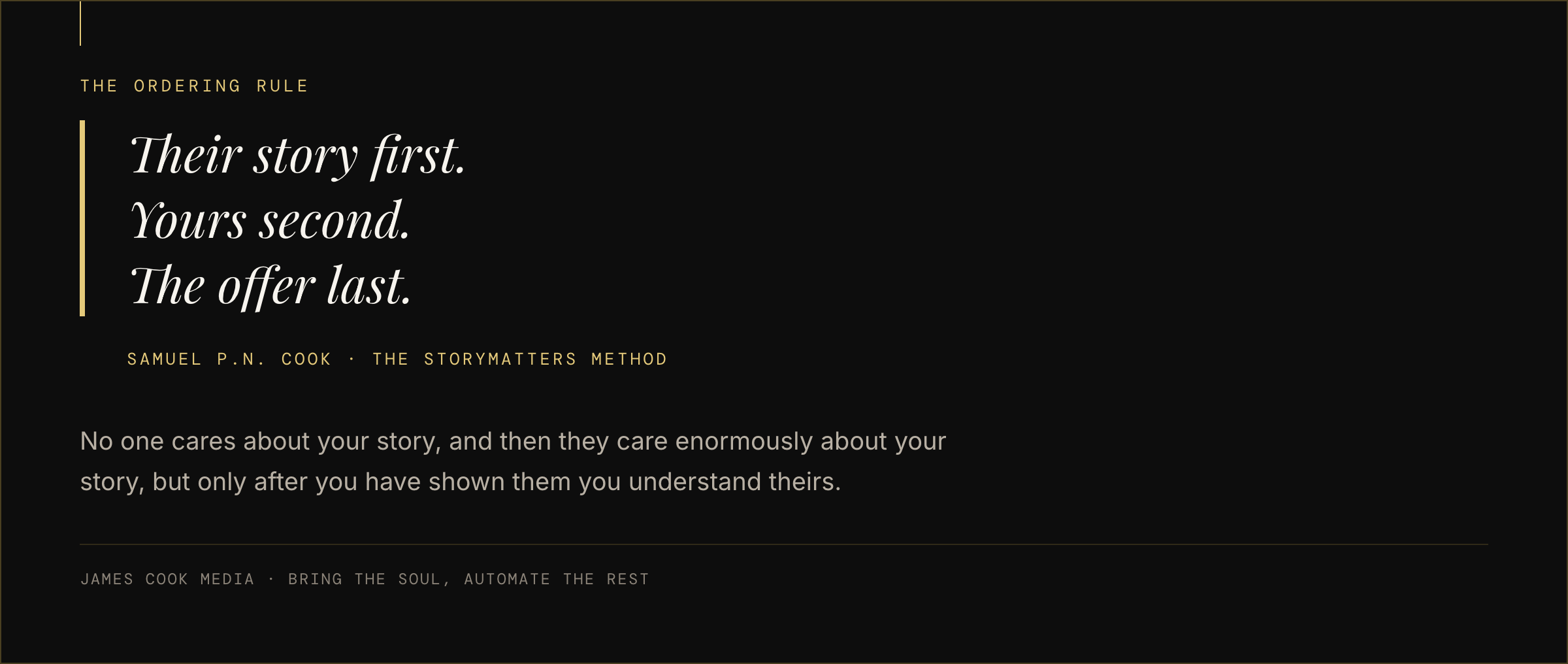
So you do talk about yourself. You talk about yourself in the second half of the sentence. My own version of the rule, which I have repeated for years: no one cares about your story, and then they care enormously about your story, but only after you have shown them you understand theirs.
That ordering is the entire craft. Their story first. Yours second. The offer last.
It also explains why so much expert content reads as arrogant when the expert is anything but. The material was fine. The sequence made him the protagonist of a story the reader was trying to be the protagonist of.
Bobby wouldn't say the line
James Cook Media's first client was a six-time Olympic running coach who refused to record a scripted sales video. His words: he would rather not make sales than sell himself that way. The fix was not a better script or a braver client. It was removing the script and building the campaign around his story instead.
Bobby McGee is the reason this agency exists in the shape it does.
He was an Olympic running coach and my first client. I had paid for his coaching myself years earlier, when I was competing, and it was among the most transformational coaching I have ever received.
He was also stuck. Not because his message was weak, but because getting it out there meant, as he saw it, sacrificing his reputation and his authenticity. So I did what the industry had taught me: I wrote him a sales video, handed him the script, and asked him to look into the camera and say it.
He said: "No. I'm not going to do that. I'm not going to sit there and prostitute myself online in order to make a few sales. I'd rather not make sales than do that."
Notice the conviction that takes. Then notice whether a part of you nodded along. That sentence is the expert's dilemma, and if it's yours, you are in respectable company.
My first instinct was to hide him. Cartoons, whiteboard explainers, anything that conveyed what Bobby did without putting Bobby on screen. None of it worked, because the power was in Bobby. In his personality, in what he was like in a room with an athlete.
The problem was never Bobby. The problem was the script. We stopped asking him to perform and built the campaign around his story instead. He was on camera. He was entirely himself. He was not the hero of the pitch.
Years later an Englishman named Rory came up to me after a talk in London. He had spent forty-four years not doing the work he was actually passionate about, largely because the look-at-me style of internet marketing was unbearable to him. What he said was not thank you for the tactics. It was: "Thank you for giving me permission to make this happen. To put myself out there. Because that's what would have always stopped me."
Permission, not technique. That is what the reframe hands you.
One small next step
See how the casting actually works before you rewrite anything
The Storytelling MasterClass walks through the StoryMatters method the way we run it for clients, including how to put yourself on camera as the guide rather than the star. Watch it, then decide what to change.
Watch the Storytelling MasterClass → About 90 minutes · Watch at your own pace · No subscriptionWhat to change on your own pages this week
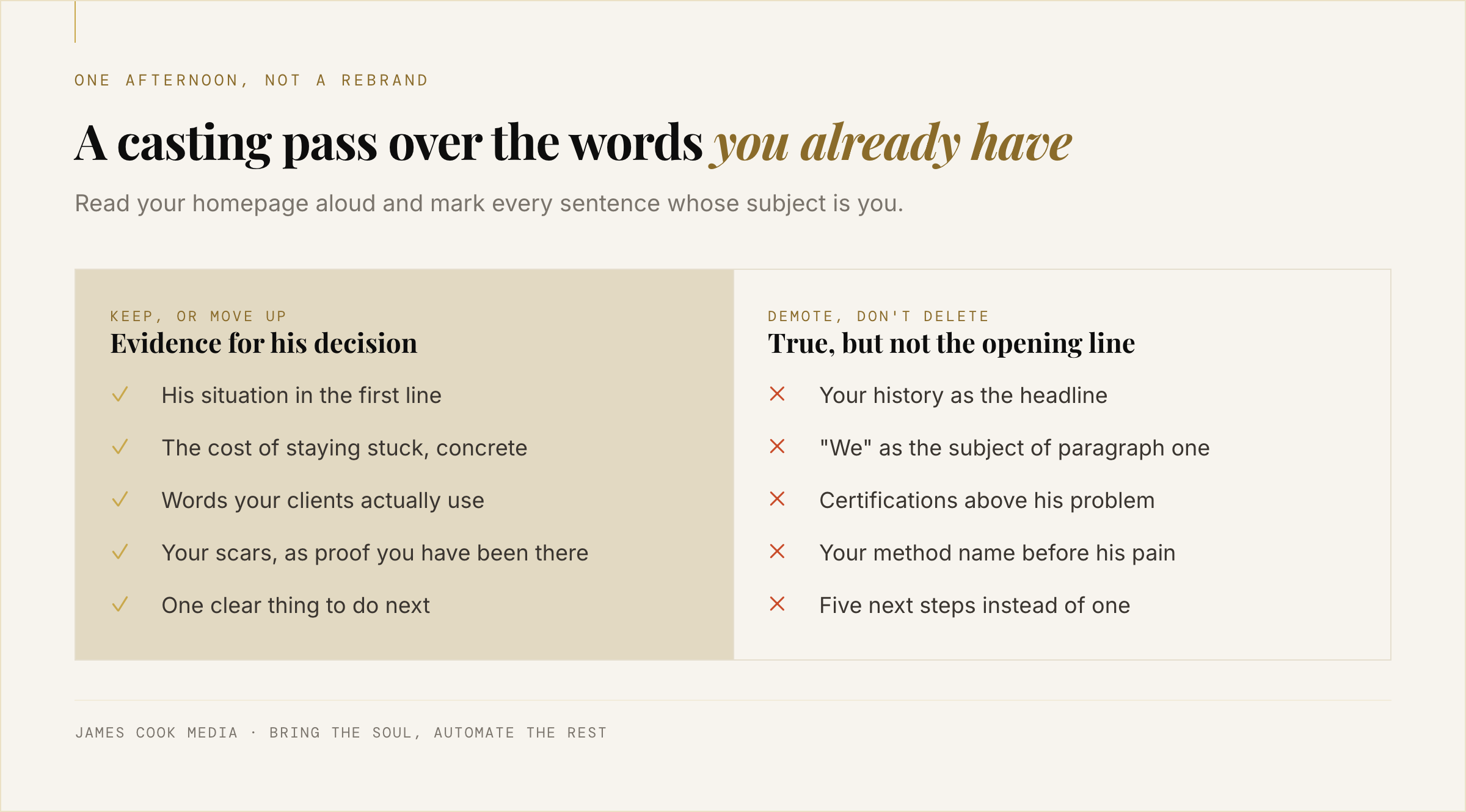
Start with your homepage's first screen and your about page's first paragraph. If either opens with your history, your credentials or the word "we", the casting is wrong. Rewrite so the first thing a stranger reads is his situation, named precisely enough that he recognises himself in it.
You don't need a rebrand. You need a casting pass over the words you already have, and it takes an afternoon.
Read your homepage aloud and mark every sentence whose subject is you or your company. Then ask, for each one, whether it earns its place as evidence for his decision. Most won't. Move them, cut them, or turn them around.
Then check your headline against one question: does a stranger who has never heard of you see himself in the first line? Not your promise, not your method name. Himself.
The mechanics of doing that on a page you can actually publish are in how to build a story-driven landing page. The deeper version of the resistance itself is in marketing for people who hate self-promotion.
One warning about the standard advice. Marketing Against the Grain's version describes a jewellery brand that wanted to lead with its ethical labour practices and was steered toward the customer's milestones instead: the promotion, the anniversary, the birthday. Good advice, easy to over-apply. The ethical labour practice did not stop being true or being a reason to buy. It stopped being the opening line. Demoting a fact is not deleting it.
Where humility turns into hiding
The customer-as-hero shift can become an excuse. If casting the client as hero means you never appear, never state a position and never make an offer, you have not adopted a framework. You have found a respectable reason to stay invisible. The guide is on screen, named, and unmistakably willing to be judged.
This part has to be said plainly, because the reframe is comforting and comfort is where good instincts go to sit down.
A guide who never appears is not a guide. He is a rumour. If your version of "the client is the hero" produces a site with no face, no point of view and no ask, the casting isn't what changed. Only the excuse did.
The test is simple. Can a stranger tell, in thirty seconds, who you are, what you believe about his problem, and what he is invited to do next? If not, you're hiding, however elegant the reasoning.
Since 2013 this approach has generated more than $10M for clients, and since 2018 the StoryMatters method has been taught to over 100,000 experts. Those are agency-scale numbers and they should reassure you rather than intimidate you: the mechanism underneath them is the same one that worked with an Olympic coach who wouldn't read a script, and it works with three clients and a laptop.
Bobby's story and Rory's turn on the same hinge, and it isn't courage. Neither became louder. Both stayed exactly who they were and got a role they could occupy without flinching.
You already know how to be the person in the room who makes it about someone else. That is not a marketing weakness you have to overcome. It is the job.