
You can sit with a client for ninety minutes and change how they see their own life. Then you open a blank page to write a landing page about it and something in you goes cold.
The word for it, if you've ever said it out loud, is icky. Not hard. Not confusing. Icky. Writing the thing that would bring you clients feels like putting on a costume you'd be embarrassed to be seen in. So the page stays half-written, the email sequence stays a folder of good intentions, and the only clients who find you are the ones who already knew someone who knew you.
The problem is almost never your discipline. It's that nobody gave you a structure, so every time you sit down you're improvising, and the only models you've absorbed are the loud ones. This is a structure. Hero's journey marketing is the usual name for it, which is unfortunate, because the reason it doesn't feel like marketing is that it isn't built out of marketing shapes at all. It's story shape, and it's about four thousand years old.
I spent years as a historian and before that as a Cavalry officer, which is to say I've spent most of my working life reading and writing accounts of people who went somewhere difficult and came back different. Narrative structure is not a marketing trick I picked up. It's the thing I know best. What follows is the smallest usable version of it.
What hero's journey marketing actually borrows from Campbell
Hero's journey marketing borrows one structure from Joseph Campbell's 1949 monomyth: a person leaves an ordinary situation, meets a guide, crosses a threshold, endures trials, and returns changed. Campbell described seventeen stages across three phases, but he warned against treating them as rigid steps. For a coach's funnel, six beats carry almost all the weight.
Joseph Campbell named the pattern in The Hero with a Thousand Faces. The Joseph Campbell Foundation describes what he called the nuclear unit of the monomyth as three stages: separation, initiation, return. Inside those, he catalogued seventeen named stages, from the Call to Adventure through the Road of Trials to Freedom to Live.
Two things matter about that list. The first is that the stage names are real and specific and you can look them up: a full catalogue of the seventeen includes Refusal of the Call, Supernatural Aid, Crossing the First Threshold, The Ultimate Boon, Master of Two Worlds. If a marketing article gives you stage names you can't find in Campbell, someone has invented them and attached his name for authority.
The second is that Campbell himself did not intend a checklist. The Foundation is explicit that much analysis goes wrong by mistaking his discussion of common elements for rigid, sequential steps present in every myth. Which means the honest way to use this is to take the beats that do work for your situation and leave the rest in the library.
Most marketing articles about this do the opposite. They recite the seventeen, or a mangled seven, and stop. Marketing Examined's guide is one of the better ones and it still lands on a principle rather than a build: cast the prospect as the hero, the brand as mentor, then apply it across channels. True, and you still don't know what to put on page two.
The six beats that actually map onto a coach's funnel
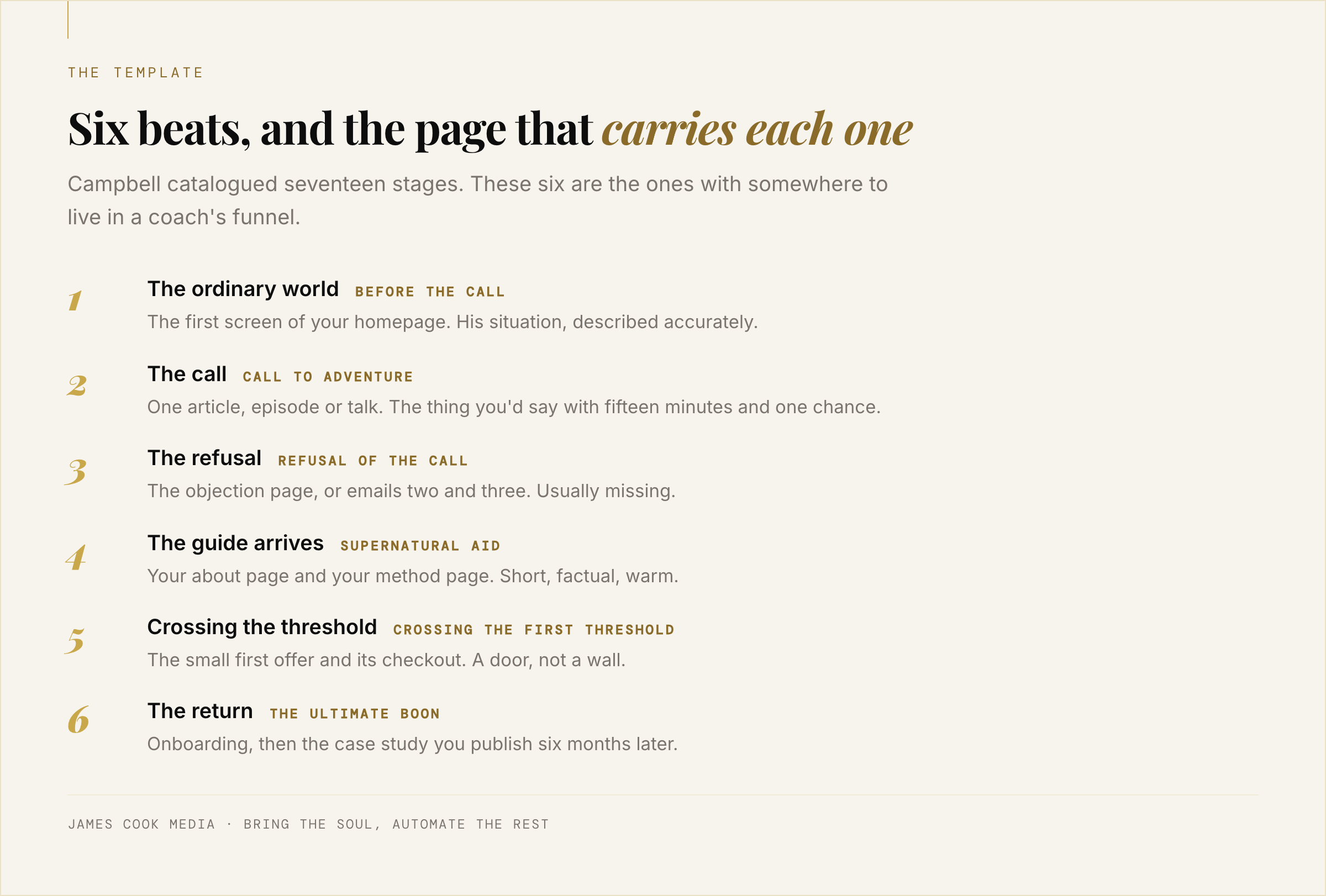
Six beats do the work: the ordinary world, the call, the refusal, the guide's arrival, crossing the threshold, and the return. Each maps to a specific asset a solo coach either has or is missing. The ordinary world is your homepage's first screen. The refusal is the beat almost every funnel skips, and it's where the ickiness actually lives.
Here is the collapse. Campbell's stage name in the middle, the thing it becomes in your business on the right.
| Beat | Campbell's stage | What carries it in your funnel |
|---|---|---|
| 1. The ordinary world | Before the Call | The first screen of your homepage |
| 2. The call | Call to Adventure | Your best top-of-funnel piece: article, post, podcast episode |
| 3. The refusal | Refusal of the Call | The objection section, or email two and three |
| 4. The guide arrives | Supernatural Aid | Your about page and your method page |
| 5. Crossing the threshold | Crossing the First Threshold | The small first offer and its checkout |
| 6. The return | The Ultimate Boon, Master of Two Worlds | Onboarding, then the case study you publish after |
Six beats, six places to look. Nothing here requires you to write about yourself in a voice that isn't yours, which is the whole point of using a story structure instead of a sales formula.
Beat 1: the ordinary world, or your homepage's first screen
Campbell's hero starts somewhere ordinary and slightly wrong. That's your reader's Tuesday. Good at the work, invisible to anyone who hasn't met them, quietly tired of it.
Your first screen has one job: describe that Tuesday accurately enough that he recognises himself. Not your credentials, not your framework name, not a promise. If he can't finish the sentence "yes, that's exactly where I am" in five seconds, nothing further down the page gets read. Most homepages fail here and then blame the traffic.
Beat 2: the call, or your best single piece of content
The call is the moment the possibility becomes concrete. Something says: this could be different, and here's why.
In a coach's funnel that's one specific asset, not a content strategy. One article, one podcast episode, one talk recording that says the thing you'd say if you had fifteen minutes and one chance. It should end with a named possibility, not a request. Getting that piece found is a separate problem, and it's the one findability, not more content is about.
Beat 3: the refusal, the beat your funnel almost certainly skips
The second stage in Campbell's Departure phase is Refusal of the Call. The hero hears the summons and says no. Fear, obligation, a sense of inadequacy, the suspicion it's for other people.
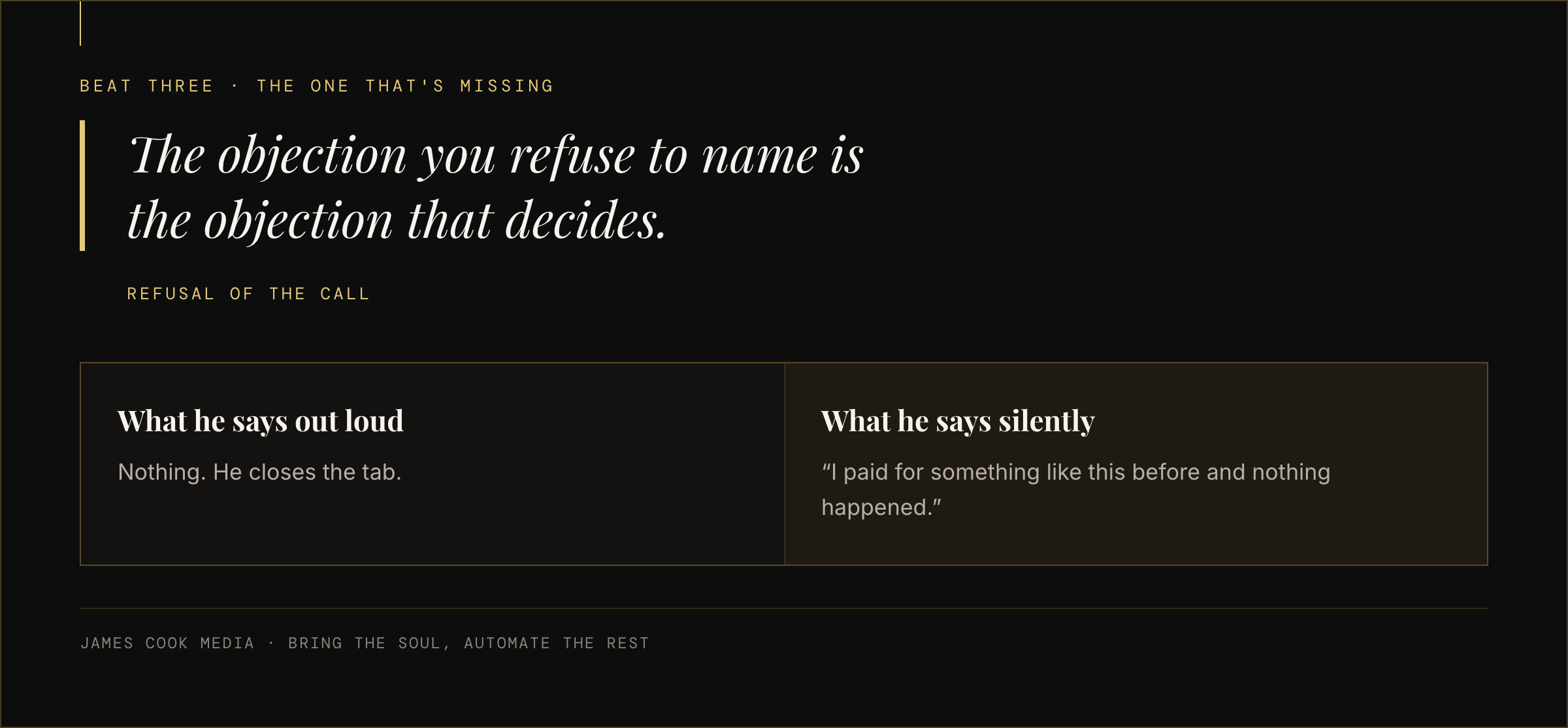
Your reader does this too, silently, and then closes the tab. He thinks: "I've paid for something like this before and nothing happened." Or "this works for people who are comfortable on camera." Or the quiet one, "maybe I'm too late."
Almost every funnel I've audited has nothing at this beat. Beat 2 hands straight to beat 5, call to purchase, and the refusal goes unanswered. That gap is what people are feeling when they say marketing seems pushy. A page that names your reader's reason for saying no, and takes it seriously rather than dismantling it, is the least icky page you will ever write. It is also usually the one that converts.
Beat 4: the guide arrives, on your about and method pages
This is Campbell's Supernatural Aid, the helper who shows up with something the hero can't supply alone. In a funnel it's the two pages you probably find hardest: the one about you, and the one about how you work.
The relief here is structural. A guide in a story is not the interesting character. He's credible, he's been there, he hands over a map and steps back. That's a much smaller role than the one you've been dreading, and it means your about page can be short, factual and warm rather than a performance. Which character you are is the whole subject of the customer is the hero, not you. That piece is the casting decision. This one is the structure you cast into.
Beat 5: crossing the threshold, or the small first offer
Crossing the First Threshold is the point of no return. In a story it's a door, a border, a decision that can't be walked back.
In your funnel it's a transaction, and the size of it decides whether anyone crosses. A threshold that costs him a year and four figures is not a threshold, it's a wall. Something small and finite that produces a real result is a door. This is why the whole industry sells a cheap first thing, and it's also why the cheap first thing has to be genuinely good rather than a teaser. The page that carries this beat is doing one job: making the door look like a door. A story-driven landing page is how that gets built.
Beat 6: the return, in onboarding and the case study
Campbell's Return phase gets skipped more than any other in marketing, because most funnels stop at the sale. But the boon and the crossing back are where your proof comes from.
Practically: your onboarding sequence is the Road of Trials handled well, and the case study you write six months later is the hero returning to the ordinary world visibly changed. That returning client's story becomes the call for the next person. The loop closes. Nothing in your marketing is as persuasive as one accurate account of someone who started where your reader is standing.
One small next step
See the structure applied end to end
The masterclass walks through how we build story structure into a funnel, beat by beat, with the pages and emails on screen. Watch it in one sitting or in pieces.
Watch the masterclass → About 90 minutes · Watch at your own pace · No subscriptionHow to audit your own funnel in twenty minutes
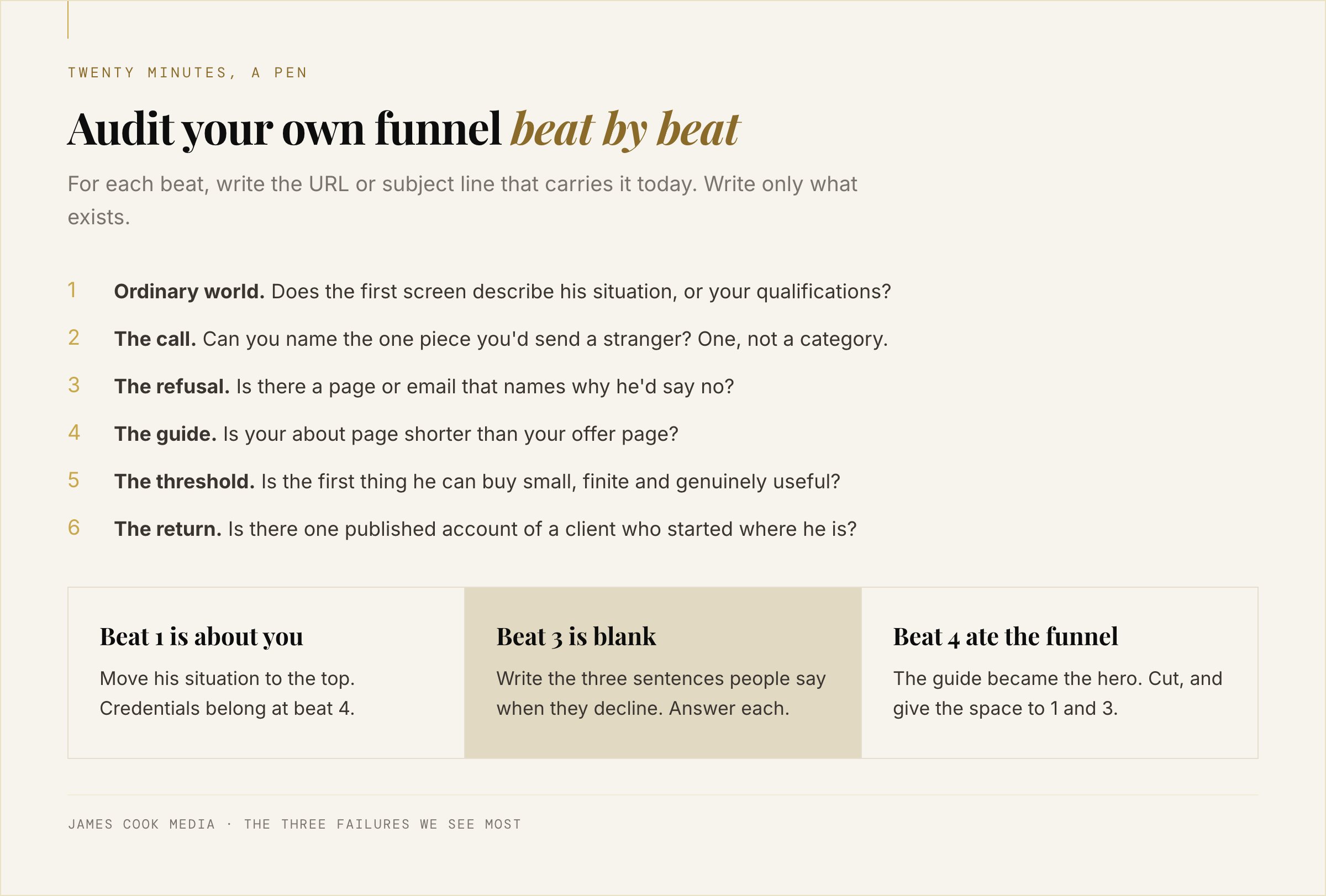
Open the six beats as a list, then walk your own funnel in order and write the name of the asset that carries each one. Beats with no asset are your gaps. Beats with two competing assets are your confusion. Most solo coaches find beat three empty and beat four overbuilt, which is the exact shape of a funnel that feels like marketing.
Do this with a pen, not a strategy document. Twenty minutes is enough.
Write the six beats down the left of a page. Then open your own site and your own email sequence and, for each beat, write the URL or subject line that carries it. Write only what exists. Not what you meant to build.
Three patterns show up almost every time.
Beat 1 is about you instead of him. The first screen opens with your qualification or your framework's name. Fix: move the reader's Tuesday to the top and your credentials to beat 4, where they belong.
Beat 3 is blank. No objection page, no email that says "here's why you're hesitating and here's the honest answer." Fix: write down the three sentences prospects actually say when they decline, and answer each one in a paragraph. That's the asset.
Beat 4 has taken over the whole funnel. About page, story page, credentials, philosophy, a manifesto. The guide has become the hero. Fix: cut, and move the space to beats 1 and 3.
If you find four of six empty, that is normal and it is not evidence of anything about you. It's evidence that nobody handed you the structure. We've trained more than 100,000 experts on story structure since 2018, and the gaps look almost identical every time, whether the person has a team or a laptop.
Where this template breaks, and what to do then
The hero's journey suits transformation work with a clear before and after. It fits badly when your work is ongoing, communal, or structural rather than personal. Critics rightly note the framework has been handed to everyone regardless of whether its story is true for them. If the arc doesn't match what you actually deliver, don't force it.
The structure is not universal and the honest version of this article has to say so. The writer Peta O'Brien-Day makes the sharpest case, arguing the framework is built on individualism and the wrong model for community-centred brands: it treats community as something to transcend, frames structural exhaustion as a motivation problem, and promises a clean resolution when real change is messy and ongoing.
That lands. If you run a membership, a peer community, or long-horizon work where nobody arrives, a single-hero arc with a triumphant ending will read as a lie to the people who know your work best. The other common failure is subtler: coaches who use the arc correctly on the page and then deliver something that has no threshold in it at all.
What survives the critique is the sequence, not the mythology. People do move from a situation, through hesitation, past a decision, into difficulty, and out somewhere different. That much you can rely on. Whether it looks like one triumph or twenty small returns is a question about your work, and your marketing should answer it accurately. If it doesn't, no structure will save it.