
You have a show. Episodes go out on a schedule, the numbers are small but real, people occasionally tell you they loved the one about pricing, and not one of them has ever become a client.
That is the situation this is written for. You are not wondering whether to start a podcast, and you do not need convincing that speaking is your best format. You have a show that produces goodwill and no work, and a suspicion that you are doing something obvious wrong.
You probably are, and it is almost always mechanical. A podcast marketing strategy that produces clients is not a better show. It is the same show with four or five missing pieces of plumbing installed behind it, boring enough to build in a weekend and then leave alone.
Why "no leads" is almost never a content problem
When a podcast gets listened to but produces no leads, the cause is usually structural, not editorial. The episodes are good, and there is no path from a listener's ears to a conversation with you. A listener finishes an episode, feels warm towards you, has nothing specific to do next, and closes the app. Nothing about the content caused that.
Rule out the thing you are probably worried about. If people tell you unprompted that they liked an episode, your content is working. That is a weak signal for a lot of things, but it does rule out "nobody can stand listening to me," which is the fear underneath most of this.
What is missing is a path. Not a funnel in the loud sense, with countdown timers and upsells. Just a route from "that was good" to "I should talk to him" that a normal person can follow without initiative.
That route almost certainly has a gap in it, probably several, and each gap loses roughly everyone. The listener is on a walk, or driving, or doing the dishes, with no spare capacity for working out what you would like him to do.
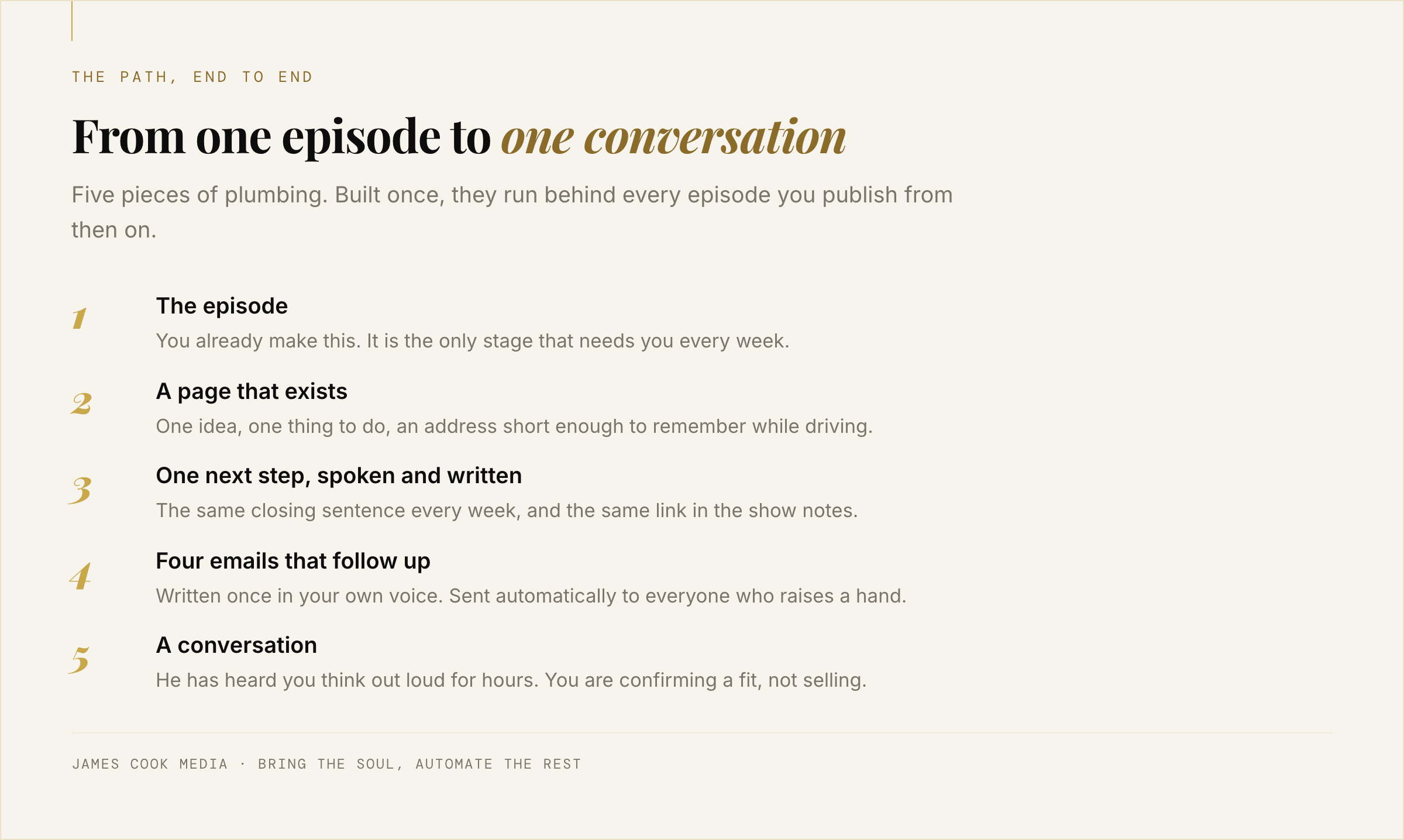
The rest of this article walks that path stage by stage. If you have not started a show yet, what makes a podcast get clients from episode one is the piece to read instead, because these decisions are easier made before you record. This one is for a show that exists and needs repairing rather than designing.
The five places a podcast marketing strategy leaks
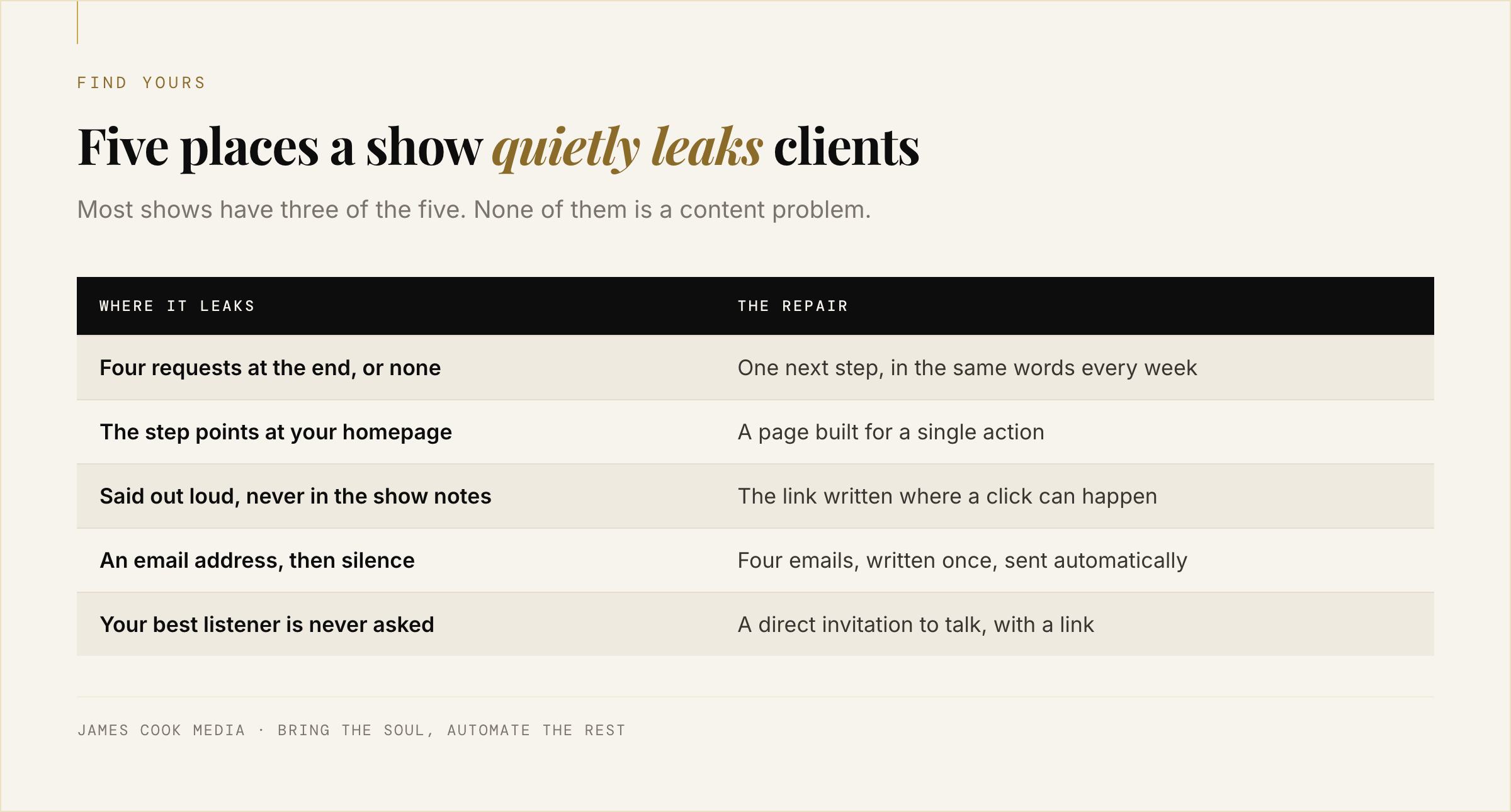
Five leaks account for nearly every show that has listeners and no clients: no single next step, a next step that points at a page not built for one action, an invitation said out loud but never written down, no follow-up after someone raises a hand, and no moment where anyone is actually invited into a conversation. Fix them in that order.
Name them individually, because you probably have three of the five and the fix differs for each.
Leak one: no single next step, or too many. Most episodes end with "thanks for listening, don't forget to subscribe, leave a review, and connect with me on LinkedIn." That is four requests, none of them a step towards working with you. A listener given four options picks none.
Leak two: the step points at your homepage. Your homepage summarises everything you do. There is nothing to do on it. Sending a warm listener there is like ending a good conversation by handing someone a brochure and walking off. We wrote about that gap in funnel versus website.
Leak three: it was only said, never written. You mentioned the guide in episode fourteen. It is not in the show notes. Every podcast app shows a description field, and that field is the only clickable surface your episode has. If the link is not there, the invitation did not really happen.
Leak four: the handshake goes nowhere. Someone downloaded your thing three weeks ago and has heard nothing since. An email address is not the win. It is where most shows stop, halfway through the sentence.
Leak five: nobody is ever invited. The hardest to admit. Your most engaged listener, the one who has heard every episode, has never been asked directly whether he wants help. He is waiting to be invited, and you are waiting to be approached.
None of those five is about audio quality, cadence, artwork, guest bookings or download numbers. Those are what most podcast advice optimises, and they are not why your show is quiet.
The page your episode points at has to exist
Every episode needs one destination, and it has to be a page built for a single action rather than a general page about you. One idea, one thing to do, an address a person can say out loud and remember. The most common version of this failure is not a bad page. It is a page nobody ever built, because the episode was the whole plan.
This is the stage people skip, and skipping it makes everything downstream impossible. With nowhere specific to send a listener, no call to action will save you.
The page does not have to be elaborate. It needs one idea, one thing to do, and enough of your actual voice that arriving there feels like the same person who was just talking. One breakdown of a podcast funnel calls the three parts the hook, the bridge and the destination, which is a useful way to hold it: the episode hooks, the closing line bridges, and something has to be standing at the other end.
Two constraints matter more than they sound.
It has to be sayable. A URL he has to spell is a URL he will not visit. Short, one word if possible, no hyphens you have to explain.
It has to match the episode. A generic newsletter signup after an episode on hiring your first operations person converts far worse than a page about hiring your first operations person. You do not need a page per episode. You do need both to be recognisably about the same problem.
Why this pairs so well with a podcast is what a listener is doing while he listens. Signal Hill Insights found that 83% of highly influential executives had listened to a podcast in the past week, most while commuting or exercising, and that they choose shows for insight rather than entertainment. That is a person with attention and no hands. Give him one address to remember and he will type it later.
One next step, said the same way, every time
Say one thing at the end of every episode, in almost identical words, and write the same thing in the show notes. Repetition is not laziness here. A listener needs to hear an invitation several times before he acts on it, and a next step phrased differently each week never accumulates into anything he can remember or repeat to someone else.
The closing thirty seconds of your episode is the most valuable unused real estate you own. Right now it is probably improvised, which means it is different every week and lands nowhere.
Write it once. One sentence of what the thing is, one sentence of who it is for, the address. Then stop talking. The temptation to soften it with three more sentences is exactly what makes it forgettable.
One guide to podcast lead generation suggests a second mention shortly before the point where listeners typically drop off. Worth doing once you know your own drop-off, and a refinement rather than the fix. The fix is having one step at all.
Then the unglamorous half: put it in writing. In the episode description, in the transcript, on the episode page. The spoken invitation creates the intent, and the written one is the only place a click can happen.
One small next step
See how a show is built to bring people to you
The Podcasting MasterClass walks through the whole listener-to-client path, including the question structure that makes episodes worth pointing somewhere and the closing that turns a listener into a conversation. About ninety minutes, at your own pace.
Take the Podcasting MasterClass → About 90 minutes · Watch at your own pace · No subscriptionWhat happens after someone raises a hand
A listener who downloads something or joins your list has told you he has the problem your show is about. What he needs next is four short emails that continue the conversation the episode started, in your voice, one of them containing a direct offer to talk. Most shows send nothing, and the interest cools within a fortnight.
This is the leak that costs the most, because these are the warmest people you will ever have.
Consider what he has actually done. He listened to forty minutes of you, then took the trouble to type an address into a phone. In intent, that is closer to a referral than a cold click. And in most shows I look at, he then hears nothing at all.
What he needs is not a nurture campaign. Four emails, written once, sent automatically. The first delivers what he asked for and says one honest thing about why you made it. The second tells a story about a client with the same problem, unnamed if it needs to be. The third answers the objection he is having. The fourth invites him to a conversation, with a link.
That is the whole sequence, and it goes out to everyone who raises a hand, forever, without you touching it. This is what bring the soul, automate the rest means in the least romantic possible way. You wrote four emails in your own voice on one afternoon. The machine sends them.
James Cook Media has helped clients generate more than $10M, including $1.8M in ten months for one of them, and much of that work is exactly this: writing down sentences somebody already says well and letting a system deliver them. That is an agency-scale number, and the mechanism under it is four emails and a page. It works identically with six clients and a laptop.
The conversation, and why it barely feels like selling
The last stage is a real conversation, and with a podcast listener it is unlike a cold sales call. He has heard you think out loud for hours, already knows how you work, and has usually decided most of the question before he books. Your job on that call is to find out whether you can actually help, and to say so plainly either way.
This is the part reluctant experts dread, and with a show behind you it is the part that changes most.
A listener arrives pre-sold in a way no ad can produce. He knows your opinions, your caveats, the things you refuse to do. The question he is answering by the time he books is not "is this person any good" but "is this the right moment."
So the call needs no technique. Ask what he is stuck on, listen, and say honestly whether the thing you do is the thing he needs. Reluctant experts usually offer a version of the same sentence: "I'd rather not sell than sell myself." You are not selling yourself here. He listened to eleven episodes. You are confirming a fit.

If it is not a fit, say so in the first ten minutes. It costs you a proposal and buys you the only reputation that compounds.
What the whole path looks like in one pass
Assembled, the path is: one episode, pointing at one page, offering one thing, followed by four emails, ending in an invitation to talk. Built once, it runs behind every episode you publish from then on. The build is a weekend of unglamorous work. What it changes is that every future episode now has somewhere to send people.
Written out, it is almost disappointingly small. That is the point. A five-part path you actually finish beats a twelve-part system you abandon in week three.
The honest sequencing, starting from a show that exists today: build the page first, because nothing works without it. Write the closing thirty seconds second. Add the link to the show notes of your best five old episodes, an hour of work that quietly makes your archive useful. Then the four emails. Then, and only then, worry about audience size. Shows that do this in the wrong order chase downloads for six months with no destination built, then conclude podcasting does not work for their market.
Note how little of this is about producing more. The episodes you already have are the raw material, and one recording, a month of content covers how to get more visibility out of each one. That article multiplies reach. This one is about what happens to the people the reach brings.
Most podcast marketing advice assumes a team. Content Allies' guide to B2B podcast lead generation is a fair example: sound thinking, addressed to your sales team and your marketing team, with a CRM and a dashboard behind them. You need a page, a sentence, four emails and a calendar link.
Timelines, since nobody gives them honestly: expect the first inbound conversation within a couple of months of the plumbing being finished, from someone listening far longer than you would guess. The Podcast Studio exists for people who would rather build this with someone than alone.