
You have a website you are not proud of, and a growing suspicion that what you actually need is a funnel. Nobody has told you plainly what either word means, so here are both definitions and the order to build them in.
Someone told you your site is the problem and you need a funnel. Someone else told you funnels are for course-sellers and what you really need is a proper website. Both of them were selling one of the two, and neither of them explained what the words mean, so you have been stuck on the question for months while the referrals keep being the only thing that works.
The funnel vs website argument is mostly a vocabulary problem dressed up as a strategy problem. Once you know what each thing is for, the choice stops being a choice. You need a small amount of both, and you need them in a particular order, because building them in the wrong order is how people waste a year.
What a website actually is
A website is a place people go to check you out. It is browsable, non-linear, and permanent: several pages, a menu, and a visitor who decides where to click. Its job is credibility and discovery, not persuasion. It answers "is this person real, and are they any good?" for someone who already has a reason to look you up.
A website is a library. Someone arrives with a question, wanders the shelves, and leaves when they have what they came for. You do not control the route. That is the point of it.
For a solo expert, a website does three jobs and almost nothing else. It confirms you exist and are a real practitioner. It gives search engines and AI assistants something to read about what you do and who you do it for. And it holds the pages that build trust slowly over time: your writing, your case studies, your face.
That is not a small job. A structured collection of interconnected pages on your own domain is what makes you legible to the internet. But notice what is missing from that list: nowhere does a website ask anyone for anything. A browsable site full of good information will happily let a perfect-fit client read three pages, nod, and close the tab.
What a funnel actually is
A funnel is a path, not a site. It is one deliberate sequence of steps that takes a stranger from first contact to a specific next action, usually booking a call or joining a list. It removes choices instead of offering them. A funnel does not attract traffic. It processes the traffic you already have.
The word sounds like software. It is not. A funnel is a decision you make about the order in which someone meets your ideas, and then the two or three pages and emails that carry that order.
The most useful sentence in the whole debate comes from the vendors themselves: funnels are not designed to bring in traffic, only to process it. Simvoly's comparison puts it as a funnel guiding people through a campaign journey toward one outcome, while a website lets them navigate freely. That is honest, and it quietly kills the idea that a funnel fixes an invisibility problem.
A minimum funnel for a one-person business is genuinely small. One page that makes one promise to one kind of person. One thing worth giving your email address for. A short sequence of messages that earn the right to ask. One clear invitation to talk. That is it. If someone is quoting you a nine-step launch sequence with upsells and downsells, they are selling you a machine built for a different business.
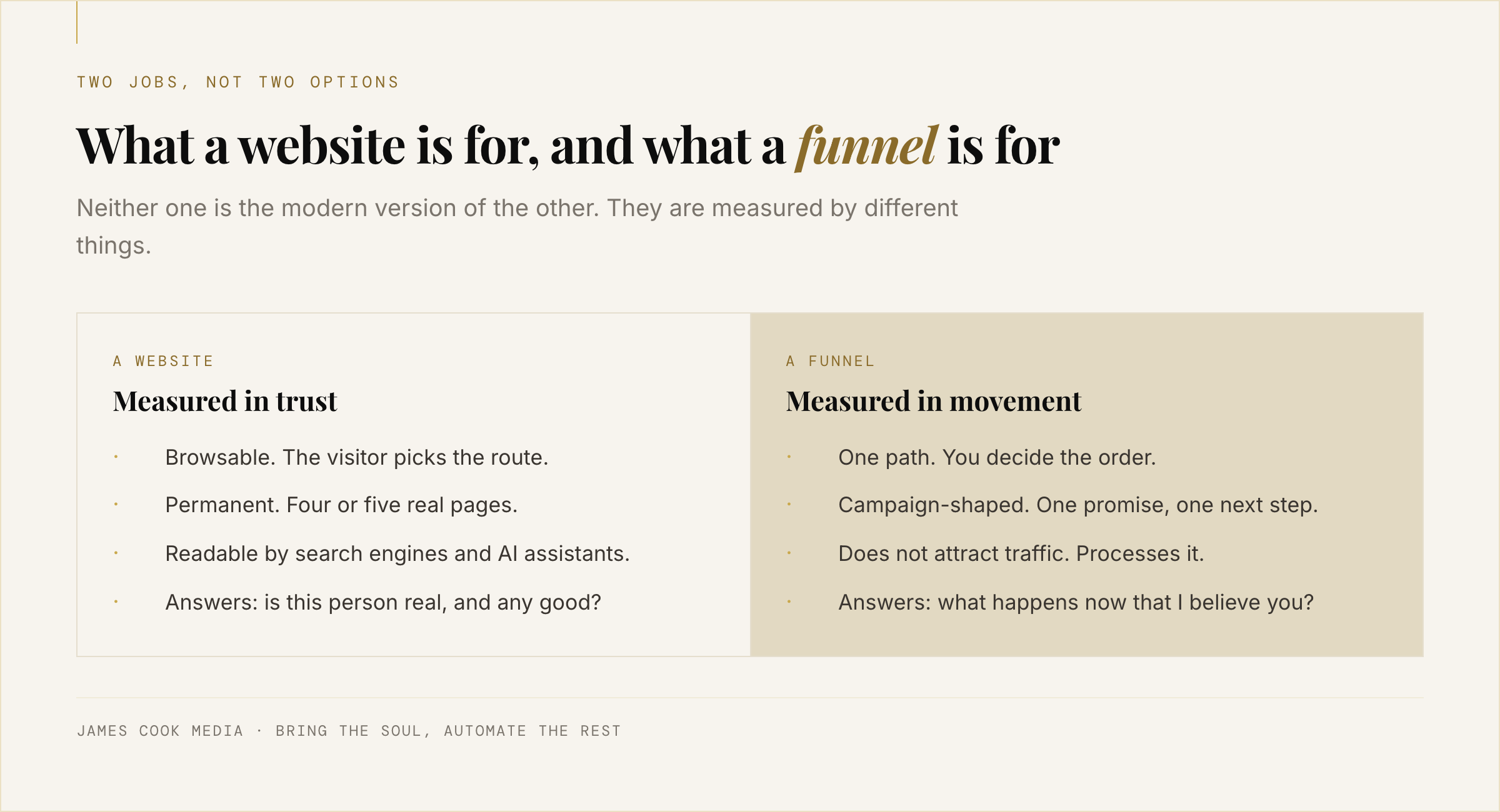
Funnel vs website: the difference that actually matters
The difference is not quality or modernity. It is intent. A website assumes the visitor is in charge and gives them options. A funnel assumes you are in charge of the sequence and gives them one option. You need the first so people can find and verify you, and the second so the ones who fit have somewhere to go.
Every comparison article online will hand you a table of seven differences. Most of them are the same difference restated: navigation, distraction, linearity, focus. Underneath, there is one distinction worth remembering.
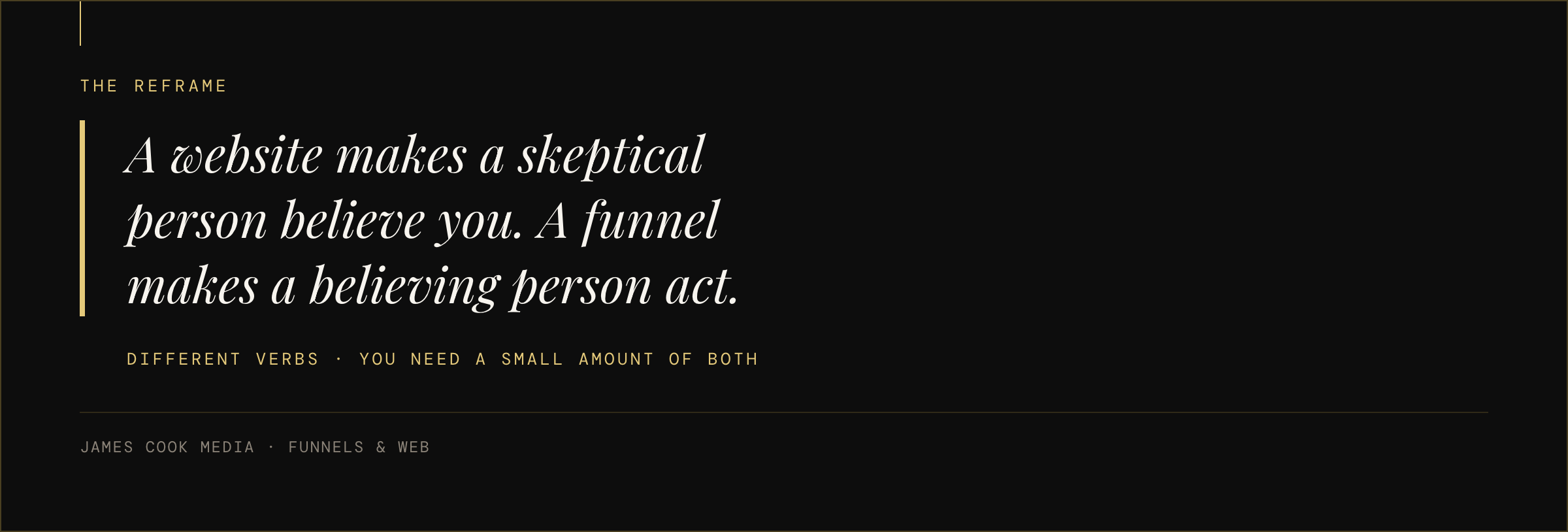
A website is measured in trust. A funnel is measured in movement. A good website makes a skeptical person believe you. A good funnel makes a believing person act. Those are different verbs, and no single page does both well.
This is where the numbers get slippery, so be careful with them. ClickFunnels' own comparison page states that websites convert at 2–3% while funnels convert at 3–10%, and that funnels convert 137% higher on average. Maybe. It is a company that sells funnels, quoting figures about how much better funnels are, to an audience of people deciding whether to buy funnel software. Read it as a claim, not a fact.
The trap in those percentages is that a conversion rate needs a denominator. Ten percent of no visitors is no clients. That is the actual reason most solo experts who build a funnel first end up disappointed, and it is not because the funnel was badly written.
It was never either/or
Most solo experts need both, in small amounts: a modest site of four or five real pages, and exactly one working path through it. The failure mode is not choosing wrong. It is building a big version of one and none of the other, then concluding that online marketing does not work for people like you.
I have watched this go wrong in both directions, and the second one is more common than the funnel sellers admit.
Direction one: you spend three months and real money on a beautiful site with an About page, a Services page, a blog nobody reads, and no single place where an interested person can take a next step. Traffic arrives, admires the typography, leaves. That specific failure is the subject of our piece on why a brochure site does not convert. That article makes the case against the brochure and what to build instead. This one is the definitions and the order.
Direction two: you buy the funnel software, build the landing page, write the emails, and switch it on to an audience of nobody. Now you have a conversion machine with nothing to convert. So you consider ads, which is how a $500 experiment becomes a $3,000 lesson.
Neither failure is a skill problem. Both are sequencing problems.
The right order to build
Build in this order: clarity on who you help, then one page that makes the promise, then the small site around it, then the path from that page to a conversation, then a way for strangers to arrive at all. Each step exists to give the next one something to work with. Skipped steps do not get skipped, they get paid for later.
The order matters because every step produces the raw material the next step needs. Here is the sequence, and why each one precedes the next.
1. Decide who this is for and what changes
Before any page exists, you need one sentence: who you help, and what is different afterwards. Not a niche in the marketing sense. A recognizable person with a recognizable problem.
This is first because it is the input to everything else. Page copy, headline, email subject lines, even your site navigation are all derived from this sentence. Skip it and you will rewrite everything twice.
2. Write the one page that makes the promise
One page. One reader. One promise, one proof, one invitation. This is your offer page, and it is the hardest writing you will do, which is exactly why it comes before the site rather than after.
It comes second because it forces the decisions the rest of the site will inherit. If you cannot write this page, you do not yet have a website problem. Our guide to the story-driven landing page covers how to structure it so it reads like a person rather than a pitch.
3. Build the small site around it
Now the site, and keep it small: home, about, the offer page, proof, contact. Four or five pages of real substance beat twenty of filler, and they give search engines and AI assistants something specific to quote you for.
Third, because now you know what the site is arguing. A site built before the offer page becomes a brochure by default. A site built after it becomes the supporting evidence for a claim you have already made.
4. Connect the page to a conversation
This is the funnel, and it is smaller than you think. A reason to give you an email address. Three or four messages that are actually useful. One low-friction invitation to talk. If you want to understand the emotional sequence underneath those steps, the five feelings a funnel has to create is the companion to this section.
Fourth, because a path needs a destination and a starting point, and steps two and three just built both.
5. Then, and only then, work on being found
Content, search, being cited by AI assistants, podcast appearances, your existing network. This is the traffic step, and it goes last because everything it sends somewhere needs to already exist.
Doing this first is the single most common expensive mistake. You get attention you have nowhere to put, decide attention does not work, and stop.
One small next step
See what a working path actually looks like
StoryFunnels is the software we use to build the small site and the one path through it, in the same order described above. Have a look at how it is put together before you commit to anything.
See StoryFunnels → Have a look first · No commitment · Built for one-person businessesEverything above is doable by hand, in any tool you already own. We built StoryFunnels because doing it by hand takes longer than most solo experts have.
What you can safely skip for now
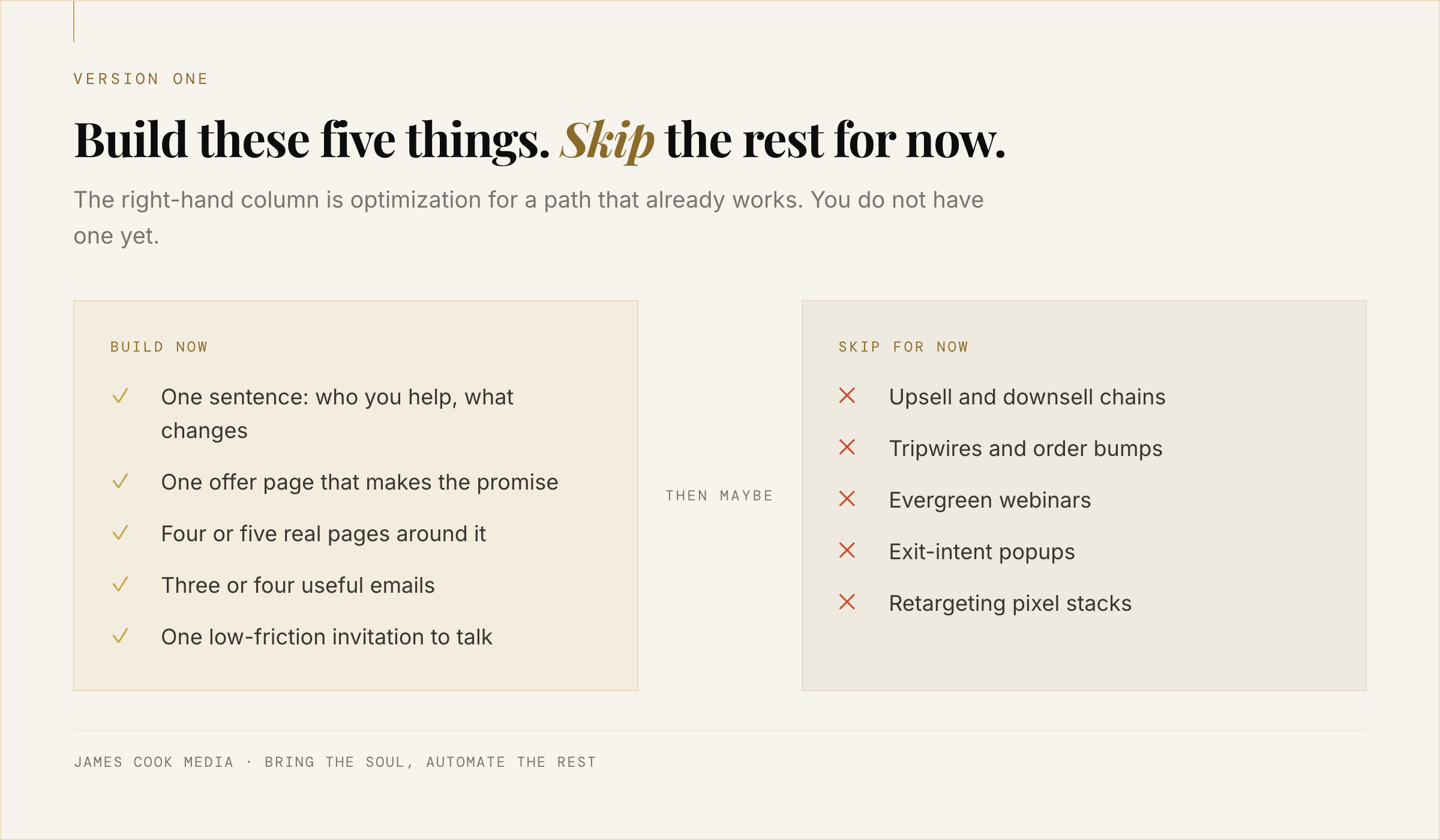
Skip the upsell chain, the tripwire, the webinar, the exit-intent popup, the retargeting pixel stack and the twelve-email nurture sequence. Those are optimizations for a path that already works. Until you have had five conversations from your site, you do not have enough information to optimize anything.
The funnel conversation is crowded with tactics designed for businesses selling low-priced digital products at volume. You are selling your judgement at a real price to a small number of people. Different physics.
We have generated more than $10M for clients and trained over 100,000 experts since 2018, and the number of those funnels that needed a nine-step sequence is small. Most of the work is upstream, in the sentence about who you help. That is reassuring rather than impressive: the expensive part of this is not the technology.
One client's revenue per visitor went up 50.4%. No extra funnel steps were involved. That is not a promise about your results, and it is not a number you need to match. It is a hint about where the leverage actually sits: in the page and the promise, not the plumbing.
How to tell whether it is working
Ignore traffic for the first few months. Watch three things instead: whether anyone starts the path, whether they finish it, and whether the conversations you get are with the right kind of person. A small number of correct conversations beats a large number of visits, and it tells you which step to fix.
If nobody starts the path, the promise on the page is wrong or aimed at the wrong person. That is a step-one and step-two problem.
If people start and drop out, the messages in between are not earning the ask. That is a step-four problem, and it is usually solved by making the emails more useful and less promotional.
If people finish and the conversations are with the wrong people, the offer page is attracting badly. Back to step two.
And if none of it moves because almost nobody is arriving, that is step five, and it is the only one of the five that is genuinely a volume game. Getting found is its own subject, and it is not solved by making more of everything.