
Your download graph is going up and your inbox is exactly as quiet as it was before you started. This is how to build the path from a listener's ear to a conversation, and why almost nobody tells you to build it.
You are nine episodes in. The numbers are respectable, three or four hundred a month, up and to the right, and not one person has ever emailed you because of the show. You know some of them are listening properly, because a client mentioned an episode on a call. But nothing has moved. No enquiry, no booking, no reply.
That gap is not a content problem. A download is a file arriving on a phone. A client is a person who decided to talk to you. Between those two things sits a path, and in almost every podcast started by a solo expert, that path was never built, because the advice you were given optimised for the first number and stopped there.
A podcast that gets clients is built backwards from that path. Same recording, same voice, same expertise. What changes is the twenty seconds inside each episode where a listener is given something to do, and the two or three pages that catch them when they do it.
Why downloads and clients are two different numbers
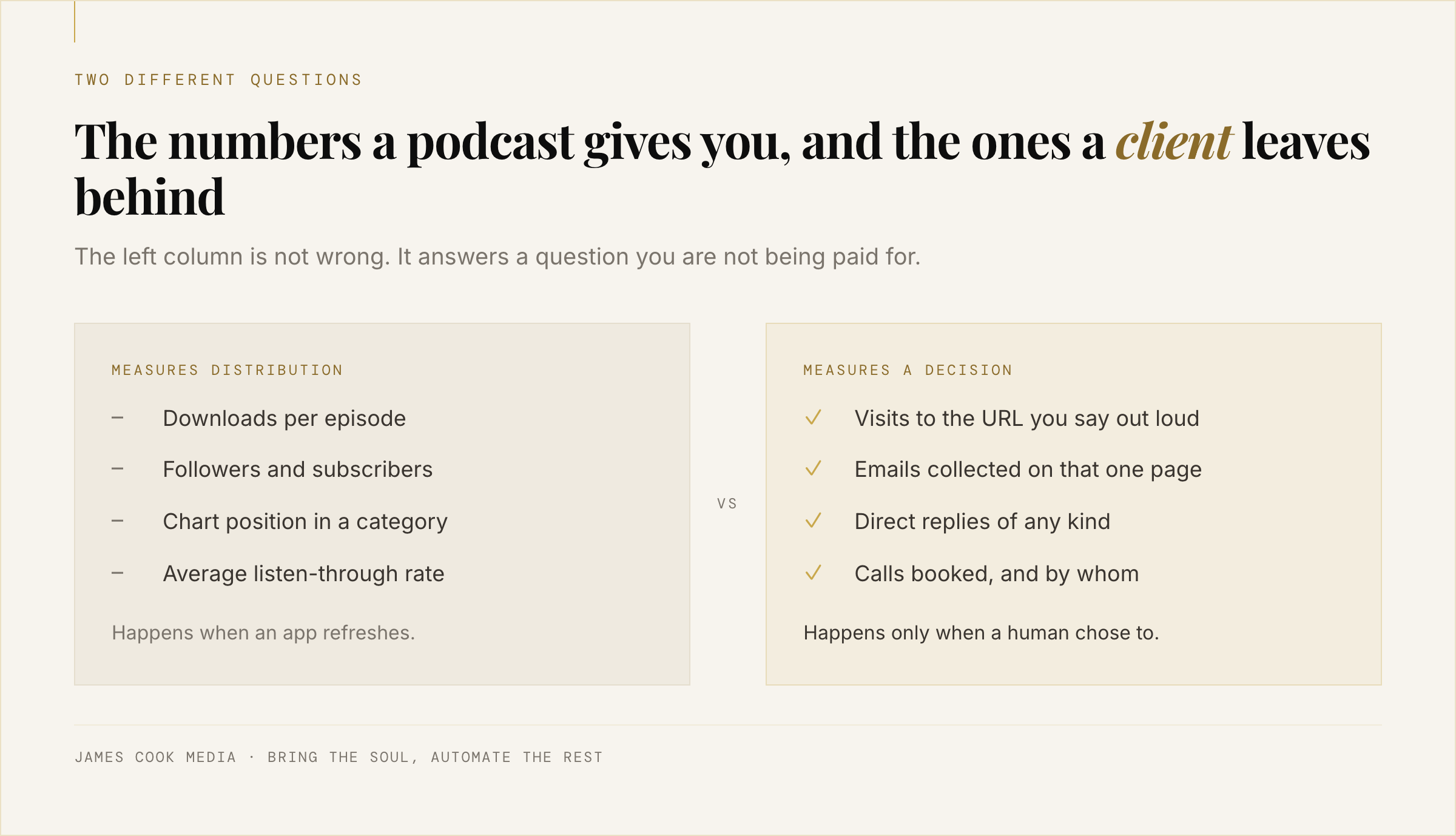
A download counts a file transfer. It happens automatically when an app refreshes, whether or not a human ever presses play. A client is a decision made by a person who found a way to contact you. Downloads measure distribution. Clients measure whether a path existed. Growing the first does nothing to create the second.
Most podcast advice is written for shows that make money from advertising. Those shows genuinely need downloads, because downloads are the inventory they sell. Reach is the product.
You are not selling reach. You are selling three or four engagements a year at real money, to people who need to trust you before they will book a call. Ten thousand casual listeners are worth less to you than eighty who are exactly the person you help and who know where to find you.
So the download number is not lying to you. It is answering a question you do not have. Tim Wohlberg at Podcast Performance Coach puts the first decision as "what role is this podcast meant to play in my business?", and most people never answer it. Skip it and you build a show that performs well against a metric nobody is paying you for.
The three seconds where a listener could act, and usually can't
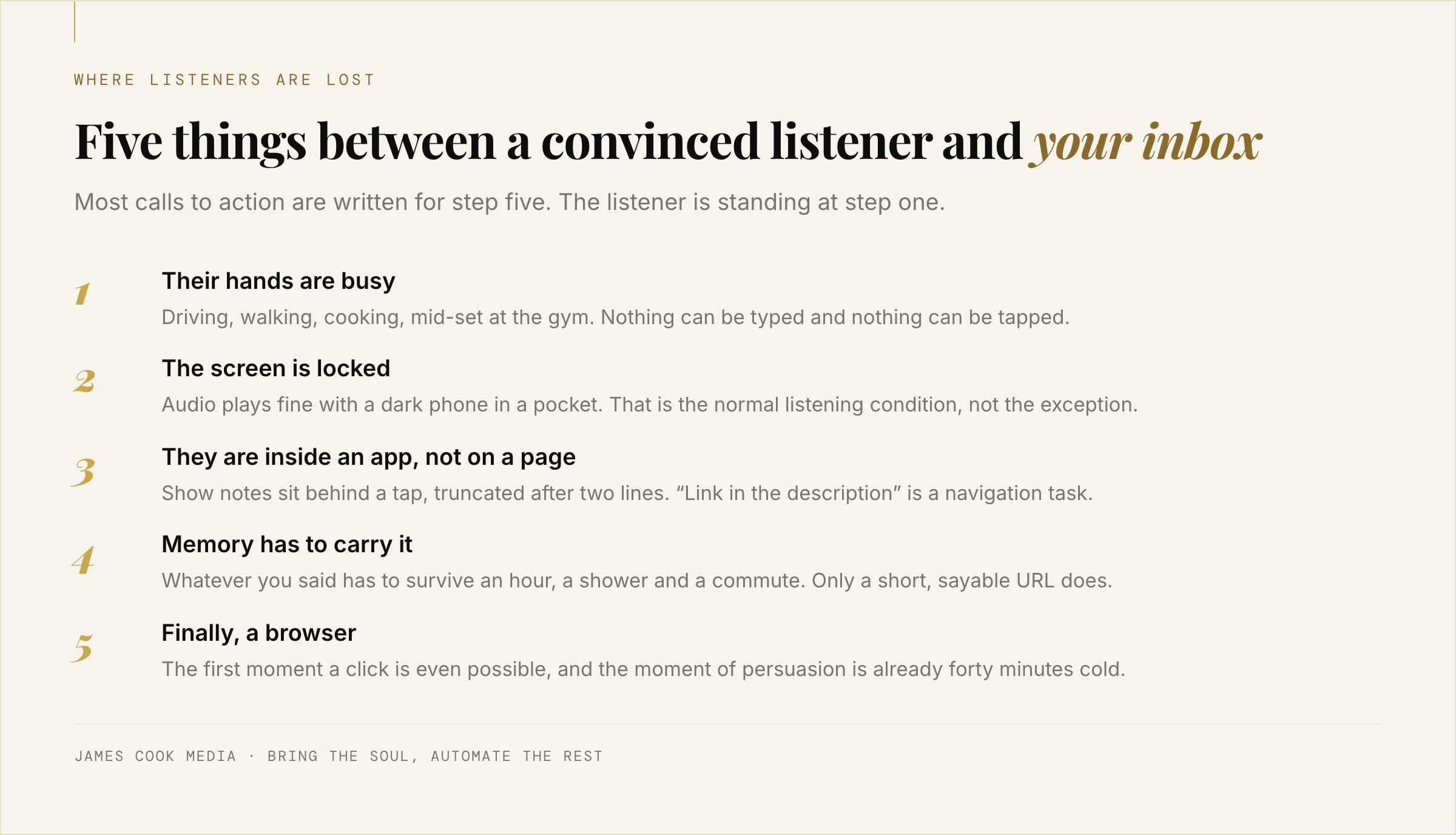
Podcasts are consumed in the worst possible conditions for taking action. The listener is driving, walking, cooking or at the gym. Their hands are busy, the screen is locked, and they are inside an app that has no easy way to click anything. Any call to action that assumes a free hand and a visible screen will be missed by most of your audience.
Picture the actual moment. Someone is thirty-two minutes into your episode, on a treadmill, phone strapped to their arm, and you say something that genuinely lands. This is the most persuaded they will ever be. And they can do precisely nothing about it.
That is the mechanical reason podcasts under-convert. Not weak content, not a weak offer. The medium separates the moment of persuasion from the moment of action by an hour, a shower and a commute, and by the time they have a free hand the feeling has cooled and the episode has scrolled away.
Everything that follows is an attempt to survive that gap. Not to close it, because you cannot, but to leave something behind that still works forty minutes later.
How to design a call to action that works without a screen
A spoken call to action has to be memorable rather than clickable. That means one destination, said aloud twice, at a URL short enough to hold in your head: your domain plus one word. Say what is on the page and what happens next. Never make "link in the show notes" the whole ask, because it sends a distracted listener into an app to go looking.
Three rules, and the first one is the hardest.
Say a URL a human can remember. Not a tracking link, not a subdomain, not a slash-heavy path. yourname.com/start or yourname.com/audit. One word after the slash, and a word that says what is there. If you cannot say it out loud once and have someone repeat it back, it is too long.
Use the same one every episode. The instinct is to make an episode-specific offer each time. Resist it. A single destination said forty times becomes something people know without thinking, the way you know a radio station's number. Forty different destinations said once each are forty things nobody remembers.
Say what happens when they get there. "It's a one-page walkthrough, it takes about four minutes, and there's no call to book." A distracted listener will not gamble a click on a mystery. Captivate's guidance on podcast CTAs is blunt about volume: one per episode, two at absolute maximum, because asking for several things reliably produces none of them. It also makes the point that the ask should be completable in under five minutes.
Where you put it matters almost as much. Not in the pre-roll, which people skip, and not after the outro, which people never reach. Somewhere in the middle, right after the most useful thing you said, in your normal speaking voice rather than an announcer's.

A podcast that gets clients points at one thing
Most shows ask for four things at once: follow the podcast, leave a review, connect on LinkedIn, join the newsletter. Each one splits attention and none of them is a step toward hiring you. A show that produces clients has exactly one destination, and it is the same destination in every episode, on every page, in every description.
People stack CTAs because each one feels free. It costs nothing to add "and follow me on LinkedIn" to the outro. But it does cost something: the listener now has to choose, which for a distracted person is the same as being asked to do nothing.
Pick the door. For a solo expert it is almost never "book a call" straight off a first episode, because that is a large ask from someone whose voice they have known for twenty minutes. It is usually a small page that gives them something specific and asks for an email, or a short conversation framed as "tell me what you're stuck on".
Reviews help a little with discovery. Followers make a chart number nicer. Neither is on the path to a client, so neither belongs in the twenty seconds you get.
If you are still deciding whether the show is even the right channel for you, do experts need a podcast is the honest version of that question. This article assumes you have answered yes and want it to pay.
The show notes and the episode page are the actual funnel
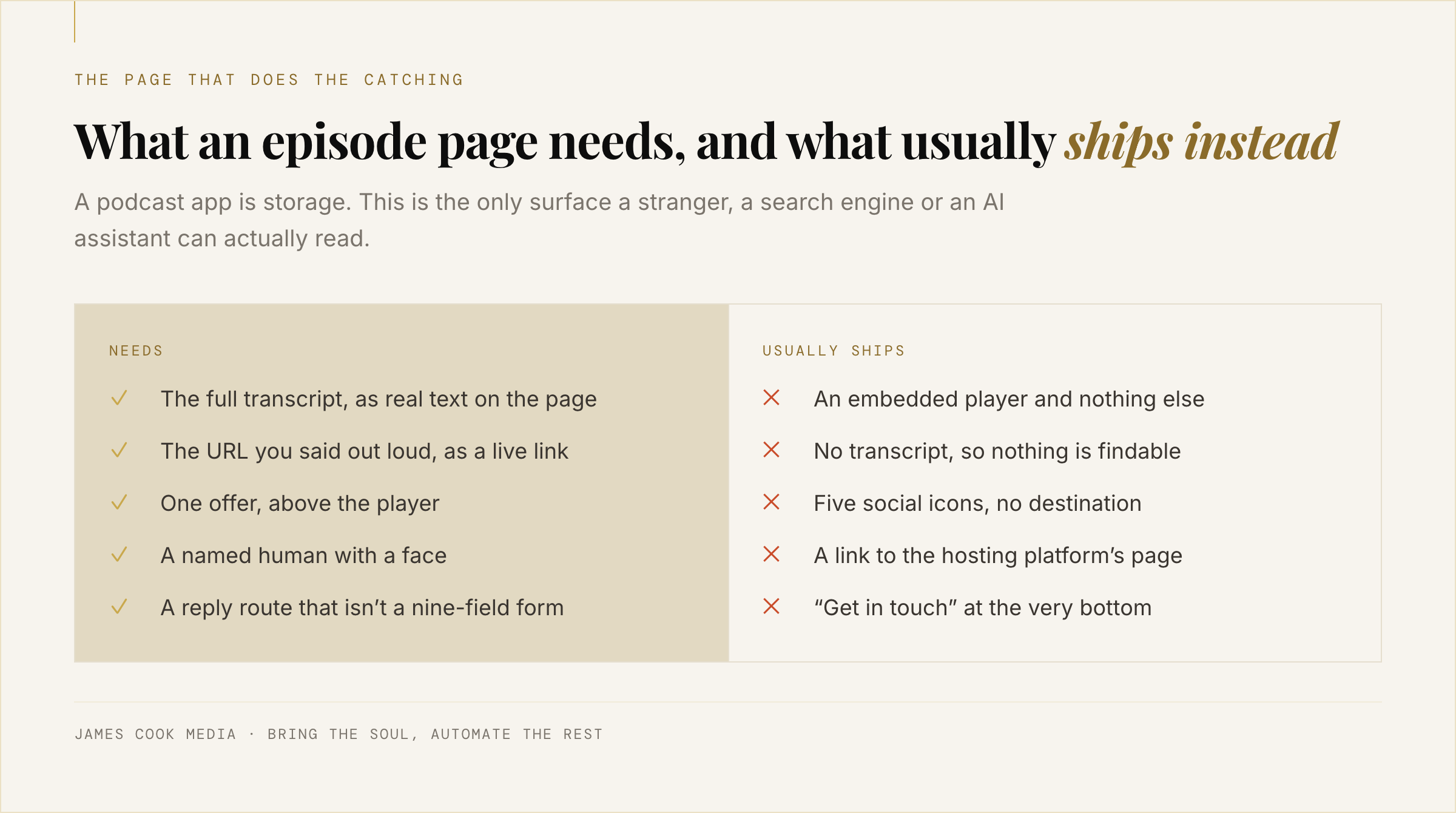
The spoken call to action creates the intent. The written one collects it. Show notes need a single primary link in the first two lines, above every social handle, labelled with what the page does. And the episode needs a page on your own site, because a podcast app is not indexable, cannot be found in search, and cannot show anyone your offer.
Two written surfaces do the catching, and most shows get both wrong.
Show notes. Almost every app truncates them after two or three lines behind a "more" tap that nobody taps. So the link goes in the first two lines, on its own, with a label that says what happens: "The four-minute walkthrough: yourname.com/start." Then everything else. Wohlberg's rule of thumb is worth keeping: one or two clicks from curiosity to satisfaction, and the link goes above your socials, not below them. Put the same link in the show description at channel level too, since that one is constant across every app and every episode.
An episode page on your own site. This is the piece almost nobody builds, and it is the one that compounds. Spotify and Apple are storage. They do not appear in search results for your client's question, they cannot host a form, and they cannot show a stranger who you are. A page per episode with the transcript, the one link and a way to contact you turns each recording into something findable, quotable and citable by AI answer engines as well as people. The mechanics of that whole pipeline, transcript to page to email, are the subject of the podcast marketing machine. That article is the full system once the show exists. This one is how to start it so the system has something to work with.
Start smaller than feels respectable
A precisely targeted show with a small audience out-earns a large vague one, because a consulting client is a high-value conversion and trust is built by depth rather than reach. Making a show for a narrow, specific person is not a compromise you accept while you grow. It is the mechanism.
The most useful thing I can tell you is that the show you are embarrassed by is probably the right size. Twelve episodes answering the exact questions one type of person asks, with two hundred people listening, is a functioning client channel. A general business show with ten thousand listeners often is not, because nobody in that audience feels the episode was made for them.
This is where most advice quietly swaps readers halfway through. It starts by talking to you and ends up talking to a marketing team with a launch budget, a producer and a growth target. Matchmaker's guide for coaches and consultants is right that a general life coach will struggle where someone serving a very specific group will not, but the tactics stacked on top of that assume time you do not have.
You have a laptop and a full client week. Two episodes a month, one question each, one spoken URL, one page. That is the whole build. We have trained over 100,000 experts since 2018, and the ones who get clients from a show are almost never the ones with the best gear or the biggest launch. They are the ones whose path existed at episode three and was still there at episode thirty.
That number is an agency-scale number and it should reassure you rather than intimidate you. The mechanism underneath it works identically with three clients, a USB microphone and a spare room.
One small next step
See how the show turns into enquiries
The Podcasting MasterClass walks through the whole thing in order: choosing the one destination, writing the spoken call to action, and what happens to a recording after you stop talking. Built for one person with a laptop, not a production team.
Take the Podcasting MasterClass → About 90 minutes · Watch at your own pace · No subscriptionWhat to measure instead
Track the things that only happen when a human decided something: visits to the page you say out loud, emails collected there, replies, and calls booked. One number matters more than all of them, which is how many people arrive at a conversation already knowing your thinking. That is the whole point of the show.
You do not need analytics infrastructure for this. A single page with a single source of traffic tells you almost everything, because the only way anyone lands on yourname.com/start is that they heard you say it.
Watch four things. Visits to that page. Emails collected. Direct replies of any kind. Calls booked. If visits are near zero while downloads climb, your spoken call to action is the problem, not your content. If visits are healthy and emails are not, the page is the problem. That is a much more useful diagnosis than "I need to grow the show."
And watch one soft signal no dashboard reports: how many sales conversations start with the other person already agreeing with you. When that becomes normal, the show is working, whatever the download graph says. If and when audio quality becomes the actual bottleneck, our Podcast Studio is there, and the show should earn its way in rather than start there.