You have been about three weeks from ready for roughly two years. This piece is not a push to get on with it; it is an argument that readiness was never the thing standing in the way.
There is a folder on your laptop with a name like site-rewrite-final. The About page is half written, the framework you walk every client through still doesn't have a name you can say out loud without wincing, and you have decided, sensibly, that you'll start putting things out once it's all sorted. That was two years ago. In the meantime you have kept serving clients brilliantly and stayed completely invisible to everyone you haven't met.
I want to be careful here, because the phrase people reach for is imposter syndrome, and in expert marketing that label gets thrown around loosely. Sometimes it fits. Often what is actually happening is something else, and it is the opposite of a deficiency. You know exactly how good the work should be. A half-finished website offends you. That instinct is the reason clients trust you, and it is quietly costing you the ones who never find you.
"Not ready yet" is usually a standards problem
For a genuine expert, "not ready yet" is rarely laziness or fear of failure. It is standards. You know what good looks like in your field, so a rough website or an unpolished article reads to you as evidence of carelessness. The instinct that protects your craft also blocks your visibility, because the standard you are applying belongs to finished client work, not to a first published page.
Think about what you actually refuse to ship. Not the work itself: you deliver that to a standard most people in your field can't match. What you refuse to ship is the representation of the work. The page. The post. The thing with your name at the top and no client in the room to explain it to.
That refusal is coherent. In your paid work, half-finished is unacceptable, and you have spent years training yourself to feel that as physical discomfort. Then you open a text box to write about what you do and the same alarm goes off, on a piece of writing that has an entirely different job.
A client deliverable has to be right. A published page only has to be true. Those are different bars, and you have been holding the second one to the first one's standard for two years.
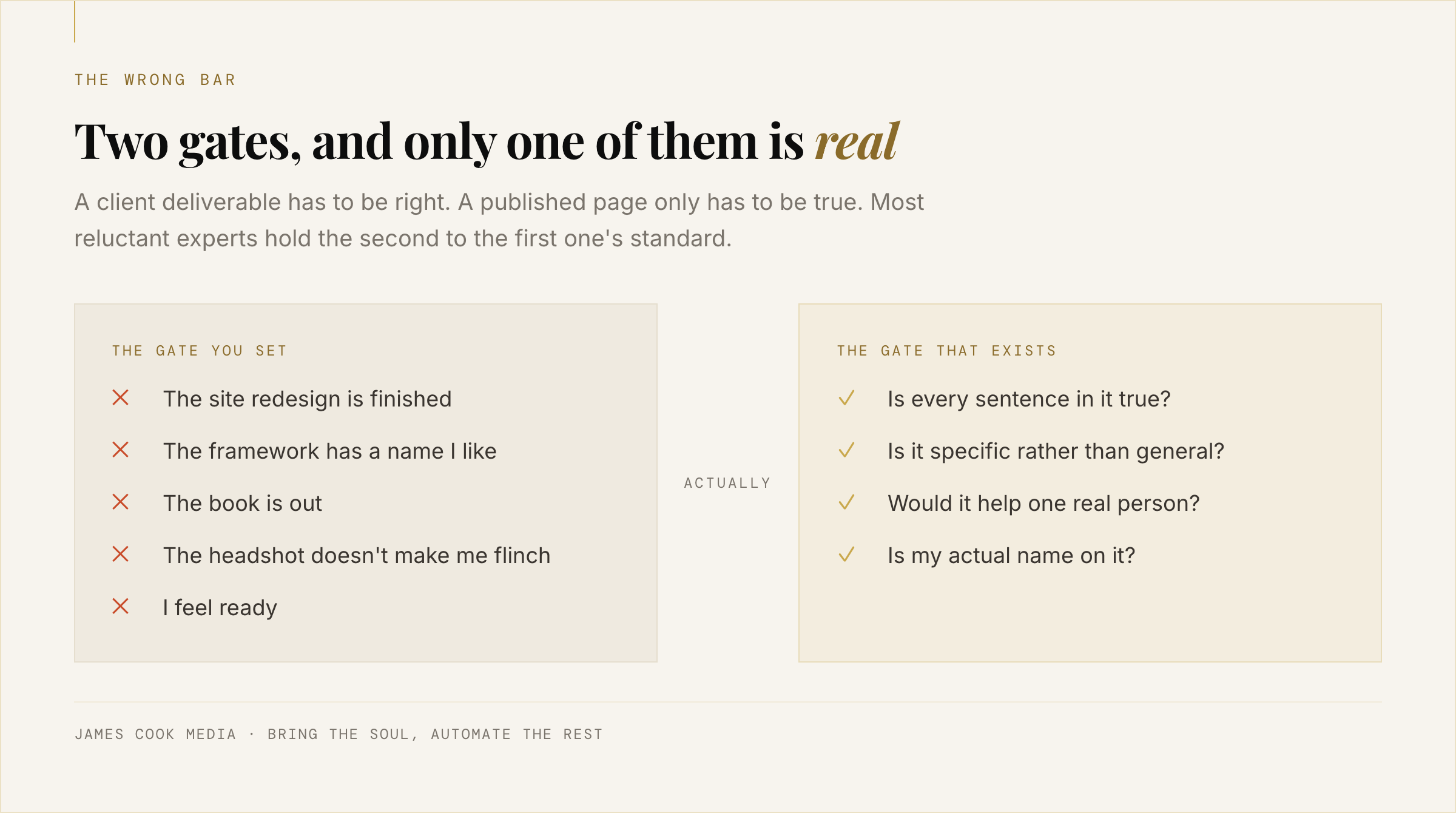
The tell is that your gates keep being about polish rather than substance. A better headshot. A named methodology. A finished book. None of those change what you know. All of them delay the moment a stranger can find out.
What imposter syndrome in expert marketing is, and what it isn't
The impostor phenomenon was named in 1978 by psychologists Pauline Rose Clance and Suzanne Imes, describing high achievers who cannot internalise their own success and fear being exposed as frauds. It is a real, studied experience, not a synonym for having high standards. Many reluctant experts have the second without the first, and the advice for each is different.
The term comes from research, not from marketing. The University of Maine's teaching guide traces it to Clance and Imes, who noticed high-achieving people describing themselves as intellectual imposters despite clear evidence of competence, and defines it as the persistent inability to believe your success was legitimately earned.
The clinical literature is also specific about how it shows up. The StatPearls review on the imposter phenomenon describes an imposter cycle with two typical responses to any achievement-related task: over-preparation, or procrastination. Perfectionism feeds it by setting standards that cannot be met, which keeps the loop running into the next task.
That is worth knowing because it explains the shape of your last two years. Over-preparing on the website and procrastinating on publishing are not two separate failures. They are the same move.
I am not going to tell you which of these you have. You know whether the feeling is "I might be found out" or "this isn't good enough yet." If it's genuinely the first, that is worth talking to someone about, and no marketing article is the right tool. If it's the second, keep reading, because the second one has a mechanical fix.
The finish line moves, because you are holding it
Readiness never arrives because you are the one who defines it, and your definition improves as you do. Every month of practice raises your sense of what good looks like, which moves the bar you are trying to clear. Waiting to feel ready is waiting for your own standards to stop improving, which is the last thing you want.
Here is the uncomfortable arithmetic. The better you get, the more clearly you see the gap between what you produce and what excellent would be. So the person most capable of publishing something genuinely useful is also the person least likely to feel entitled to.
This is why "build confidence first, then publish" doesn't work as a sequence. The confidence is downstream. It comes from having published something and watching it land, or not land, and finding out that neither outcome was fatal.
We have trained more than 100,000 experts since 2018, and this is the single most common thing standing between someone and their first published page. Not skill, not budget, not tools. The number is only there to tell you the pattern is ordinary. It is not a sign of a personal defect, and it does not require an agency to solve.
What the waiting actually costs
While you get ready, the client who needed you last Tuesday searched, found someone with a worse method and a live page, and hired them. The cost of not publishing is invisible by definition, which is exactly why it doesn't feel like a cost. Nothing breaks. You simply keep receiving only the clients your existing network can reach.
The reason this gate stays shut for years is that closing it has no consequences you can see. An unfinished website doesn't send you an angry email. There is no notification for the person who typed your exact problem into a search box, read three pages by other people, and never knew you existed.
So the ledger looks fine. You are busy, your clients are happy, referrals trickle in. And every month the same quiet thought returns: why is someone visibly worse than me getting that work?
Because they are findable and you are not. That is the entire mechanism. It has nothing to do with who is better and everything to do with who published something a stranger could read at eleven at night.
The smallest publishable thing that is still true
The smallest publishable thing is one page that answers one question you have already answered out loud for a client, in plain language, with your real name on it. It needs to be true, specific and useful to one person. It does not need a redesign, a named framework, a book, a logo or a headshot you like.
Not a website. Not a content strategy. One page.
Pick the question you have answered so many times the answer has become genuinely good. The one where you hear yourself starting the same sentence for the fortieth time. Write down what you actually say, in the order you actually say it. Publish it. Leave the rest of the site exactly as ugly as it currently is.
What makes this work is that the standard has changed from is this excellent to is this true and does it help one person. That second standard you can clear this week, and it is the only one a reader or a search engine cares about.
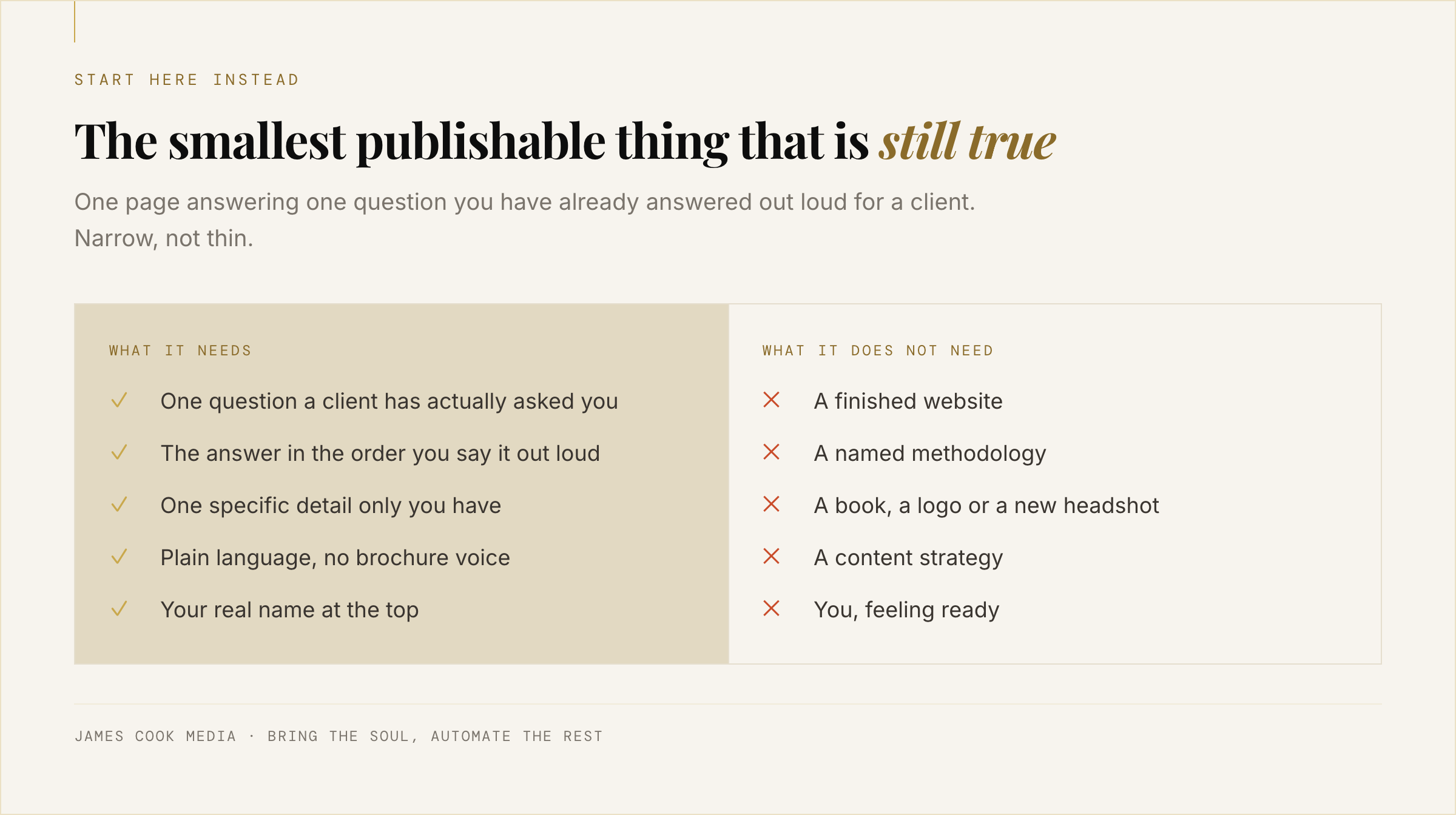
The word still in "still true" is doing real work. This is not permission to publish something thin. It is permission to publish something narrow. A single honest answer to a single real question is a better first page than a comprehensive service description that nobody searched for.
Publishing what you already say is a transcript, not a performance
The readiness objection assumes publishing means producing something new. It doesn't. What you already say to clients on calls is finished, tested material, and turning it into a page is transcription and tidying rather than creation. There is no new readiness to acquire, because the work was completed the fortieth time you explained it.
This is the part that dissolves the objection rather than arguing with it.
You are not short of expertise and you are not short of ideas. You are short of your ideas in written form. That is a mechanical problem, and mechanical problems have mechanical solutions.
Say the answer into your phone for four minutes, the way you'd say it to a client. Don't perform, don't script it, let yourself stumble. Then have it transcribed and shaped into a page. The judgement, the story and the taste are yours and stay yours. Everything after that is arrangement, and arrangement is exactly what should be automated. That is what we mean by bringing the soul and automating the rest, and turning what you already say into content walks through the least self-conscious way to start recording.
Notice what this removes. There is no moment where you have to feel ready, because you are not producing anything new. You are moving something that already exists from spoken to written. The readiness question doesn't get answered; it stops applying.
One small next step
Learn the method before you rebuild anything
The MasterClass walks through how we turn what an expert already says into something a stranger can find, in the order we actually do it. Nothing to finish first, nothing to install.
See the MasterClass → About 90 minutes · Watch at your own pace · No subscriptionHow this differs from the other reasons you haven't started
Reluctant experts usually give one of four reasons for staying invisible: they hate self-promotion, they think they are too small, they think they are too late, or they are not ready yet. Only the last one is about the work's quality rather than the person's position, which is why it responds to a change of standard rather than a change of mind.
These objections travel together and get treated as one thing, which is why the usual advice bounces off. They need different answers.
If the real block is that self-promotion feels like a betrayal of how you'd rather operate, that is a values question, not a readiness question. The reluctant experts we work with tend to arrive at some version of the same line: "I'd rather not sell than sell myself." We wrote about that specific resistance in marketing for people who hate self-promotion. It stays unresolved by anything in this article, because you could feel entirely ready and still refuse.
If the block is that you have four clients and no audience, that is a position question, and the answer is that a handful of real cases is more usable proof than a large following. Building authority with a handful of clients takes that one on.
Readiness is the one that hides best, because it sounds like professionalism. The other three feel like admissions. "I'm not ready yet" feels like a standard. That's what makes it the most expensive of the four.