You have four clients, maybe six, and you are good with every one of them. Online, that number feels like a disqualification, so you say nothing.
You have read the advice about establishing yourself as an authority and quietly counted yourself out. The people giving it seem to have hundreds of clients and thousands of followers. You have a handful of people who trust you, a laptop, and a website nobody visits. Somewhere along the way you decided authority was something you accumulate, and that you had not accumulated enough to be allowed to speak.
That decision is the actual problem. Not the client count.
Authority online is not a volume metric. It is a specificity metric and a verifiability metric. Three clients you can describe in precise, checkable detail will out-signal fifty anonymous logos, to a human reader and to a search engine both. This piece is about how to build authority with few clients using what is already in your files and your head.
Authority online is not a volume metric
Online authority is not a count of clients or followers. It is the degree to which a stranger can tell what you do, for whom, and whether it worked, and then check that answer independently. A practice with four named, specific, verifiable client outcomes reads as more authoritative than one with fifty unnamed logos and no detail.
Think about how you judge someone else. A consultant's site shows twenty grey client logos. You cannot tell what he did for any of them, whether the engagement lasted three weeks or three years, or whether the result was worth the fee. The logos exist to overwhelm you into assuming competence.
Now a second site. One page, one client, named. The situation she was in. What she had already tried that failed. What the consultant changed, in what order. What moved, by how much, over what period.
The second one is more convincing, and it took one client to build. Volume was never the signal. Detail was.
Google says the same thing in its own language. Its guidance on creating helpful content asks whether content demonstrates "first-hand expertise and a depth of knowledge" and whether it is clear who created it, and it names trust as the most important of the four E-E-A-T factors. Nowhere in that document is there a threshold number of clients.
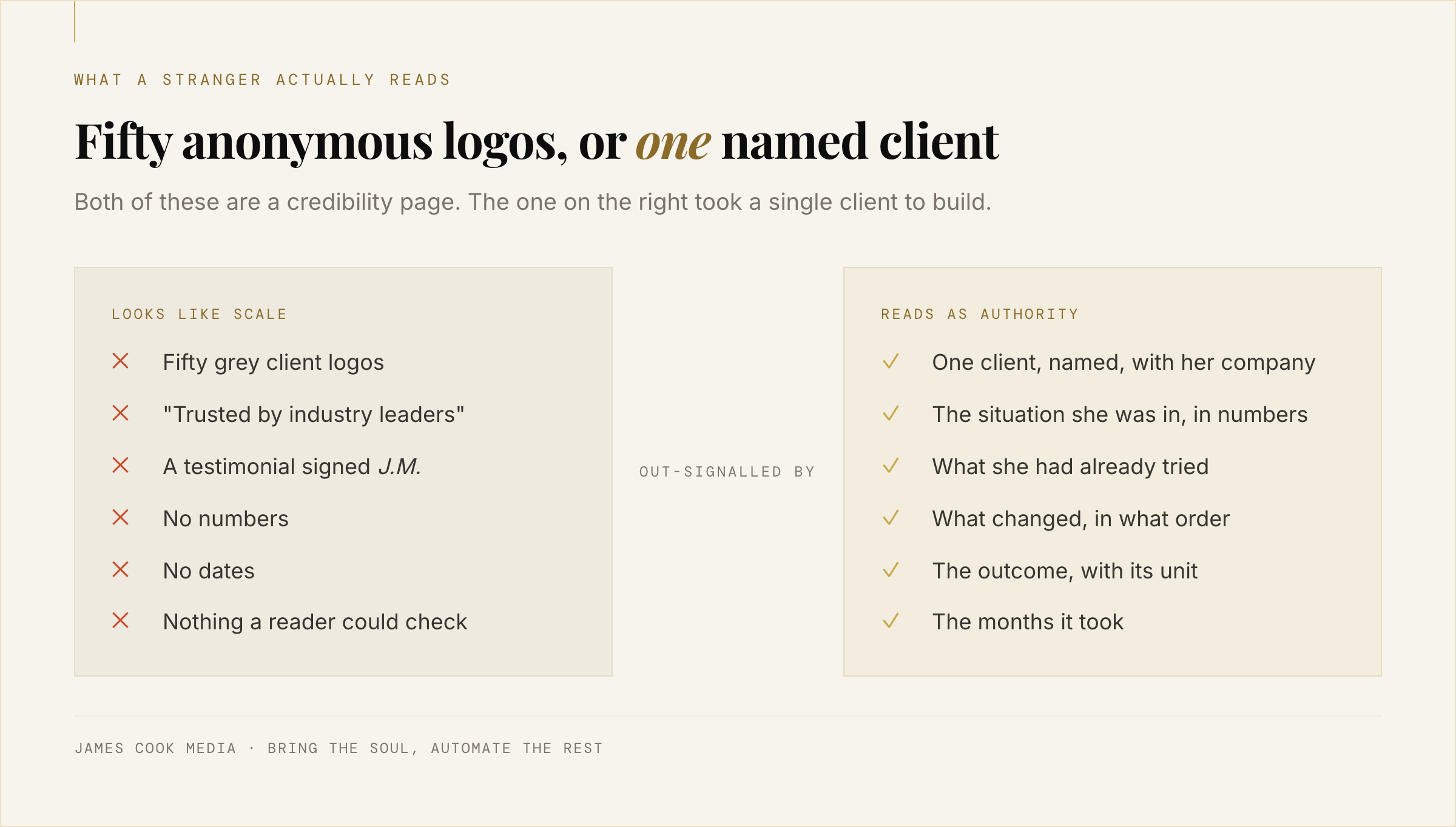
The left panel is what most small practices build because it looks like scale. The right panel is what a stranger actually reads.
What it takes to build authority with few clients
Two things, neither of which requires more clients. Specificity: naming the exact situation, the exact change, and the exact outcome instead of speaking in categories. Verifiability: making every claim something a stranger could check, through a named person, a date, a published artefact, or a credential that exists outside your own website.
Most guides on this subject hand you a content schedule. Post three times a week, build a topic cluster, run a ninety-day sprint. The Search Engine Land piece on building authority when nobody knows you is one of the better ones, and it still assumes you have the hours for a ninety-day content programme alongside your actual work. You do not. You are busy serving the handful of clients you have, which is precisely why you have a handful.
So set the schedule aside and work the two levers that cost you almost nothing.
Specificity is a writing decision. "I help businesses improve their operations" is a category. "I take a twelve-person manufacturing firm's month-end close from nine days to three, usually in one quarter" is a claim. Same experience, same person, same effort. The second is authority and the first is noise, and the only difference is that you decided to be exact.
Verifiability is a permissions decision. Asking one client whether you may use her name. Putting a date on the engagement. Linking to the paper you published, the talk you gave, the licence you hold. Consulting Success makes the practical version of the point in its guide to consulting testimonials: ask permission to name, and if the client prefers anonymity, describe the firm precisely instead. That guide names no target number. There isn't one.
The number you are ashamed of is not the number anyone is reading.
One client story, told properly, out-signals fifty logos
A single properly told client story does the work of an entire credibility page. It needs six things: who they were before, what they had already tried, what specifically changed, what moved and by how much, over what period, and a named person willing to confirm it. Most small practices already have most of that material.
This is the highest-leverage thing you can do this month, and it uses exactly one client.
Pick the engagement you are proudest of. Not the biggest. The one where you know precisely what you did and why it worked, because that is the one you can write without hedging. Write it with the client as the protagonist, not you. A reader who sees himself in the client's before-state will follow the whole thing; a reader watching you perform will not, which is the argument of why the customer is the hero of your marketing, not you.
Six elements make it carry weight:
| Element | What it looks like when it's vague | What it looks like when it works |
|---|---|---|
| Before | "Struggling with growth" | "Two enquiries a month, both from the same referrer" |
| Already tried | Omitted | "Two years of a paid ads agency, then a course" |
| What changed | "We implemented a strategy" | "Rebuilt the intake call, then the follow-up sequence" |
| The result | "Great results" | The actual number, with its unit |
| Over what period | Omitted | "Between March and September" |
| Who says so | "A client" | A named person and their company |
The last row is the one people skip and the one that does the most. On our own site the testimonials carry names and companies: German Coppola of YUMIWI, Hugo Feenstra of Vincent Mock, Michele Wyngaard of Dynamic Dental. Not because six is an impressive quantity. Because a name is checkable and a set of initials is not.
If your client will not be named, describe the firm precisely without identifying it, date it, and say in one line that the client asked not to be named. Stated plainly, that reads as discretion. It is unexplained anonymity that reads as invention.
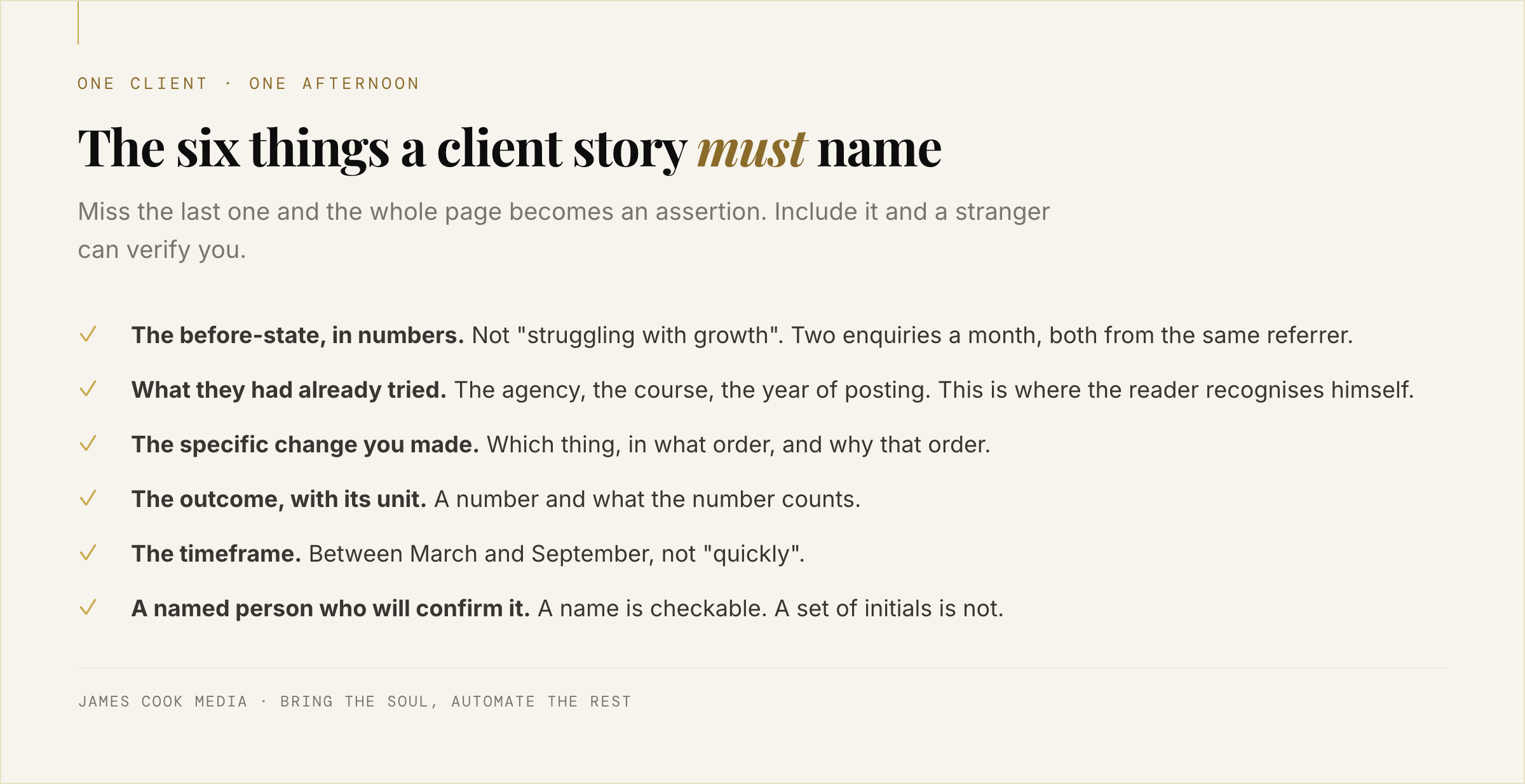
You are not writing a case study for a procurement committee. You are answering the questions one skeptical stranger has.
The questions you answer over and over are already a body of work
Every expert repeats himself. The four or five questions you answer in nearly every first conversation are the highest-value content you own, because they are proof of pattern recognition across your whole career, not just your current client list. Written down once, they demonstrate experience that a client count cannot express.
Here is the part most guides skip. Your client count measures how many people have paid you recently, not how much you know. Twenty years of practice, a previous career, the fifty conversations that never converted but taught you something: all of it sits outside the count, and none of it is visible.
The questions are where it becomes visible. Open your sent mail and find the explanation you have written eleven times. The thing you always warn people about. The mistake you spot in the first ten minutes of a call.
Write those down, one page each, in the words you actually use. Such a page does three things at once. It ranks, because it matches what people type into a search box. It gets cited by AI assistants, because it answers a question cleanly and in full. And it does the same work in a sales conversation, so the writing is never overhead.
Note what that required: no new clients, no follower count, no posting cadence. Only the willingness to write down what you already say for free.
Bring the offline credentials online
Most solo experts hold credibility that exists only offline: a licence, a degree, a former career, a published paper, a talk, a board seat, years in a named industry. None of it is visible to a search engine or an AI assistant until it is written on a page with names and dates attached. Moving it online is transcription, not self-promotion.
I am a West Point graduate and a former U.S. Cavalry officer, and I spent years as a historian before any of this. That is not marketing copy. It is a set of facts that explains why I think about narrative the way I do, and it took nothing but writing them down.
You have your own version. The qualification you never mention because everyone in your field has it, which is exactly why people outside it need telling. The industry you worked in for twelve years before consulting to it. The talk, the professional body, the book chapter, the certification that took two years.
Put it on a proper about page, in plain sentences, with institutions named and years given, and link out to whatever exists elsewhere. That external existence is what makes a credential verifiable rather than merely asserted. Mine is on my own page and it is deliberately dull: what I did, where, when.
If this feels like bragging, it isn't, though the discomfort is worth naming. Rory, one of the reluctant experts whose story sits at the centre of how we think about this work, put the resistance about as bluntly as it can be put: "I'd rather not make sales than prostitute myself." Writing "MBA, Warwick, 2009" on a page is not what he was talking about. If that resistance is what is actually stopping you, we wrote a whole piece on it: marketing for people who hate self-promotion.
What to do with three clients, starting this month
Four moves, in order: ask your best client for permission to be named and for one specific number, write that one engagement up in full, write the three questions you answer most often as three pages, and rewrite your about page with institutions and dates. That is a body of work a stranger can verify, built from a practice of three clients.
None of this is a ninety-day sprint. It is roughly four sittings, and it produces something permanent rather than something that scrolls away.
- Ask one client for two things. Permission to use her name, and one number she is willing to stand behind. Ask soon after the result, not a year later.
- Write that engagement up in full, using the six elements above. One page. The client is the hero.
- Write your three most repeated answers as three pages, in the language you use on a call.
- Rewrite your about page so every credential has an institution and a year, with links out wherever the thing exists elsewhere.
Then stop and let it sit. Four pages of specific, verifiable, first-hand material will do more for you than four months of posting into a feed. Volume is what people reach for when they have nothing exact to say. You have exact things to say, which is the whole advantage of being small.
If the number that worries you is your age rather than your client count, that is a different piece: it's not too small and it's not too late is about starting in your forties and fifties. This one is only about smallness.
One small next step
Bring us the handful of clients you already have
An AI System Design Sprint is a conversation, not a pitch. Tell us what you're stuck on. We'll look at what you already have (the clients, the credentials, the questions you keep answering) and what it would take to make it findable.
Book an AI System Design Sprint → One conversation · Bring what you have · No preparation neededThe honest limits of being small
Specificity and verifiability solve the credibility problem, not the reach problem. Four excellent pages will convince the people who find them, but they will not by themselves make many people find you. That takes time and some distribution, and it is a separate job from being credible.
It would be dishonest to end without this. A handful of clients is not a disadvantage for credibility, but it is a real one for volume of proof: when someone finds you, you get one shot at convincing them rather than the several a bigger firm gets. You cannot afford a vague page.
The other honest limit is patience. There is no version of this where four pages published on a Tuesday produce enquiries on the Thursday.
What is true is that the mechanism does not scale down badly. James Cook Media has generated more than $10M for clients since 2013 and trained over 100,000 experts. The reason to mention it here is narrow: what produced that was never budget or headcount, it was a specific story told to a specific person and made findable. Which works identically with three clients and a laptop. Smaller, not different.