You are good at the work and allergic to almost everything you have been shown about selling it. This is the method that treats that refusal as good judgement and builds around it.
Somebody has told you that to get clients online you need to look into a camera and explain why you are the best at what you do. You would rather not sell at all than do that.
I have been hearing that sentence for over a decade, and the first time it came from a man sitting in front of a camera I had paid for.
So this piece on marketing for people who hate self-promotion starts from an unusual position for a marketer. I think your refusal is correct. Not brave, not principled-but-impractical. Correct. The tactics you are refusing would make you look like something you are not, and they were never the mechanism anyway.
Your refusal is not a flaw to be coached out of
The reluctance most experts feel about self-promotion is not shyness or a confidence gap. It is a judgement about integrity: the tactics on offer would misrepresent the way you actually work, and you can feel it. That judgement is usually right. What is missing is not courage. It is a method that produces proof without asking you to make claims about yourself.
In 2013 my first client was Bobby McGee, a six-time Olympic running coach. That is where James Cook Media started: one expert, a percentage of his revenue, and no idea what I was doing.
I did what the industry had taught me. I wrote sales videos for him and said, "Bobby, I want you to look in the camera and say this."
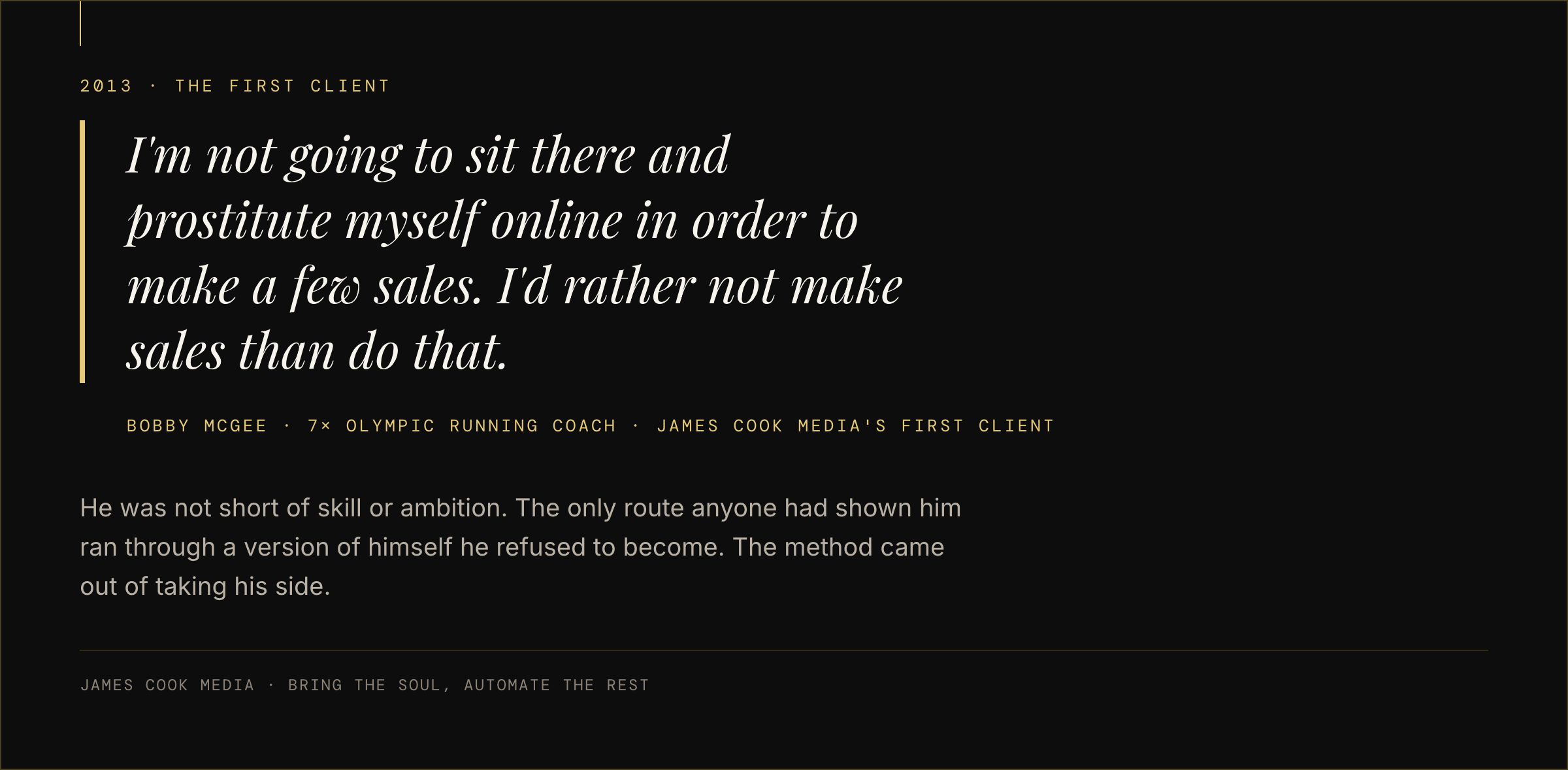
He said: "No. I'm not going to do that. I'm not going to sit there and prostitute myself online in order to make a few sales. I'd rather not make sales than do that."
He called it sacrificing his reputation. His authenticity. And his real question, the one I could not answer that day, was this: how do you get on camera without feeling dirty when you walk off the shoot?
Sit with how much conviction that takes. Bobby was not failing for lack of skill. He was failing because the only route anyone had shown him ran through a version of himself he refused to become.
Marketing for people who hate self-promotion starts by agreeing with you
Most advice for reluctant experts is mindset advice. It asks you to feel differently about the same uncomfortable act: post more, share behind-the-scenes, reframe promotion as service. A better approach changes the act itself. You stop making claims about yourself and start producing evidence of how you work, which is a different job with different tools.
The standard guidance is not stupid. Forbes contributor Chelsea Tobin suggests curating other people's ideas and letting client stories carry the credibility. Post Road Marketing makes the sharper point that the real question is not how do I get noticed but what does this person need to understand.
Both are true, and both leave you holding the hard part. Every one of those articles ends with a content calendar, and the calendar still requires you being interesting on purpose, forever. For a one-person business with a full client week, that is where it dies.
The reframe that moves a reluctant expert is more mechanical than a mindset shift. A story is a person, who wants something, and what stands in the way. The twist most experts never make is that the person in that sentence is not you. Your marketing becomes a story the moment its hero is the person reading it, which is why we wrote a whole piece on why the customer is the hero and not you.
Once the hero is your client, self-promotion has nowhere to happen. You are the one who knows the way through.
The one question that gets a reluctant expert talking
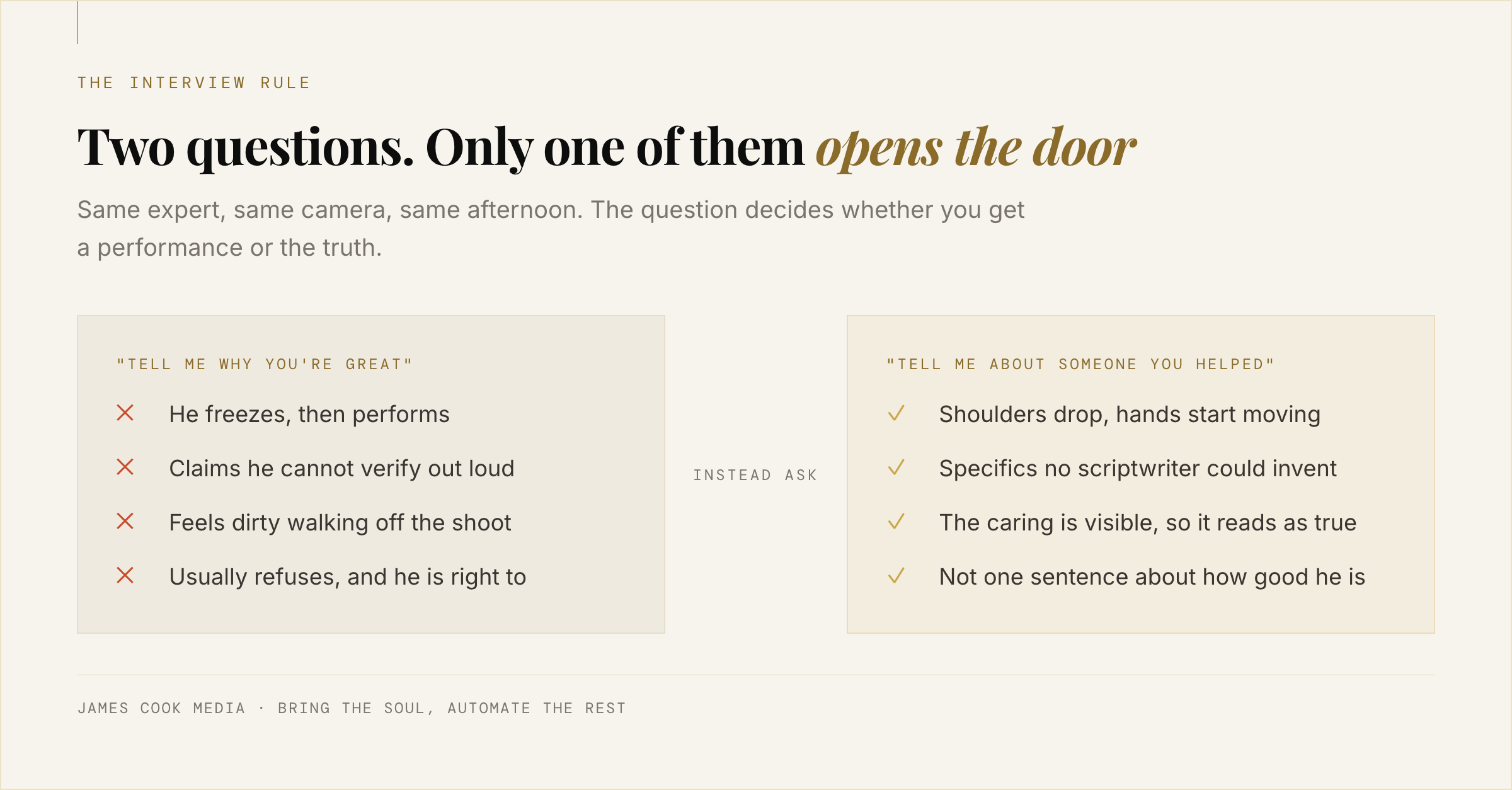
Never ask an expert to talk about themselves. Ask them to talk about the people they have helped. The first question makes a modest person freeze and perform. The second makes them forget the camera entirely. Every reluctant expert has a door that opens, and it is always the same door: their people, their work, one specific case.
After Bobby refused, I tried to go around him. Cartoons. Whiteboard explainers. Ways of showing what he did without putting him in frame. None of it worked, because the power was in Bobby, in how he was in a room with an athlete. The problem was never Bobby. The problem was the script.
Two rules fixed it, and they cost me a great deal to learn, so take them for free.
The first: ask about their people. Ask Bobby "tell me why you're a great coach" and he freezes, because that is the thing he refused to do. Ask Bobby "tell me about an athlete you worked with last month" and he disappears into it. Shoulders drop, hands start moving, and twenty minutes later you have material no scriptwriter could have produced.
The second: roll long, and use the middle. The first ten minutes of any recording is a person performing who they think they should be. Then they forget the camera, and the forgetting is visible. Amateurs record ten minutes and get the performance. We recorded two hours and got the truth.
Notice what neither rule asks of you. Not confidence. Not a persona. Not one sentence about how good you are.
What Bobby's film actually proved
An unscripted film about how a coach cared for his athletes outsold every scripted sales asset written for him. The lesson was not that documentary production is required. It was that the moment which convinces a stranger is never a credential. It is one piece of visible evidence that you will treat them as the only person in the room.
I hired a filmmaker, after hearing him say at a conference in Australia that the best way to make a sales video is to not script it. We filmed the four clients I had at the time.
The best thing to come out of it was Bobby's film, and I give you the numbers as history, because they come from a different internet with different ad costs. That unscripted film generated $250,000 in sales in six months, for a running course, off an email list of about four thousand people.
Read the ingredients again. One expert who refused to sell himself. One honest recording. Four thousand email addresses. Not an audience, not a budget, not a team. Our agency numbers since then are larger, and they are context, not an entry fee.
The objection I get after every talk is "that's easy for Bobby, Bobby coached at the Olympics, I'm not Bobby." But his credentials are not what made that film work. The moment it turned was Bobby saying: "Every time an athlete is in front of me, it's the only person on the planet at that period of time."
That is not a credential. It is a way of caring, caught on camera. I have since watched the same kind of moment work for a first-year coach with three clients and for an author whose book was not finished. What your future client is scanning for is not is this the most decorated expert alive. It is will this person see me.

Rory, and the machine built around the man
A marketing system can be tuned to a quiet person's temperament rather than the reverse. Gentle reminders, an application instead of a buy button, story videos instead of sales videos: the sequence still does the work of selling, while every visible piece of it stays recognisably the expert. An aggressive machine wrapped around a gentle human reads as fake.
The other story at the centre of how we work belongs to Rory, an Englishman who spent forty-four years not doing the thing he actually cared about. He came up to me after a talk in London, and his objection was the modest one: "I don't want to make it about me." He hated the look-at-my-beach-house style of internet marketing, which he reasonably took to be what everyone meant by storytelling.
What he said to me later is the sentence I think about most in this whole line of work: "Thank you for giving me permission to make this happen. To put myself out there. Because that's what would have always stopped me."
The system we built around Rory obeyed his personality at every stage. The first page a stranger landed on told them nothing about Rory. It asked which of four people they were, and what their biggest problem was, in their own words.
Then came story videos rather than sales videos, released one at a time, with a soft reminder cadence, because Rory liked to be invitational and the machine was tuned to him rather than the reverse. At the end there was no buy button, only an application and a link into his diary.
He took his own calls, because he wanted to understand the people he was helping. By then they had watched hours of him thinking out loud, so the call was not a pitch. It was logistics. How much, when, is there a payment plan.
One small next step
See the method that was built around a man who refused to sell
The MasterClass walks through the same approach we used with Bobby and Rory: how to find the story, why the hero is your client rather than you, and what to actually record. Watch it before you change a single thing on your website.
See the MasterClass → About 90 minutes · Watch at your own pace · No subscriptionWhich sentence is yours
In practice, three sentences stop good experts from being found: I don't want to make it about me, I'm not ready yet, and what if I put myself out there and nothing happens. They need different answers. The first needs a method where the client is the hero. The second needs permission. The third needs a system, because courage is unreliable.
It helps to know which one is yours, because people spend years working on the wrong problem.
If it is the first, this whole method is built on it not being about you. If it is the second, readiness was never the missing ingredient. One more certification, one more revision of the website, one more year of getting the book right, and nobody was going to hand you the permission.
The third is the one nobody says out loud. Not criticism, you could handle criticism. The silence. Rory's fear did not end when he got over himself. It ended when a sequence was running with real people walking through it, which made the silence unlikely rather than merely survivable.
What this looks like for you, this month
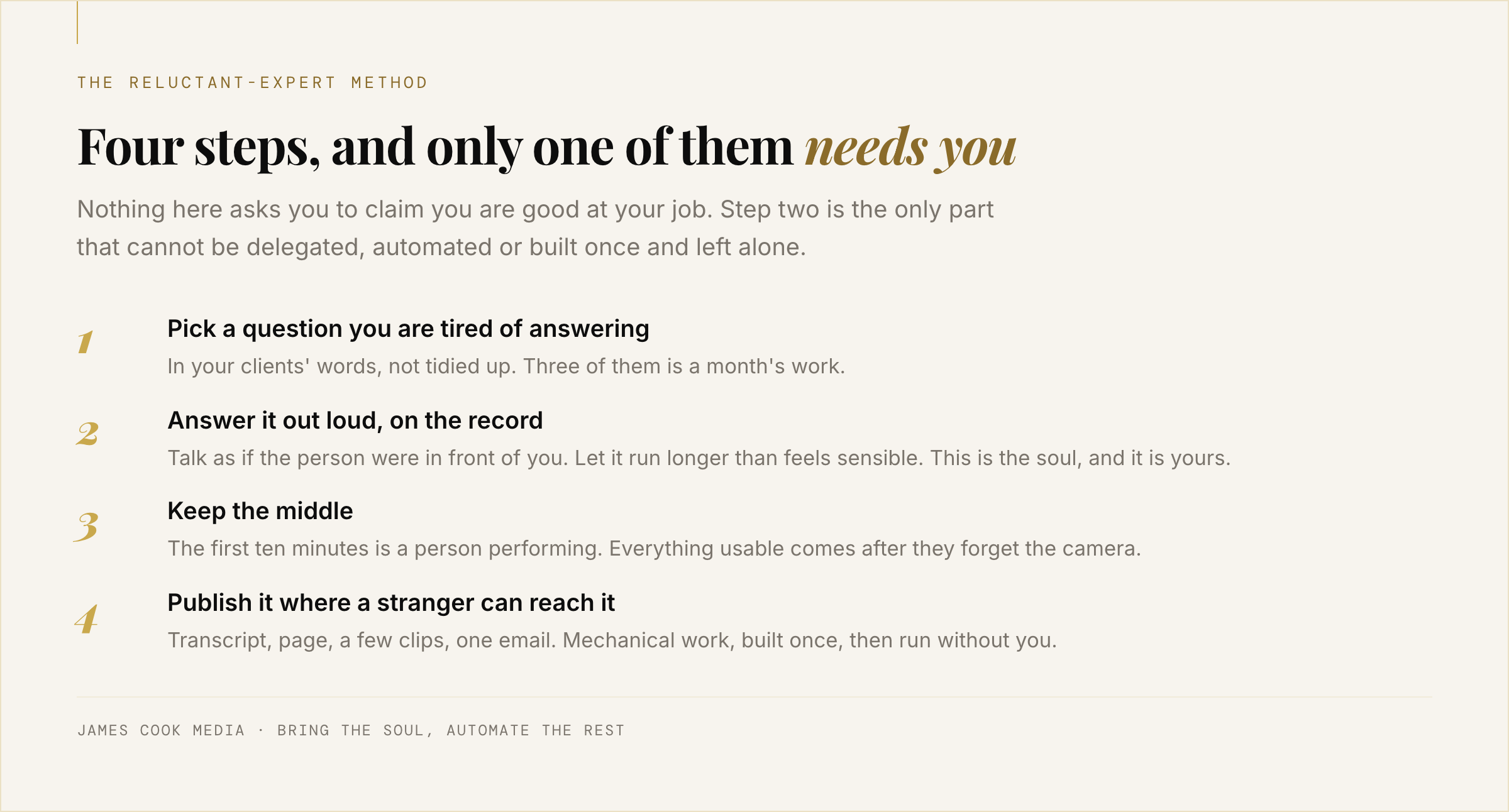
Start by recording answers you already give. Pick three questions clients ask you repeatedly, talk through each one for as long as the answer takes, keep the middle, and publish it somewhere a stranger can find it. That is the whole first pass. No claims about yourself, no persona, no content calendar you will abandon in five weeks.
None of this needs a film crew. The documentary was 2013 and a serious invoice. Today the recording is the only part that needs you.
Write down the three questions you are most tired of answering, in your clients' words rather than tidied up. Talk each one through as if the person were in front of you, and let it run longer than feels sensible.
What comes next is transcription, a page, a few clips, an email. That is machinery, and machinery should be built once and then run without you. The practical version of catching what you already say every week is the subject of turning your best call answers into something findable. This article is why you are allowed to; that one is the mechanics.
Bring the soul. The soul is the twenty minutes where you forget the camera and talk about someone you helped. The rest can be built once and left alone.