
You did the thing everyone told you to do. You gave away your best thinking for free, and the internet did not notice. Value is no longer scarce, and trust was never made of value in the first place.
You posted something genuinely useful last week. Not a hook, not a hustle post: an actual piece of what you know, the kind of thing a client pays you for, written out carefully and given away. It got four likes, two of them from people you already know, and nobody wrote to you.
So you did what most experts do. You assumed the value wasn't good enough, and you wrote something more useful. Then you did it again. That is a reasonable response and it is the wrong one, because the problem was never the quality of what you gave. The advice you followed was not wrong. It was incomplete. It told you what to put in the post and said nothing about the only thing that makes a stranger trust the person behind it.
Why your value posts get crickets
Value posts fail because value answers "does this person know things?" and a stranger deciding whether to hire you is asking a different question: "has this person been where I am, and what did it cost them?" Useful information proves competence. Competence is now assumed, cheap and everywhere. Trust is built by evidence of lived experience, not by the usefulness of a tip.
Watch what actually happens in a reader's head. He reads your framework, thinks "that's a good framework", feels slightly better informed, and scrolls. Nothing in that sequence creates an obligation, a memory, or a reason to come back tomorrow. You gave him a fish and he ate it.
Nothing in it told him who you are. He does not know what you got wrong, who you sat across from at the worst moment of their business, or why you believe the thing you just told him. He has your conclusion without your evidence.
So your post competes on a single axis: usefulness. On that axis you are up against every consultant in your field, every content team with a budget, and a machine that can produce a competent framework about anything in nine seconds. That is not a fight you win by being more useful.
Value became abundant, and abundance is not a signal
A signal only works when it is costly to fake. Free expert-level information used to be rare, so giving it away signalled generosity and depth. It is now effectively free to produce at scale, which means giving it away signals nothing about the giver. The market did not stop wanting value. It stopped reading value as proof of anything.
Here is the scale of what changed. An analysis by the SEO firm Graphite, using detectors on articles pulled from CommonCrawl, found that by November 2024 the quantity of AI-generated articles published on the web had passed the quantity of human-written ones. Roughly half of new written content is machine-made, and it has stayed near that level.
Read that as an economist rather than a doomsayer. When supply goes vertical, price goes to zero. Your carefully written tip and a generated listicle now sit in the same feed, in the same format, at the same price. The reader cannot tell them apart at a glance, so he stops using the format as evidence and starts looking for something else.
The same study contains the half almost nobody quotes: the researchers found those AI articles "largely do not appear in Google and ChatGPT." Volume is being produced and ignored at once. The web has more value on it than ever and less trust in it than ever.
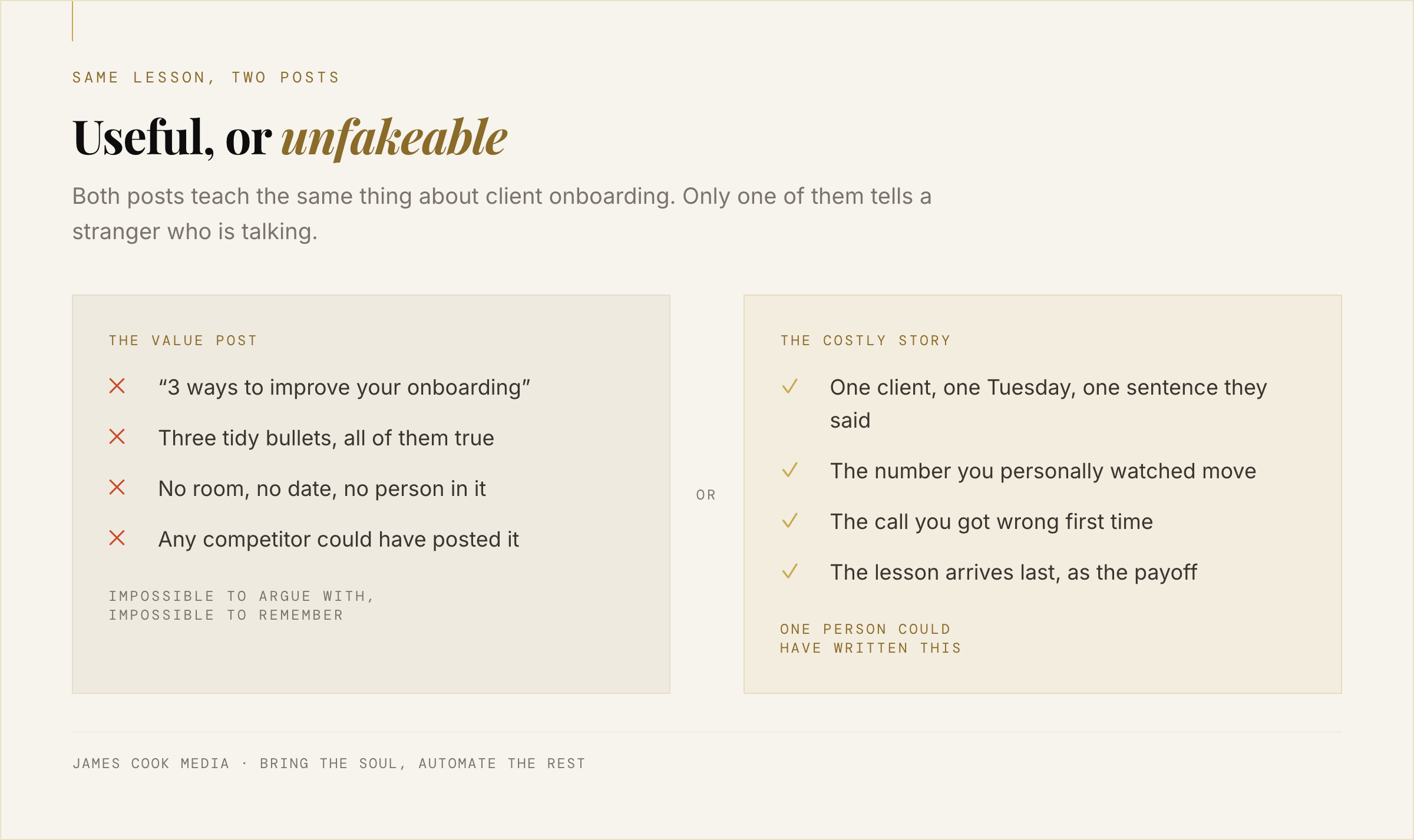
Trust followed the same curve downward. The 2025 Edelman Trust Barometer, reported by the Australian Institute of Company Directors, found that 68% of people surveyed distrust business leaders and 68% believe business leaders deliberately mislead them. Your reader arrives at your post already braced for a pitch. Usefulness does not disarm that. Specificity does.
Trust comes from what the story cost you
Trust is built by unfakeable detail: a specific room, a specific date, a client who said a specific sentence, a decision that cost you money or reputation, and what you would do differently. A language model can generate advice about anything. It cannot generate the eleven years you spent watching one problem go wrong in one particular way.
This is the mechanism, and it is worth stating plainly because most advice about how to build trust online as an expert skips straight past it to a checklist of surface signals: badges, reviews, media logos, a consistent colour palette. Those are decorations on trust. They are not where it comes from.
Trust comes from cost. The reader believes you because you told him something that would have been easier not to say. The client you lost. The three years on the wrong positioning. The moment you realised the problem the client described was not the problem the client had. Nobody invents those, because inventing them serves no purpose and getting caught destroys you.
I have watched this play out with hundreds of experts, and the pattern is boringly consistent. The post that finally works is almost never their most useful post. It is the one where they said the uncomfortable true thing, and half of them nearly deleted it before publishing.
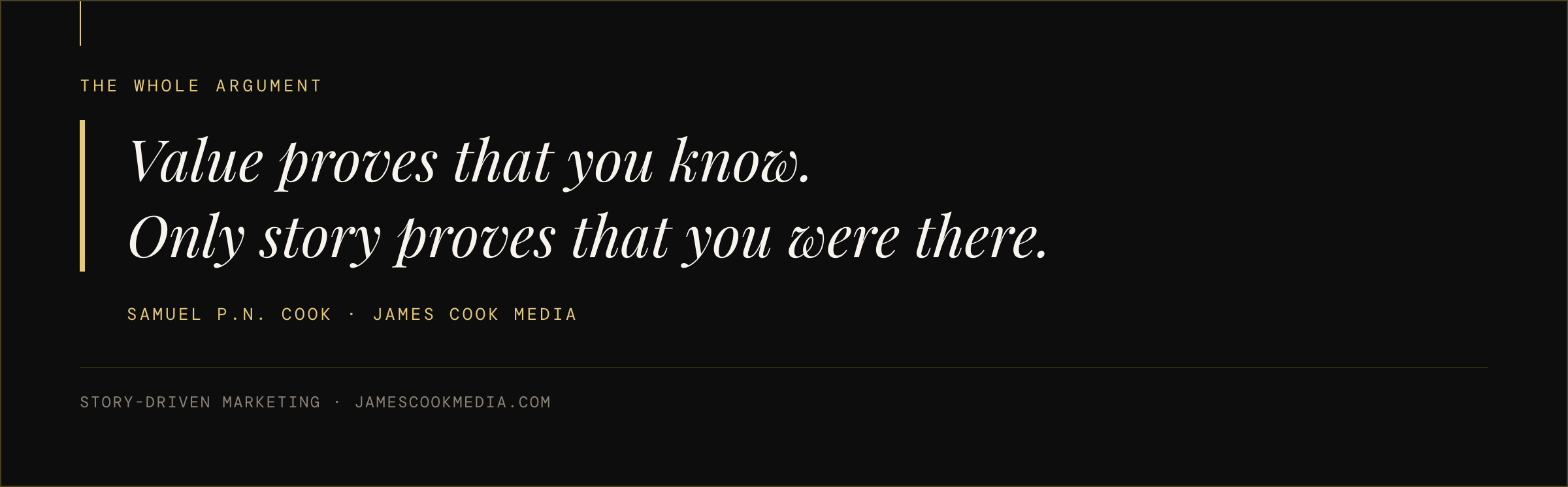
That is also why the sameness problem and the trust problem are the same problem wearing different clothes. I wrote separately about why everything online started sounding identical and why AI detectors cannot fix it; this piece is the other side of that coin. Not how do I avoid sounding synthetic, but what actually earns belief once sounding good is free.
What actually builds trust online as an expert
Four things, in order: a specific situation the reader recognises as his own, a first-hand account of you in that situation, the cost you paid and what you learned, and a claim you would defend in a room. Add proof a stranger can verify: a real name, a real number, a real outcome. Useful information comes last, as the payoff, not the pitch.
The order matters more than the ingredients. Most experts lead with the framework and bolt a personal anecdote on the front as a warm-up. Reverse it. The story is the argument. The framework is what the story proves.
Search engines are pushing in the same direction, which is convenient. Google's own guidance on helpful content asks whether your page demonstrates "first-hand expertise and a depth of knowledge" and whether it provides "original information, reporting, research, or analysis" rather than rewriting what already exists. That is not an SEO trick. It is the same question your reader is asking, written by an engineer.
Notice what this asks of you, and what it does not. It does not ask you to become louder, to post daily, or to develop a personality you don't have. It asks you to put yourself back into work you were already doing. That is a smaller job than the one you have been avoiding. And here is the part that makes it bearable. The story is the only bit that has to be yours. Structure, formatting, the seven platform variants, the meta description, all of it is machinery, and machinery can be handed off.
One small next step
See how the story gets found, not just told
The AI MasterClass walks through the method we use with clients: how to pull the story only you have out of your own head, then let the machinery turn it into everything else. Includes the prompts.
Take the AI MasterClass → About 90 minutes · Watch at your own pace · No subscriptionHow to tell a costly story without self-promoting
Make the client the hero and yourself the guide. A trust-building story is not about how good you are; it is about a person who was stuck, what changed, and the judgement call that changed it. You appear as the one who was in the room. That structure lets a reluctant expert be specific about his experience without ever making a claim about himself.
The objection is always the same, and it is honest. "I'd rather not make sales than prostitute myself." Every reluctant expert we have worked with has said some version of that sentence, and the Bobby McGee and Rory stories are the ones we keep coming back to precisely because both men meant it.
The way out is structural, not motivational. You do not need more confidence. You need a shape where being specific is not the same as boasting. That shape is very old: someone wanted something, something stood in the way, a choice was made, something was learned. You are in the story as a witness and a guide, not the subject. The customer is the hero, and that is not a niceness rule, it is what makes the story tellable by someone who hates talking about himself.
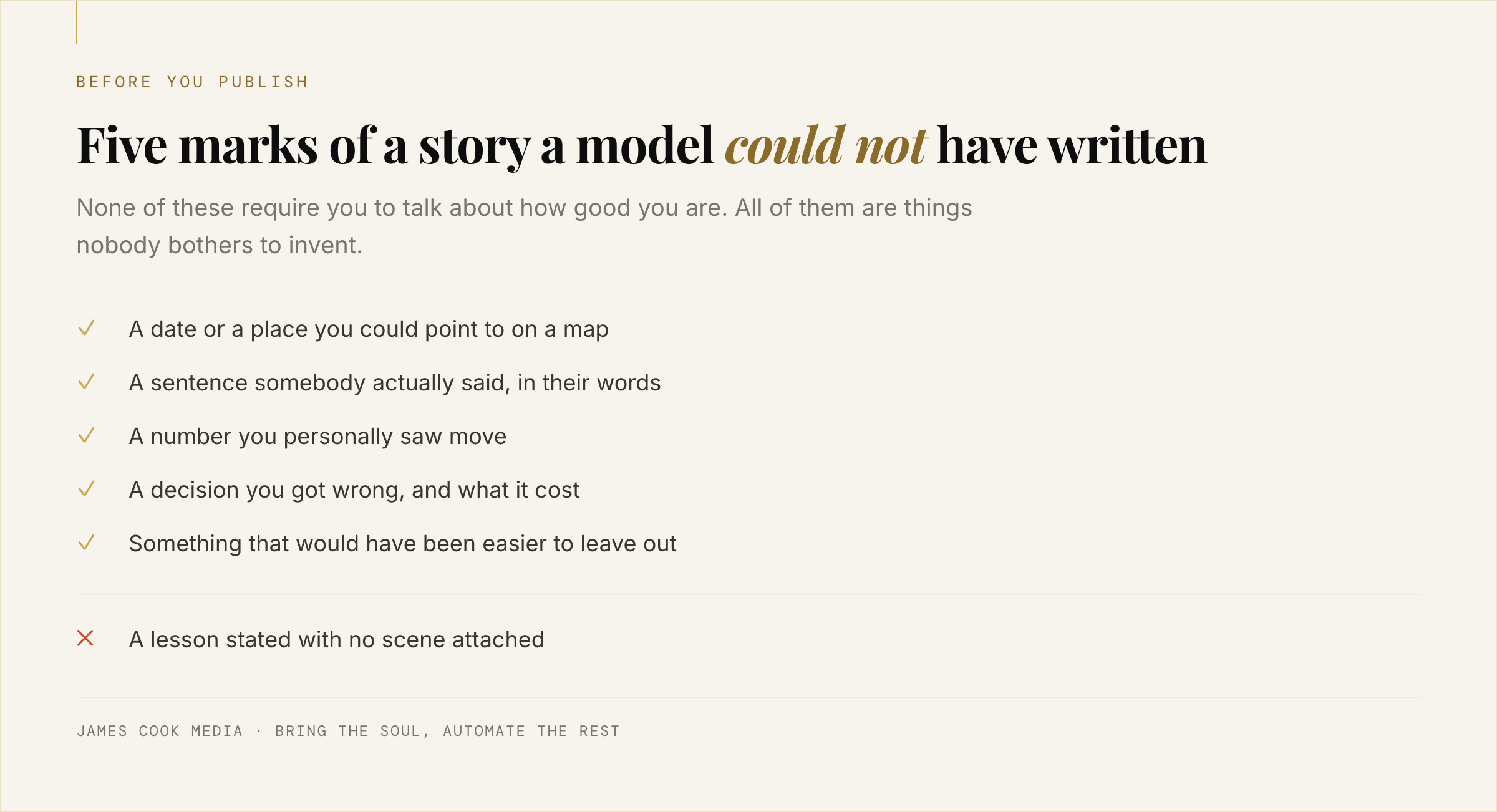
A practical test before you publish. Read it back and ask whether a competent competitor, given the same brief, would have produced roughly the same piece. If yes, you left yourself out again. Not because your writing was weak, but because you told the reader what you know instead of showing him where you learned it.
One more thing about scale, since it comes up. We have generated more than $10M for clients and trained over 100,000 experts since 2018, and none of that changes what happens on your laptop tomorrow. The mechanism that works at agency scale is the same one that works with three clients and one honest story. Big numbers are reassurance that the method is real, not a threshold you have to clear.
Where “just post value” still earns its keep
Value still does real work once trust exists. It is what a reader consumes after he has decided you are worth listening to, and it is what search engines and AI assistants index so he can find you at all. The error is using value as the trust-building instrument. Its job is depth and findability, not belief.
Drop the framing that value is worthless and you get a cleaner division of labour. Story earns the attention. Value keeps it and proves you can do the work. A reader who trusts you will read three thousand words of your method with appetite; the same reader, cold, would not have finished the first paragraph.
Value is also what makes you retrievable. A specific, well-structured answer to a real question is what gets surfaced in search and quoted by AI assistants. Story is what makes someone choose you once they arrive. Almost every stuck expert has been running only one of the two.
So keep posting the useful things. Just stop expecting them to do a job they were never able to do. Put one true, specific, slightly costly thing in front of the useful part, and the same post starts working.