
Someone told you that you need a funnel, so you built something that looks like one. It gets visits and nothing happens, and nobody has ever explained to you what a funnel is actually supposed to do to a human being.
You have a page. It has a headline, three benefits, a testimonial, a button. People land on it, a few read it, almost none do the thing at the bottom, and you have no way of telling whether the problem is the headline, the price, the traffic, or you.
So you change the headline. Then the button colour. Then the offer. This is what it looks like to debug a machine when nobody has told you what the machine is for.
Here is what it is for. A funnel is not a sequence of pages. It is a sequence of feelings, in a fixed order, inside one person's head. Understanding how funnels convert means understanding those five states, because a page only earns its keep if it moves someone from one to the next. Skip a state and the visitor leaves, politely, and you never find out why.
Your funnel didn't fail on the button. It failed on the order
Most funnels fail because they ask for a decision before the visitor has reached the state where a decision is possible. The mechanics can be perfect and the sequence still broken. A page that presents an offer to someone who does not yet feel understood is not badly designed, it is badly timed, and no amount of copy tightening fixes a timing problem.
Almost everything written about funnels is mechanical. Landing page, lead magnet, email sequence, checkout. Or it is a list of pressure levers: scarcity, urgency, social proof, countdown timers. Both are answers to "what do I build?" when your real question is "what is supposed to happen to the person?"
The one piece of psychology that survives contact with reality is boring and old. As The Drum summarises the research, drawing on Damasio and Kahneman, people decide emotionally and then justify the decision with logic afterwards. ClickFunnels puts the same thing in four words on its page about why funnels work: "Emotion decides, but logic justifies."
That is true and it is not enough, because it tells you emotion matters without telling you which emotions, or in what order. Feeling something is not one event. It is five, and they are strictly sequential.
How funnels convert: five feelings, in this order
A funnel converts by moving one person through five internal states in order: seen, oriented, capable, safe, ready. Seen means the page describes his situation accurately. Oriented means he understands why it is happening. Capable means he believes it could change for someone like him. Safe means he trusts you. Ready means the next step is small enough to take today.
None of these can be reordered and none can be skipped. You cannot be trusted by someone who has not yet understood what you are talking about. You cannot make someone ready when he still believes his case is hopeless.
The five map onto pages loosely and badly, which is why thinking in pages misleads you. One good page can carry the first three. A whole email sequence can fail to deliver the fourth. The unit of work is the feeling, not the URL.
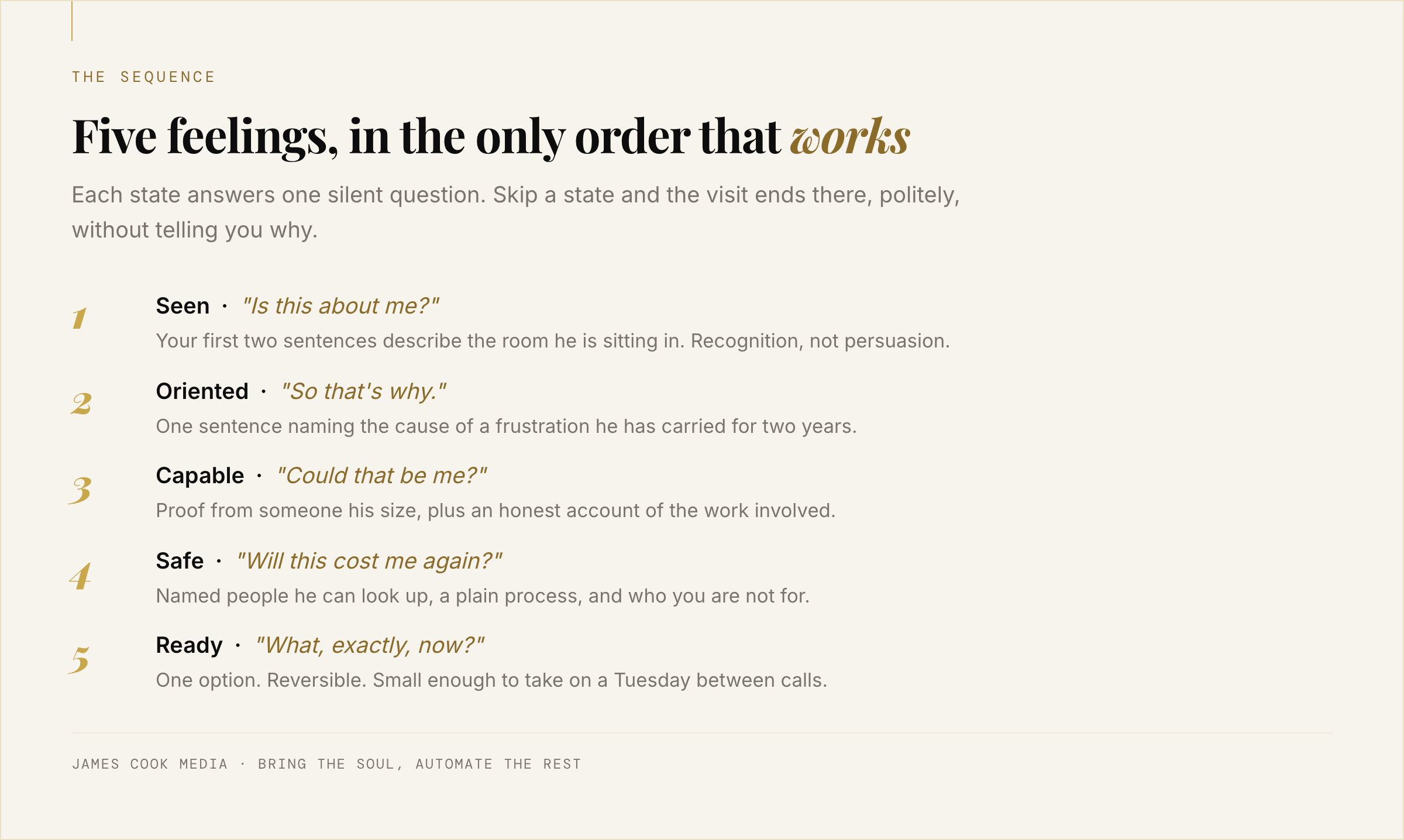
Read down that list and you will probably recognise your own page stopping at one or two. Most expert sites deliver none of them, which is the argument in why your website is a brochure and not a funnel. That piece is about what a brochure fails to do. This one is about the sequence underneath any page that works, brochure or not.
Feeling one: seen
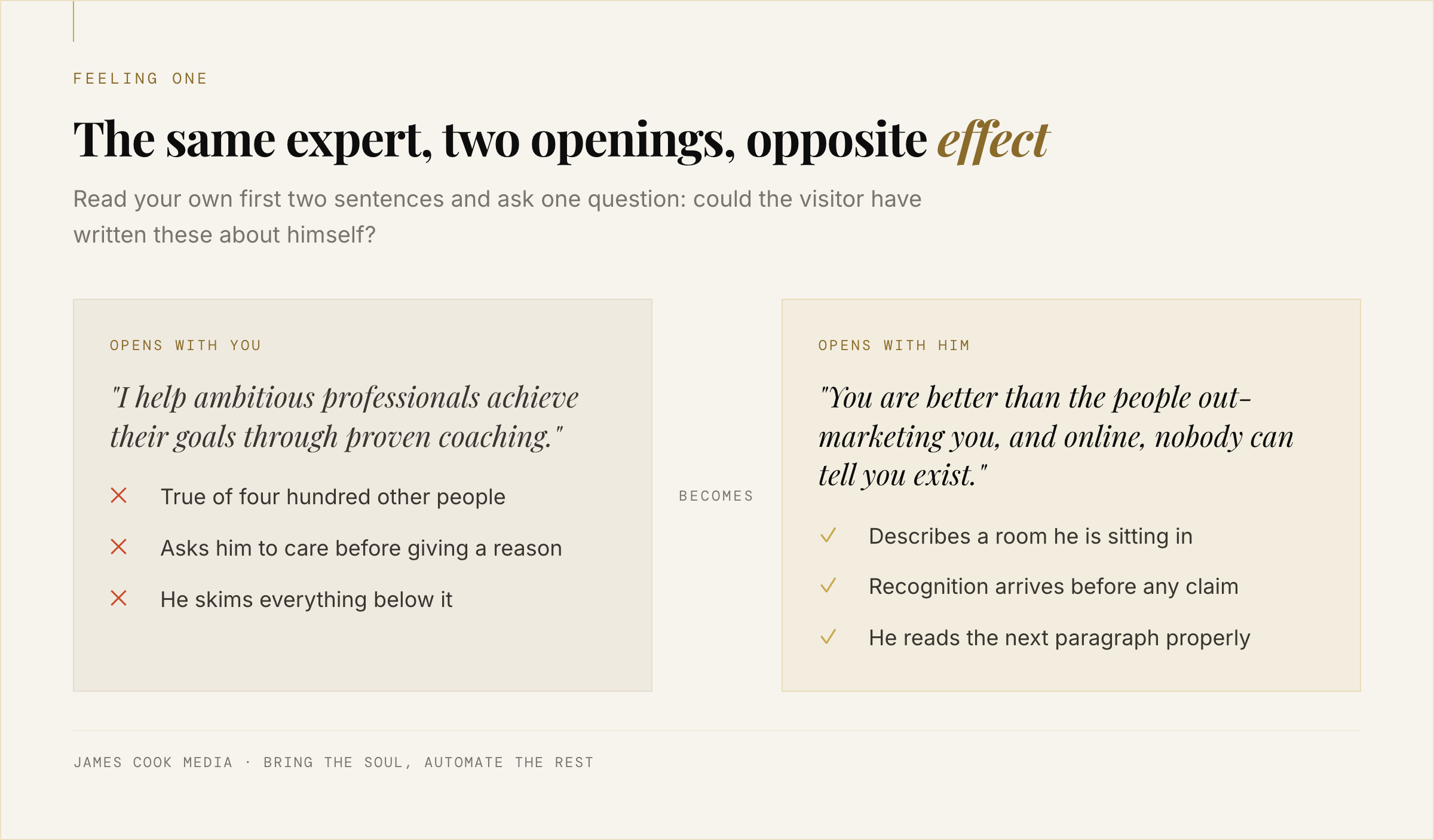
Being seen means a visitor reads your first two sentences and thinks "that is exactly my situation." It is recognition, not persuasion, and it comes before understanding. Until it happens, nothing else on the page is being read properly. Most expert pages skip it entirely and open with who the expert is, which asks the visitor to care before he has been given a reason to.
This is the state almost everybody misses, and it is first. Before someone can understand your explanation, he has to believe you are explaining his problem rather than a problem in general.
The test is mechanical. Read your own first two sentences and ask: could my visitor have written these about himself? "I help ambitious professionals achieve their goals" fails. "You are better than the people out-marketing you, and online, nobody can tell you exist" passes, because it describes a room he is sitting in.
Getting this right is uncomfortable for exactly the reader this article is for, because it means the page stops being about your credentials. That is the trade in why the customer is the hero, not you, and it is also the relief: you do not have to sell yourself. You have to describe him accurately, which is a thing you already do well on calls.
Feeling two: oriented
Orientation is the moment a visitor understands why his problem exists. Not what to buy, not how to fix it, just the mechanism. Recognition without explanation produces sympathy and no movement. A visitor who can suddenly name the cause of a frustration he has carried for two years will attribute that clarity to you, and clarity is the cheapest trust you will ever earn.
You already do this in the first ten minutes of every client call. Someone describes a mess, you explain what is actually going on underneath it, and you watch their shoulders drop. That explanation is the most valuable free thing you own and it is almost never on your website.
Orientation is also where you stop being interchangeable. Every competitor claims the same outcomes. Very few can explain the cause, because explaining the cause requires having seen the pattern a hundred times.
Keep it to one mechanism. Not a taxonomy, not a framework with seven pillars. One sentence that names the cause. If you cannot say it in a sentence, you have not finished thinking about it, and a visitor will not do that thinking on your behalf.
Feeling three: capable
Capable is the visitor believing the change is available to someone like him, not just to the case studies. This is the state big proof numbers destroy. A seven-figure result makes a solo expert with four clients feel further away, not closer. What creates capability is proof from someone recognisably his size, plus an honest description of what he would actually have to do.
This is the state I see broken most often, and it usually breaks because of something the page is proud of.
James Cook Media has built more than five seven-figure funnels. That is an agency number, and on its own it does the opposite of what you want, because a one-person business reads it as "for companies with budgets, not me." The number that actually moves a solo expert is smaller and closer: a real +50.4% lift in revenue per visitor on a page that already existed, achieved by changing the order of what it said. Same mechanism, no team, no ad budget.
Capability also needs honesty about effort. "Effortless" reads as a lie to a skeptical reader and correctly so. Telling him it takes a weekend and one hard conversation is more persuasive than telling him it takes nothing, because it means you have done it before.
Feeling four: safe
Safe is the visitor deciding you are unlikely to waste his money or embarrass him. It arrives fourth, not first, and it is built from specifics rather than badges: named people who can be looked up, a plainly stated process, an honest account of who you are not for. Most trust signals fail because they are decorative and could belong to anyone.
The reader we write for has usually already been burned once. A course, an agency, a boosted post. That money is gone and he has decided quietly never to be that stupid again. Everything on your page is read through that filter.
Anonymous trust decorations do nothing against that filter. "Trusted by hundreds of clients" is a sentence anybody can type. A named person with a company you can search, saying a specific thing, is checkable, and checkable is what safety means to someone who has been fooled before.
The most underused safety signal is telling him who you are not for. A page that rules people out is a page written by someone who does not need every sale, and that is the single fastest way to stop sounding like the last person who took his money.
Feeling five: ready
Ready is not enthusiasm. It is the moment the next step costs less than the discomfort of staying stuck. You engineer it by shrinking the step, not by raising the pressure. One option, obvious, reversible, small enough to take on a Tuesday afternoon between calls. Two options is a decision, and decisions get postponed.
This is where most funnels for solo experts break at the last inch. Four feelings delivered, and then the page asks for a sixty-minute strategy call, a form with nine fields, or a choice between three packages.
There is a genuinely useful finding on this. The ClickFunnels page cited above describes the jam study, where a display of six options outsold one of twenty-four by a wide margin. Fewer choices, more decisions. On your page that means one button, once, saying one thing.
And notice what readiness is not. It is not urgency. A countdown timer on a coaching offer does not create readiness, it creates suspicion, and suspicion sends the visitor back to feeling four to re-check whether you are safe. Every pressure tactic you add risks unwinding a state you already earned.
One small next step
Tell us where the sequence breaks for you
An AI System Design Sprint is a conversation, not a pitch. Bring the page you already have, or the fact that you do not have one, and we will work out which of the five feelings your visitors never reach.
Book an AI System Design Sprint → One conversation · No preparation needed · No commitmentWhere the sequence usually breaks, and how to tell
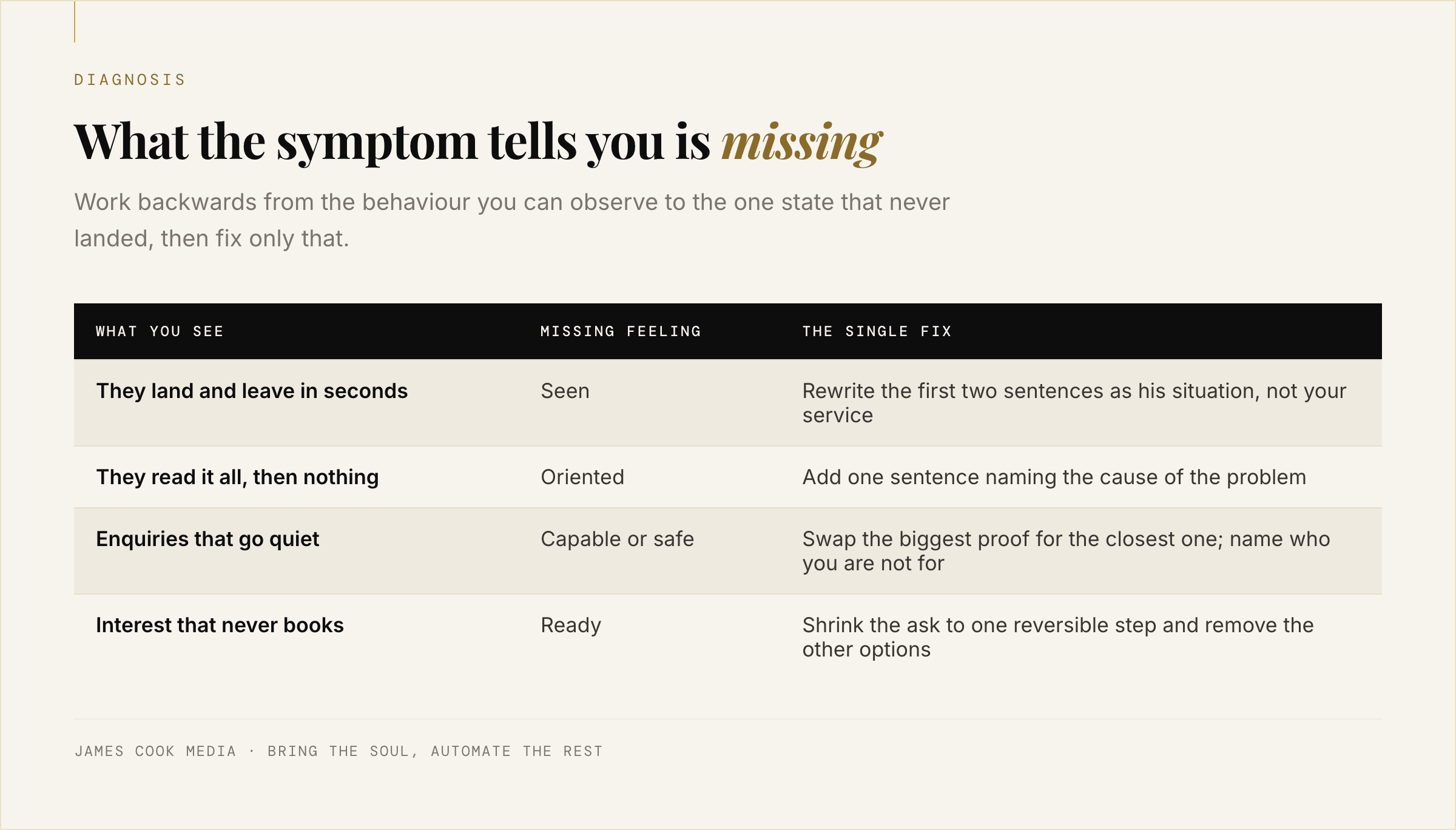
You can diagnose a funnel by symptom. Traffic that bounces in seconds means the visitor never felt seen. Long reads with no action mean he felt seen but never oriented. Enquiries that go quiet mean capability or safety failed. Interest that never books means the step was too big. Each symptom points at one state, which makes fixing it a single edit rather than a rebuild.
The reason this matters is that it turns a vague failure into a specific one. "My funnel doesn't work" is not actionable. "People read the whole page and don't click" is.
Work backwards from the symptom to the missing feeling, then fix only that. Most pages need one state added, not a redesign, and the +50.4% number above came from exactly that kind of edit rather than a rebuild.
One warning about the whole sequence. It is easy to read five feelings as five things to manufacture, which is how funnels end up manipulative and how sincere experts end up refusing to build them at all. One of the people we work with put it plainly: "I'd rather not sell than sell myself."
The five states are not levers to pull. They are what happens naturally when a stranger reads an honest account of a problem you understand better than he does. You are not creating feelings. You are removing the reasons he has to leave before he gets to the last one.
For the page-level version of this, how to build a story-driven landing page walks through the sections and the copy in order. It answers what goes on the page. This article answers what has to happen in the reader, which is why the two are worth reading together rather than instead of each other.