
You keep being told a podcast would fix your visibility problem, and you cannot tell whether that's true or whether it's just what people who sell podcasts say. Here are the conditions under which it's right for you, and the ones under which it is genuinely the wrong move.
Someone has told you that you should have a podcast. Probably more than one someone, probably in the last month, and you have been quietly resisting it because you cannot see how another weekly commitment turns into a single client. You are already busy serving the people you have. You have been burned by a course or an agency before, and the phrase "you just need to build an audience" now makes your jaw tighten.
So: do I need a podcast? For a lot of solo experts, no. Not yet, and in some cases not ever. We sell a podcasting masterclass, which is exactly why this piece starts with the reasons to skip it. A podcast is a specific tool that solves a specific problem, and if you don't have that problem, it becomes an expensive hobby that makes you feel behind.
Two pieces on this site assume you've already decided: one on why speaking suits the expert who hates writing, one on turning a single recording into a month of content. This one comes before both. It's the decision, not the method.
Five situations where the honest answer is no
Skip the podcast if you have no offer someone can buy, no existing audience to point at episode one, no appetite for a cadence you can hold for a year, no real willingness to speak, or a cash gap you need closed this month. In each of those cases a podcast delays the thing that would actually help.
You don't have a clear offer yet. If a listener finishes an episode, loves you, and lands on your site, what do they buy? If the answer is "well, it depends, we'd have a conversation", the podcast is not your bottleneck. Name the offer first. A show that points at nothing converts at nothing.
You have nobody to point at episode one. Podcast apps are close to useless for discovery. Nobody browses Apple Podcasts hoping to find a mid-market operations consultant. Shows grow through referrals, search, an email list, a LinkedIn presence, or existing clients passing episodes on. If you have none of those, you are publishing into a room with no doors.
You cannot hold a cadence for a year. This is the one people underestimate. WhichPodcast's analysis of 33,502 shows found a median publishing span of about 2.7 years, and that's among shows that got established. The broader picture is bleaker: The Podglomerate notes that of roughly 2.9 million podcasts on Apple, only about 440,000 published anything in the previous three months. Most shows are abandoned monuments. Yours will be too if a monthly recording block is not something you can honestly protect.
You genuinely don't want to speak. Not "I hate the sound of my own recorded voice". Everyone hates that, and it fades in about four episodes. I mean you would rather write, you dread being on a call, and speaking unscripted costs you more energy than it gives. That's a real answer and it deserves respect. Write instead.
You need clients this month. A podcast is a compounding asset. It pays back in quarters, not weeks. If there's a cash gap, go back to referrals, reach out directly to past clients, and fix the path from a stranger to a paying client on the site you already have before you add a channel.
Four conditions that make the answer yes
A podcast is the right move when you already explain your thinking out loud better than you write it, you have a defined offer, you have some small audience or referral flow to seed it with, and you want one recording session to produce most of your content. Three of four is usually enough. One of four is not.
You are better out loud than on the page. Many experts are. You've explained the same idea two hundred times in client calls and it comes out clear, warm and specific. Then you sit down to write a blog post and produce something stiff that sounds like a brochure. That gap is the single strongest argument for speaking rather than typing.
You have an offer, and you know who it's for. Not a niche in the marketing sense. Just: a specific person with a specific problem, and a thing they can buy from you at the end.
You have a seed. Two hundred email subscribers. A LinkedIn following of nine hundred. Thirty past clients who like you. Any of those is enough to start. It doesn't have to be a crowd, it has to be a door.
You want leverage, not another content chore. This is the real reason we teach podcasting. A single recorded conversation, done properly, becomes the episode, the article, the clips, the email and the social posts. That's the leverage argument, and it's the only one that survives contact with a time-poor one-person business. If you're going to speak anyway, capture it.
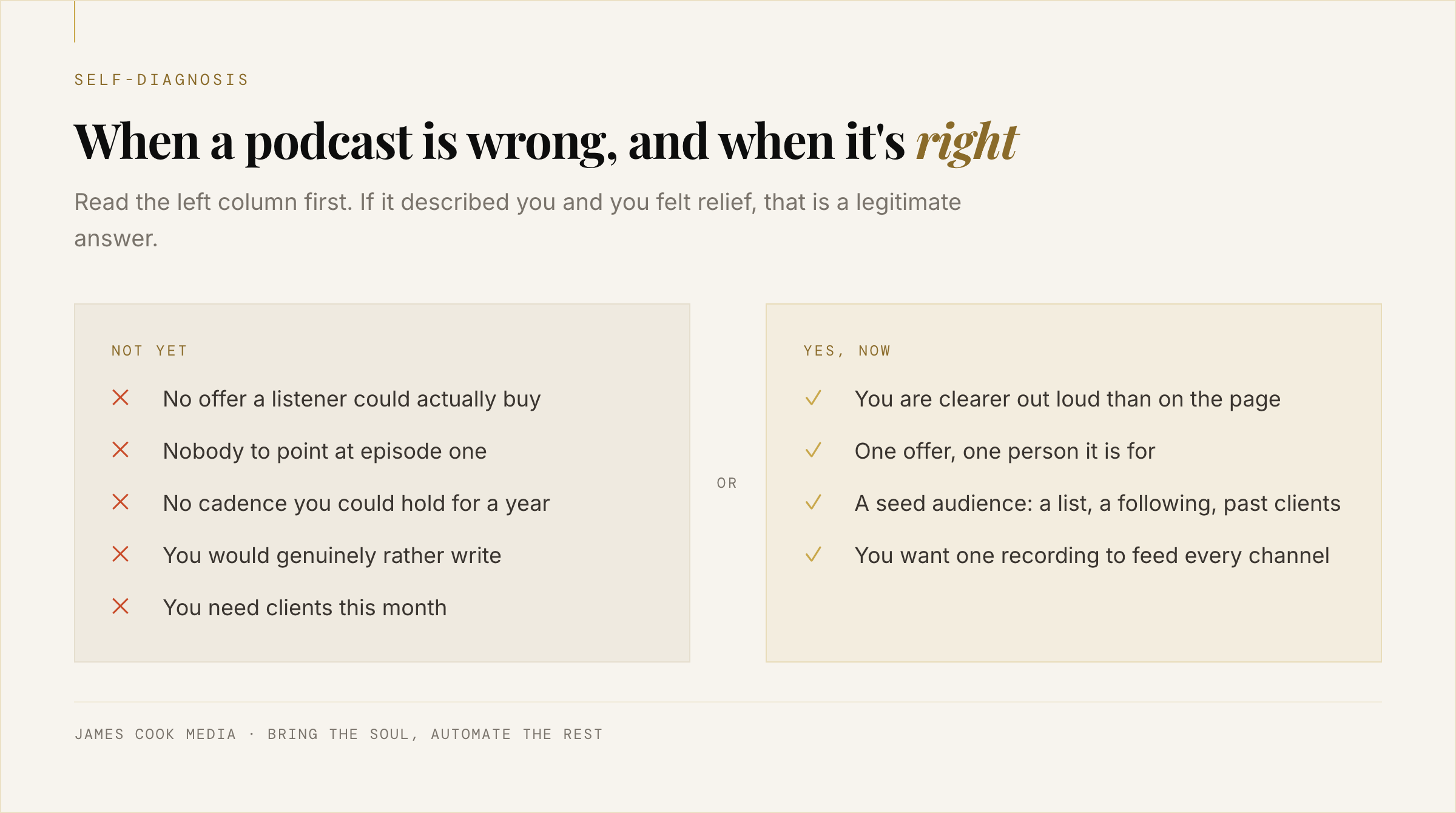
The list is not a scoring system. If you read the left column and felt relief, that's your answer, and it is a legitimate one. Being told no, not yet by someone with an incentive to say yes is worth more than another pep talk.
Do I need a podcast to be taken seriously?
No. A podcast is not a credential. Nobody has ever hired a consultant because they had an RSS feed. What buyers actually want is evidence you understand their problem and proof you have solved it before. A podcast is one efficient way to produce that evidence at volume. It is not the only way, and it is not a badge.
There's a quiet status anxiety around this. Peers announce shows on LinkedIn. Someone with half your expertise has a slick trailer and a guest with a big name. It's easy to read that as being lapped.
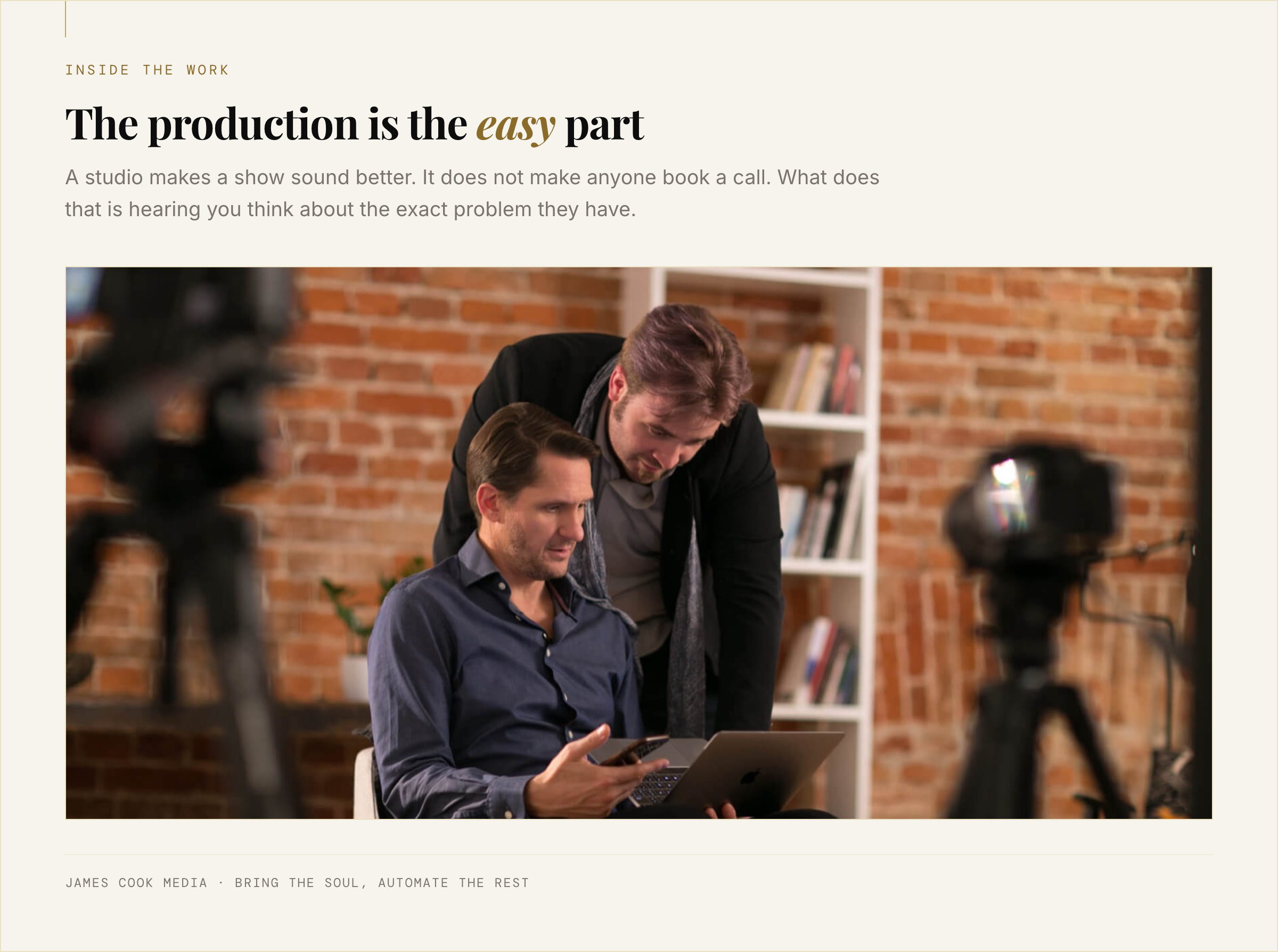
It isn't. Most of those shows will be gone in a year. Meanwhile, the thing that actually moves a buyer is unchanged: they need to hear you think about the exact problem they have, in their language, before they'll book a call. A podcast is a good machine for producing that at scale. A well-written page and three specific case studies do the same job for a narrower audience.
We've trained over 100,000 experts since 2018, and the ones who convert are not the ones with the best audio. They're the ones whose content sounds like a real conversation with a real client. That's available to you on a phone microphone in a spare room.
None of which means a podcast is a bad idea. It means the badge is not the reason to do it, and if the badge is your only reason, you will resent the recording schedule by March.
The reason most expert podcasts feel like a waste
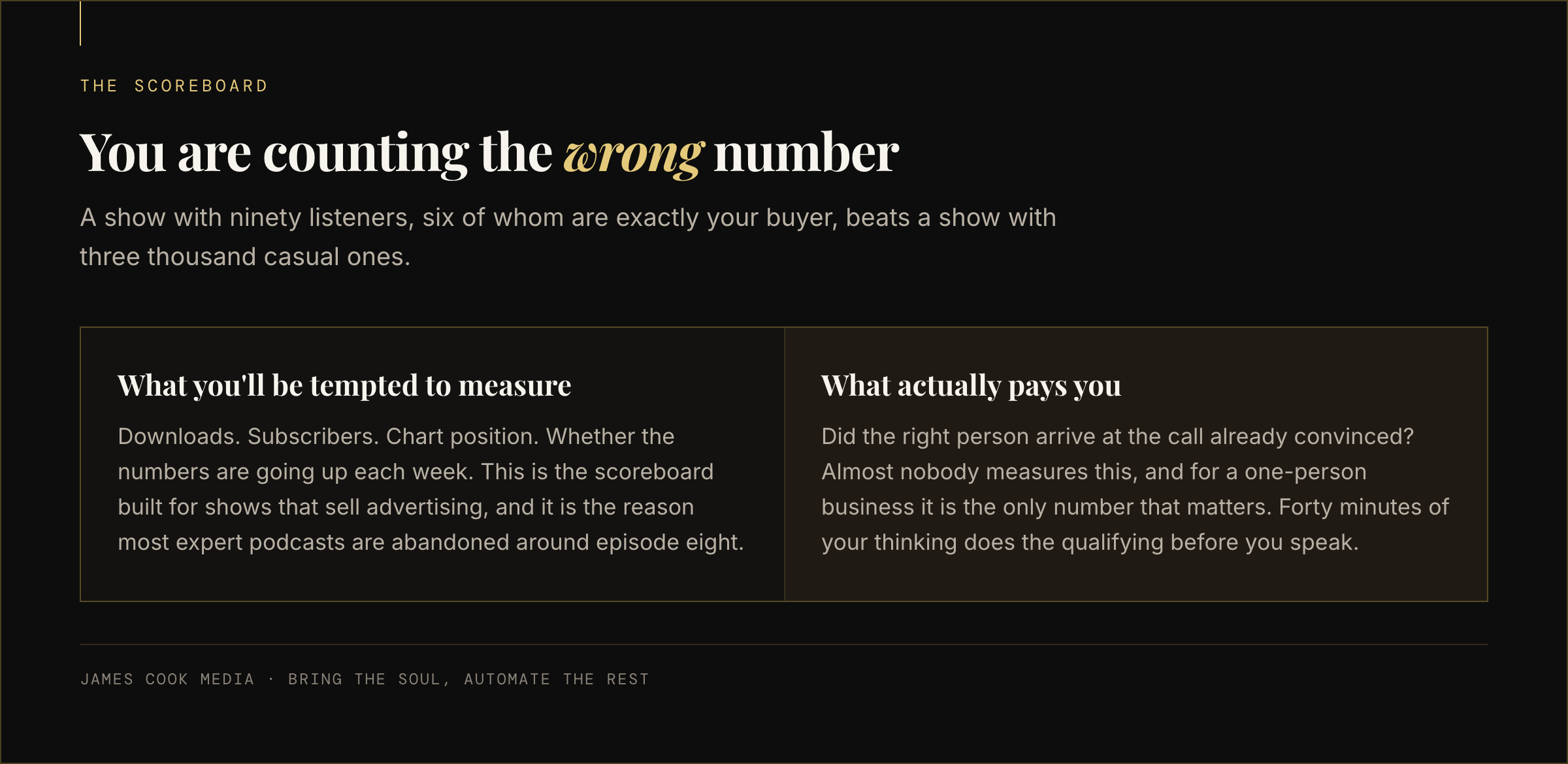
Most expert podcasts are measured as audience channels and judged by downloads, when for a solo consultant a podcast is a sales asset. Its job is not reach. Its job is to let one qualified person hear you think for forty minutes before they contact you, and to feed every other channel you have.
Here's the honest data point that should make you cautious. One host wrote up her real cons after nearly two years of publishing, and the standout was that only two clients ever told her they found her through the show. Analytics were poor. Organic discovery barely happened. Engagement stayed low.
Read as an audience play, that's a failure. Read as a sales asset, the question changes entirely: how many of the people who were already going to talk to her arrived warmer, better informed and quicker to say yes because forty minutes of her thinking was sitting there? That number is almost never measured, and for a one-person business it's the one that pays the mortgage.
This is why download counts are the wrong scoreboard for you. A show with 90 listeners where 6 are exactly your buyer beats a show with 3,000 casual listeners. If you're chasing the second number, you will burn out around episode eight and conclude podcasting doesn't work.
The cheapest way to find out before you commit
Test in two stages. First, go on three other people's shows as a guest. If you enjoyed it and the recordings were good, record four episodes of your own and publish nothing until all four exist. If you got to four without dread, you can hold a cadence. If episode two felt like a chore, you have your answer cheaply.
Guest appearances are the honest first step, and even podcast producers say so: The Podglomerate calls guesting the lower-lift route to authority before you launch anything of your own. You get the reps, the audio, and a clear read on whether you actually like the format, at zero setup cost.
Then the four-episode test. Not a launch. Four recordings, made in private, published only if all four exist. The reason is simple: almost everyone can produce episode one on enthusiasm. Episode four is where you learn whether this is sustainable or whether you were performing for yourself. Do it before you buy a microphone, commission artwork, or tell anyone.
If you clear both stages, then it's worth learning the format properly rather than improvising for a year. That's what the Podcasting MasterClass is: the mechanism, the structure of an episode that ends in a client conversation, and the repurposing chain, without any of the guru theatre.
One more thing before the invitation. Do the two tests first. If they tell you no, you have saved yourself a year, and that's a good outcome.
One small next step
Learn how a podcast turns into client conversations
The Podcasting MasterClass walks through the format we use with clients: how an episode is structured so it ends in a conversation, and how one recording becomes a month of content. Watch it before you buy any equipment.
Take the Podcasting MasterClass → About 90 minutes · Watch at your own pace · No subscriptionIf the answer is no, what to do instead
If a podcast is wrong for you now, do the three things a podcast would have done, without the cadence. Guest on other people's shows for the authority. Publish written answers to the questions clients actually ask you. Fix the path from a first visit to a booked conversation. Any of these outperforms an abandoned show.
Guest, don't host. All of the credibility, none of the publishing schedule. You show up, you speak well, someone else edits it and promotes it to an audience they spent years building.
Write the answers you already give. Every question a client asks you twice is a page. This is unglamorous, compounds well, and is increasingly how AI assistants decide who to recommend when someone asks for an expert in your field.
Fix the door before you build more hallways. More content pointed at a site that doesn't convert is the most common way solo experts waste a year. If almost everything you win still arrives by introduction, start with what changes when clients find you online instead of through a referral.
And if you find yourself, six months from now, repeatedly explaining the same idea out loud and wishing it had been recorded, the answer has changed. Come back then.