Almost every client you have came from a referral, a past colleague, or a room you happened to be in. That has worked, and it is also the reason your pipeline moves on someone else's schedule.
You can name where each of your clients came from. A former colleague. Someone you sat next to at a conference. A client who told a friend. Nobody arrived because they found you. That is not a flaw in how you sell; it is proof you are good enough that people put their own reputation behind you. It is also a ceiling, because the volume and the timing belong to other people.
This piece is about the second channel: how to get clients online as well, not instead. Not replacing referrals, and not turning you into a person who posts hustle content. Just adding a way for a stranger to find you, believe you, and get in touch, so the first channel stops being the only one.
Why referrals feel like the whole answer, right up until they don't
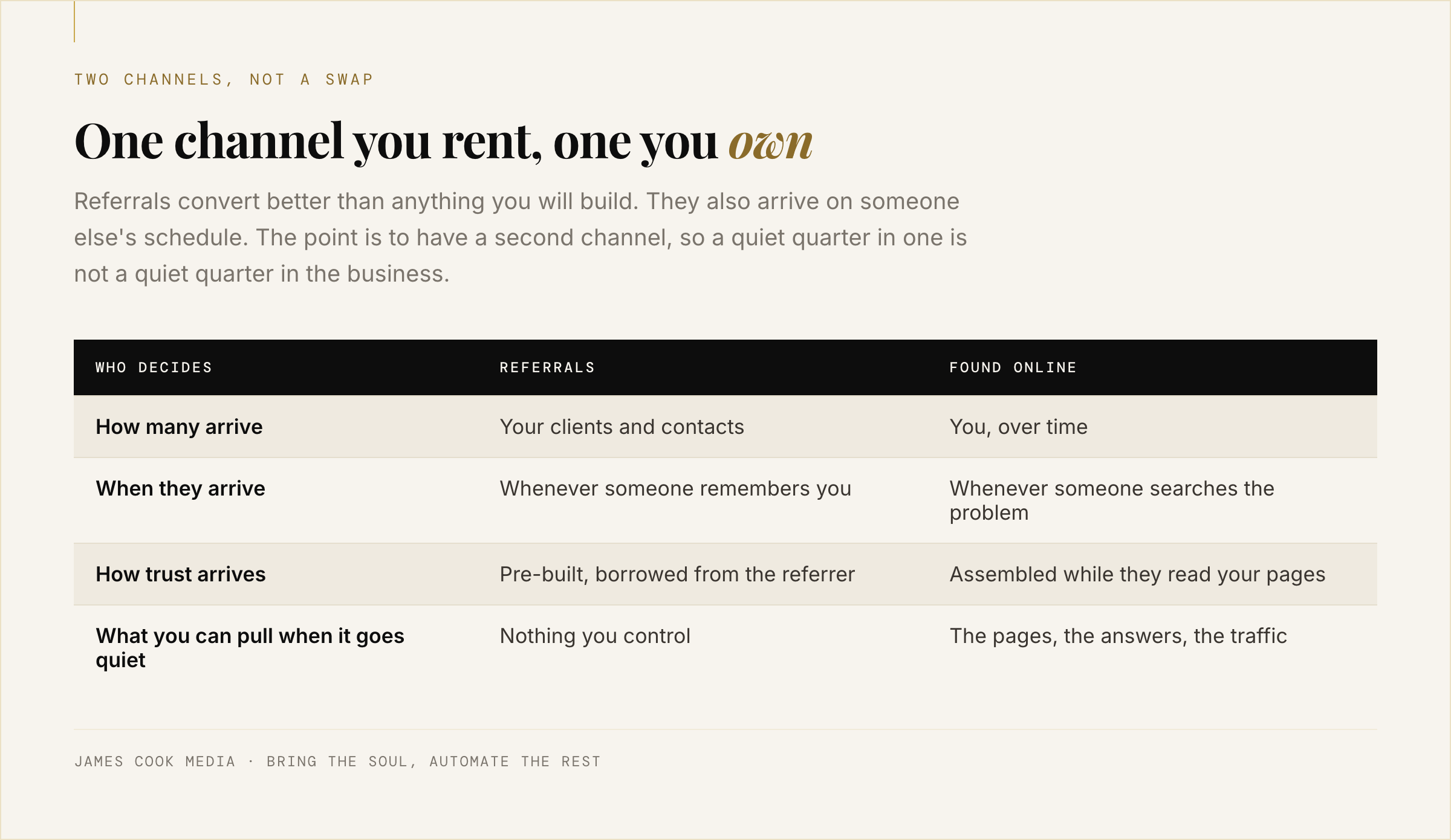
Referrals convert better than anything else because trust arrives pre-built. The problem is not quality, it is control: you do not decide how many arrive or when. A referral pipeline is a pipeline you rent from other people's memories and calendars. It works beautifully until a quarter goes quiet, and then there is no lever to pull.
There is a reason you never built anything else. Referrals close. They arrive already convinced, they rarely haggle, and the work is usually a good fit because the person who sent them knew both sides. A Haus Advisors round-up of referral research points at Wharton findings that referred customers are worth 16% more over their lifetime and stay 18% more loyal. Referrals are not the problem here.
But look at the shape of it. A referral requires three things to line up: someone remembers you, at the exact moment someone else has the problem, and is willing to spend social capital saying your name. Most of the time, at least one of those is missing. That same round-up cites Texas Tech findings that 83% of satisfied customers say they are willing to refer, while only 29% actually do.
That gap is not about how good your work was. It is about attention. Your happiest client is busy, and your name is not on the top of their mind on the Tuesday when their friend complains about exactly the problem you solve.
So the quiet quarters are not a verdict on your ability. They are a structural fact about a channel with no volume control.
What a referral actually does for you
A referral does one job: it transfers trust. A person the buyer already believes vouches for you, so you skip the entire proving stage and start the conversation at "when can we begin." Everything else about a referral, the warmth, the easy close, the fair price, is a downstream effect of that single act of borrowed credibility.
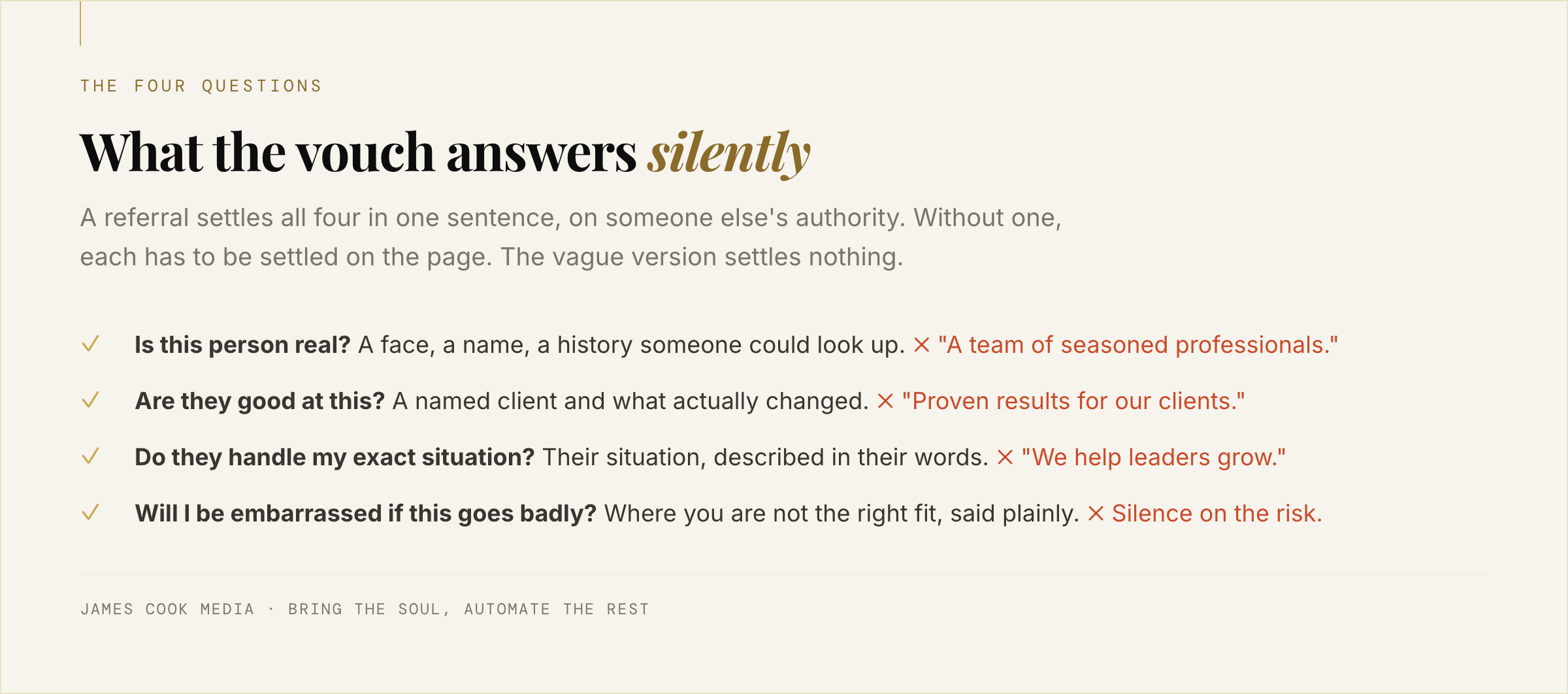
Break it down and it is almost mechanical. Before the call even starts, the referral has answered four questions for the buyer: is this person real, are they good, do they handle my specific situation, and will I be embarrassed if this goes badly.
The vouch answers all four at once, on someone else's authority. That is why referral conversations feel so different from anything you have tried online. You were not better in those calls. You just started three steps further along.
Once you see it that way, "getting clients online" stops being a marketing problem and becomes a substitution problem. If nobody is there to vouch, something else has to answer those four questions. That is the whole job.
What has to substitute for the vouch when you want to get clients online
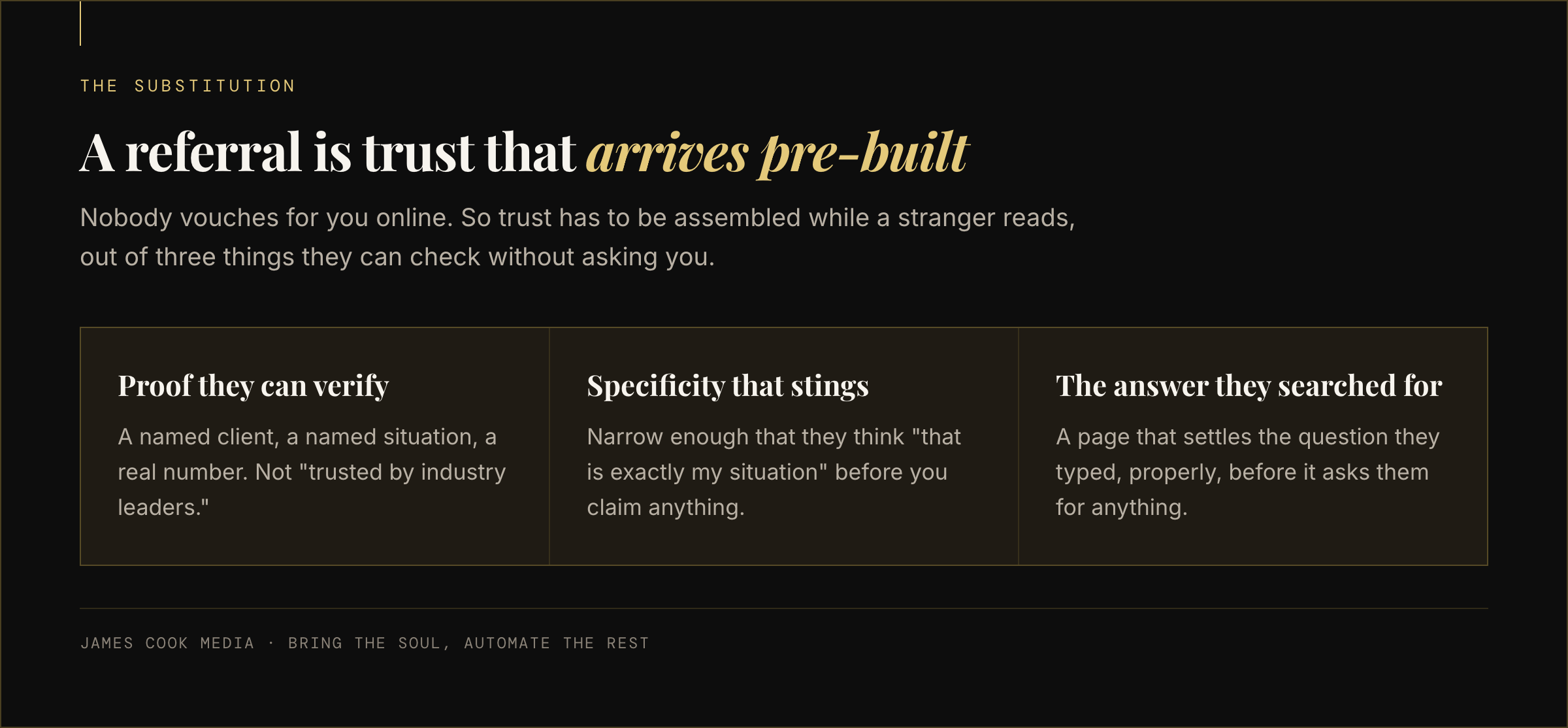
Online, you replace the vouch with three things a stranger can check without asking you: proof they can verify themselves, specificity narrow enough to feel like it was written about them, and a page that answers the exact question they typed. Trust does not arrive pre-built. It gets assembled while they read.
Proof a stranger can verify. Not "trusted by industry leaders." A named client, a named situation, a number, an outcome someone could go and confirm. A skeptical reader treats unverifiable claims as noise, which is exactly what your own BS detector does when you read other people's sites.
Specificity narrow enough to sting. A referral comes with context baked in: "talk to him, he sorted out exactly this for us." Your page has to do that unaided. "I help leaders grow" replaces nothing. "I help engineering managers who got promoted into a role nobody trained them for" does the vouch's job of saying yes, your situation, specifically.
A page that answers the question they typed. This is the part most experts skip. People do not search for you, they search for their problem. If they type the problem and land on a page that answers it properly, before asking anything of them, you have done in three minutes what a referral does in one sentence.
None of that requires you to become a marketer. It requires you to write down what you already say out loud in discovery calls. That distinction matters, and it is the same one drawn in marketing for people who hate self-promotion. That article is about the resistance itself. This one is about the plumbing once you are past it.
Why the strangers who find you are already halfway decided
Buyers now do most of their evaluating before they ever contact you. The 2025 B2B Buyer Experience Report found buyers reach out at roughly 61% of the way through their journey, and the vendor they already ranked first wins about 80% of the time. Your page is not the start of the sale. It is the part of the sale you are not present for.
Those numbers come from 6sense's 2025 B2B Buyer Experience Report, and they changed how I think about expert websites. The pitch happens whether you show up or not. Somebody is reading your page, comparing you to two other names, and deciding, alone, in a browser tab.
For a solo expert this is unusually good news. You are not being asked to out-shout anyone. You are being asked to be legible to someone who is already looking for what you do. A one-person business with a real track record can win that comparison against a bigger firm, because the thing being compared is specificity and evidence, not headcount.
It also means the low-quality traffic problem mostly solves itself. Someone who typed a precise problem into a search box and read 1,500 words about it is not a time-waster. They are further along than most of your referrals were when they first called.
The bridge, in the order it actually gets built
Start from the conversations you already have. Write the three or four questions every prospect asks you before hiring, answer each one properly on its own page, put verifiable proof beside the answer, and give one small next step. That is the minimum viable online channel. It is four or five pages, not a content strategy.
Here is the sequence that works, in order, because doing it out of order is how people waste a year.
One: list the questions. Open your sent mail and your call notes. Pull the questions prospects asked before they hired you. Not the questions you wish they asked. Real ones, in their words. You will find you answer the same four or five repeatedly.
Two: answer one question per page. Properly, the way you would on a call, including the part where you tell them when you are not the right fit. That candor is the single most trust-building move available to you, and it is free.
Three: attach the proof to the claim. Every meaningful claim gets a named example next to it. If you only have three clients, use those three. Depth beats volume here, and a handful of clients described honestly is more persuasive than a wall of logos.
Four: give one next step, and make it small. Not "book a strategy call." Something closer to tell me what you're stuck on. A stranger will not commit to a sales conversation on a first visit, and asking them to is how brochure sites stay silent. That gap between a brochure and something that actually converts is covered in why your website is a brochure, not a funnel.
Five: only then think about traffic. Search, a podcast, a newsletter, whatever suits you. Traffic pointed at a page that cannot answer the four questions is money set on fire, and if you have paid for ads or an agency before and heard nothing back, this is usually why.
What this costs you in a normal week
The build is a handful of afternoons, not a career change. Four or five pages, written once, answering questions you already answer for free. The ongoing cost is closer to two hours a month than two hours a day, because the pages do not expire. This is the part that makes it survivable for someone with a full client load.
You are time-poor. Any plan that needs you to post daily is a plan you will abandon in week three, and you will read that abandonment as more evidence that this works for other people and not for you. It is not evidence of anything except a badly sized plan.
So size it honestly. Writing down what you already know is not a new skill you have to learn, and it is the one part nobody can outsource for you. The mechanical work around it, the pages, the structure, the repurposing, the search plumbing, is exactly the sort of thing that should be built once and left running. Bring the soul, automate the rest.
James Cook Media has trained more than 100,000 experts since 2018, and the reason that number got large is that the method is small. It is the same handful of moves whether you have three clients and a laptop or a marketing department.
We have watched this fail for one boring reason more than any other: people build the traffic before they build the answers. The order in this article is the whole trick.
One small next step
Tell us where the referrals stop working
A AI System Design Sprint is a conversation, not a pitch. You describe how clients currently find you and where it stalls, and we map what your second channel would actually look like. No deck, no pressure.
Book a AI System Design Sprint → A conversation, not a sales call · Bring your real situationWhat not to do, having seen a lot of people try
Do not start a channel you would not read yourself, do not rebuild the whole website before writing anything, and do not treat volume as the goal. Most failed attempts to get clients online fail on those three, not on talent or budget. The reluctant expert's instinct to avoid anything that feels like a performance is usually correct.
Do not start with a rebrand. A new logo and a nicer homepage change nothing about whether a stranger can verify you. Answers first, design later.
Do not adopt a voice. If you would not say a sentence to a client's face, it does not belong on your site, and a skeptical reader can smell it in half a line. Your actual voice, plain and slightly blunt, converts better than a polished one because it is checkable against the call they eventually have with you.
And do not abandon referrals while you build. They are still your best channel by conversion rate. The goal is two channels, so a quiet quarter in one does not become a quiet quarter in the business.