You have twenty years of expertise, a handful of clients who all arrived through people you already knew, and a private suspicion that the window for being noticed online closed while you were busy doing the work. You have watched people with a third of your experience build followings you can't explain, and somewhere in the last year or two you quietly concluded you were too small to matter and too late to start.
I want to argue with the conclusion, not the feeling. But "it's not too late" is an assertion, not an argument, and a skeptical person is right to discount it. Most articles about starting later say it once and then hand you the advice they'd hand a twenty-four-year-old. Copyblogger's guide to building an audience from scratch is competent work, and it quietly assumes time to publish weekly, budget for collaborators and comfort with public sharing. A typical guide to consultant personal branding tells you to be authentic, consistent and persistent, and cites nothing at all.
None of that is dishonest. It just isn't written to a fifty-four-year-old with four clients, no appetite for performing and one bad agency experience he'd rather not discuss. So here is the structural case instead: which parts of building an audience after 40 compound over time, and which parts genuinely reward being twenty-five.
What compounds, and what only rewards being young
Three things compound in online visibility: a published record that keeps working, specificity that narrows who you are for, and a reputation that already exists offline. Age is irrelevant to the first two and helps the third. What rewards youth is trend-chasing, platform-native performance and raw volume. None of those three is required to get clients.
A published record compounds. An article you write this month is still working in three years. Search engines and AI assistants can only recommend what they can read and verify, and every piece you publish adds another verifiable thing about you. That is arithmetic. It does not check your birth year.
Specificity compounds. The narrower and stranger your claim, the fewer people you compete with and the more obviously you are the answer. Specificity comes from doing the work long enough to know where the interesting problems hide. You already paid for it.
An existing offline reputation compounds fastest. You have clients who would vouch for you and colleagues who remember a specific thing you fixed. A twenty-five-year-old is building from zero and knows it. You stopped counting your base because it feels like normal life.
Now the other column. Trend-chasing rewards youth, because it needs you living inside a platform and reacting within hours. Platform-native performance rewards youth, the jump cuts and the register of someone who grew up on camera. Raw volume rewards youth, because it needs time you don't have.
Nothing in that second column is required to get clients. Those are how you build a large audience fast, not how you build the right audience at all.
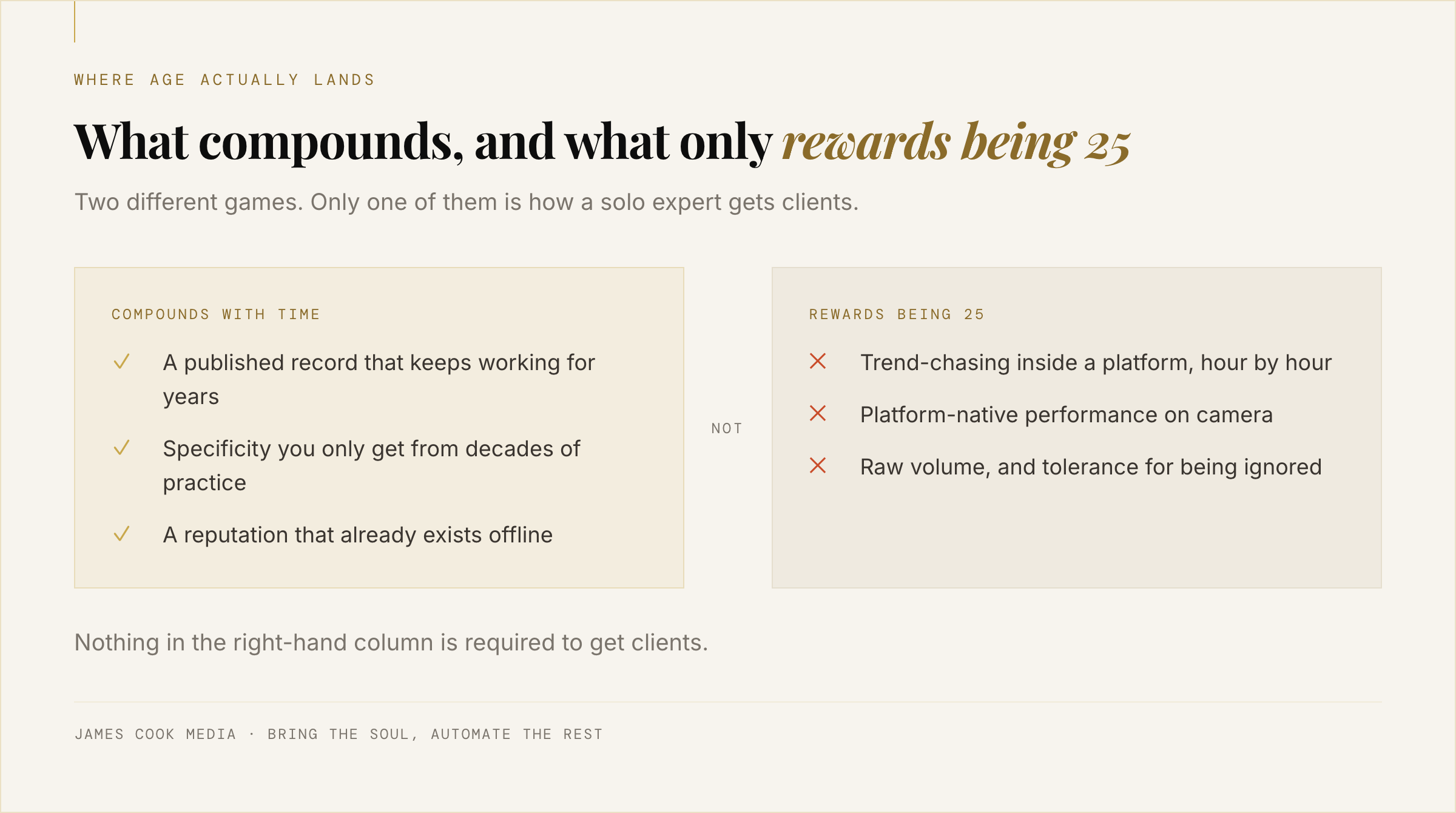
The left column is where clients come from. The right is where attention comes from. Not the same business.
The assets a twenty-five-year-old cannot buy
Starting later means starting with inventory: two decades of client problems, judgement about which conventional advice is wrong, stories with real stakes, and people who already trust you. Research on high-growth founders points the same way. Experience in the field you are building in is the strongest single advantage, and it is the one thing that cannot be accelerated.
This shows up in the data. MIT Sloan's write-up of the Census Bureau research on founder age found that among 2.7 million people who founded businesses between 2007 and 2014, the highest-growth ventures had an average founder age of 45, fewer than 1 percent of high-performing firms were founded by twenty-year-olds, and founders were 125 percent more successful when they had already worked in the sector they launched into. The same study ran in Harvard Business Review under a blunter title.
That research is about companies, not audiences, and I won't pretend it proves anything about your newsletter. What it establishes is that the young-founder story is a media artifact rather than a finding. The pattern underneath is duller and better for you: people who know a domain deeply outperform people who don't.
Applied to being findable, your inventory looks like this. Every client question you have answered a hundred times is an article that will still be earning in five years. Every time you have watched standard advice fail is a contrarian position, the rarest thing in content. Every project that went sideways and came back is a story with stakes, and stakes are what people remember.
A machine can copy your words. It can never copy where you have been.
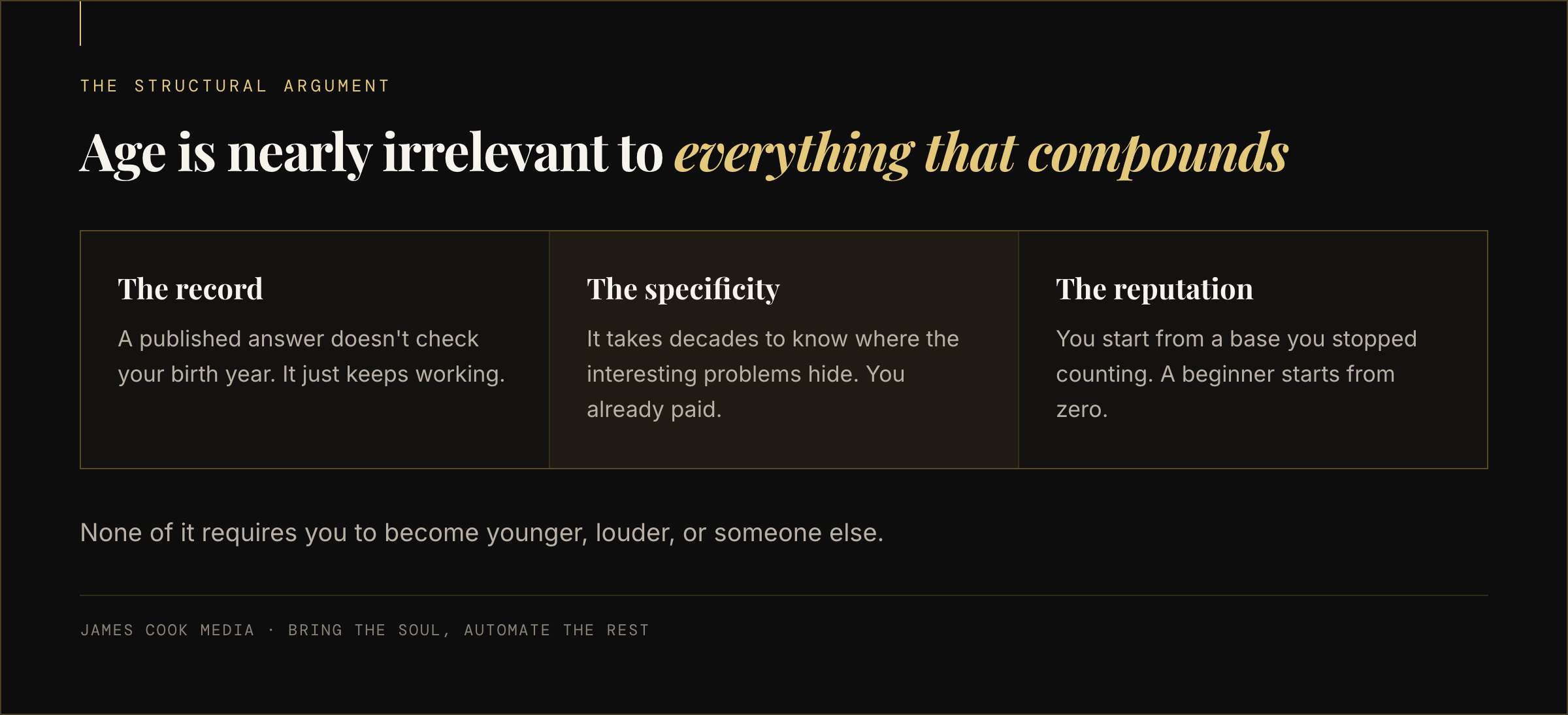
None of it requires you to become younger, louder, or someone else.
What is genuinely harder after 40
Three things are honestly harder after 40: less appetite for public performance, less time, and zero tolerance for wasting money again. Pretending otherwise is how bad advice gets sold. Each is a real constraint, and each has a structural answer that does not require you to change your personality.
If an article tells you nothing gets harder, stop reading it. Three things do.
Less appetite for being watched
At twenty-five, public flailing is survivable and possibly charming. At fifty-two, with a reputation among people whose opinion you care about, the cost of looking foolish is real. You are not being fragile. You are pricing a risk a beginner doesn't carry.
The answer is not courage. It is changing what you publish. Written, specific, useful work carries almost none of that risk, because it isn't performance. It is what you'd say in a client meeting, written down, and nobody has been embarrassed by a clear explanation of a hard problem. If it's the fear rather than the age stopping you, that's why "not ready yet" keeps you invisible.
Less time
You are serving the clients you have. Any strategy that needs daily posting is one you'll abandon in week three, and the abandonment will feel like more evidence that this works for everyone but you.
The answer is to separate the part only you can do from the part that shouldn't need you. The judgement, the story, the taste are yours, and that's maybe two hours a month of thinking out loud. Everything after it is mechanical, and mechanical work is what automation is genuinely good at. Bring the soul, automate the rest is why a one-person business can publish like a team.
No tolerance for another wasted cheque
You have paid someone before: a course, an agency, a freelancer who went quiet. The money mattered and you got nothing you could point to. Every offer now gets read through that filter, and it should.
The answer is sequence. Learn the method cheaply before you buy anything built. That's why our own entry point is a $27 masterclass rather than a discovery call: anyone who wants a five-figure commitment before you understand what they are doing is asking you to repeat the mistake.
Building an audience after 40 works as a system, not as luck
Building an audience after 40 is a system with four parts: one narrow claim about who you help, evidence published in your own voice on a page you own, that evidence made readable to search engines and AI assistants, and one obvious path from reading to talking. None of it is age-dependent and none of it requires daily posting.
Here is the whole system. It is unglamorous, which is why it survives contact with a real schedule.
One claim. Not "business coach" but something closer to "I help second-generation family manufacturers hand over without the business stalling". Narrow enough that the right person feels caught.
Evidence, in your voice, on ground you own. Substantial answers to the questions clients actually ask, published where they accumulate rather than scroll away. Twelve strong pieces beat two hundred posts, because the twelve still work next year.
Readable by the machines that now do the recommending. AI assistants can only put forward what they can read, understand and verify. A technical job, not a charisma job, and the most under-done thing on expert websites.
One path from reading to talking. One next step, not five. Most expert sites end an excellent page with nothing at all.
That's it. It works the same with four clients and a laptop as with forty staff, because the mechanism doesn't care how big you are. If size rather than age is the part that feels disqualifying, that's building authority with a handful of clients. Different fear, different answer.
One personal note, since it's relevant. I graduated from West Point in 2000, served as a cavalry officer, then taught history there until 2013. James Cook Media started after that, and the MasterClass that has now trained more than 100,000 experts didn't launch until 2018. Most of what anyone knows me for was built after forty, on top of two careers that looked like detours at the time. Not a special case, just a sequence the startup mythology has no room for. More of it on my page here.
The smallest version that actually works
Start with one claim, five written answers to questions clients genuinely ask, one page that makes the next step obvious, and ninety days. That is enough to test whether being findable produces conversations for you. It costs almost nothing but attention, and it fails cheaply if the claim turns out to be wrong.
You don't need a content calendar or a rebrand, just the smallest thing that produces a real signal.
Write your claim as one sentence you'd say to a stranger without wincing. List the five questions clients ask before they hire you, including the awkward one about price. Answer each the way you would in the room, about a thousand words each. Put them somewhere you own. Add one page that says what happens next.
Then wait ninety days and count conversations, not followers. A conversation with someone who arrived on their own and already understood what you do is the signal, and one is enough to know the mechanism works.
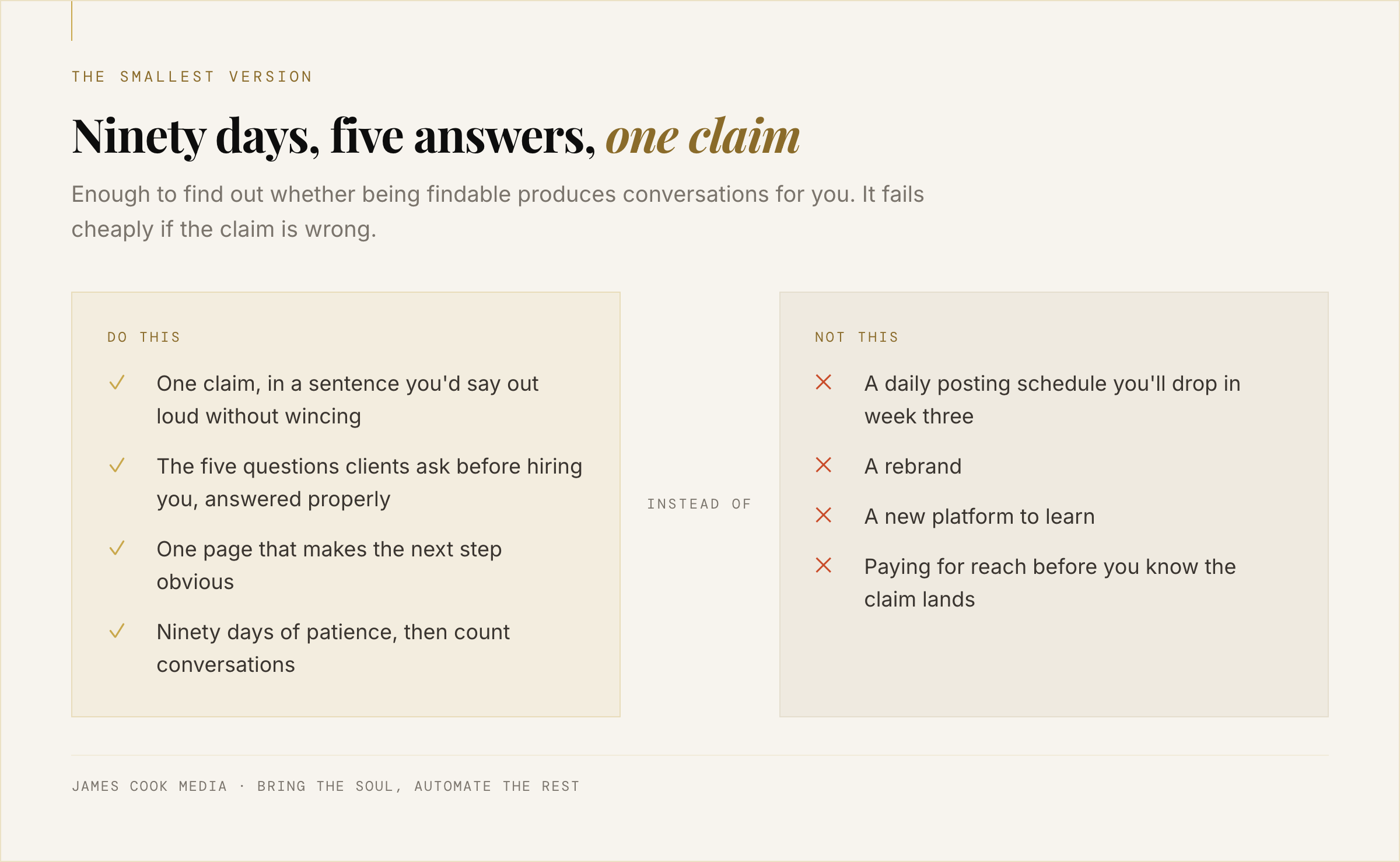
Five real answers beat fifty posts, and you can write five in a month of evenings.
Learn the mechanism first and you can tell in ten minutes whether someone selling you help actually has it. That's the protection you didn't have last time.
One small next step
Learn the method before you buy anything bigger
The AI MasterClass walks through the same approach we run for clients, prompts included, built for one person with real expertise and no marketing department. Watch it, then decide whether you want help or would rather run it yourself.
Take the AI MasterClass → About 90 minutes · Watch at your own pace · No subscriptionWhat "audience" should mean at this stage
At this stage an audience is not a follower count. It is a small number of people who already understand what you do, arrived without an introduction, and are pre-qualified by the time they reach you. Two hundred of the right people will fill a solo practice. A hundred thousand of the wrong ones will not.
The word "audience" is what makes this feel impossible. It suggests a stadium, and you don't want a stadium. You want six good conversations a quarter with people who found you on purpose. That is a small number, and small numbers are reachable. It also means most metrics the growth industry sells are measuring the wrong thing for your business.
We have trained more than 100,000 experts in this method since 2018, and most arrived as one person with real expertise and no idea how to be found. That number says the path is well-worn, not that you need scale to begin.
You were never too small. Small was the point. And you were never too late, because the record starts accumulating the day you publish the first thing, and there is no version of this where starting later than today is better.