
You are good at what you do and invisible to the people searching for it. This is the version of SEO nobody wrote for you: no jargon, no team, no tool subscriptions, just what actually changes whether you get found.
You opened a tab about SEO some months ago, read four paragraphs about crawl budgets and canonical tags, and quietly closed it. The feeling that stayed was not "I don't want to do this" but "I am not equipped to do this," which is worse, because it sounds like a fact.
It isn't. You are not missing a technical skill. You are missing a translation, and most of what got translated to you was written for somebody with a content team.
So here is the plain-English version. Every term gets explained where it appears, and I'll be direct about which common advice you can ignore. The honest answer is: most of it.
What SEO actually means, without the jargon
SEO means search engine optimisation: making it easy for Google and AI assistants to find your pages, understand who you help, and trust you enough to recommend you. That's the whole idea. Everything technical you've read is a detail underneath those three verbs, and most of it doesn't apply to a small site.
Three things have to happen before a stranger ends up on your call.
Find. Google has to know your page exists. It finds pages mostly by following links, so a page nothing points at is a locked room. Google's own SEO starter guide says most new pages it discovers each day, it discovers through links.
Understand. The page has to say, in ordinary words, what problem it solves and for whom. Not cleverly. Clearly.
Trust. Search engines and AI assistants prefer content where it's obvious who wrote it and why. Google's guidance on helpful content asks whether a visitor can tell who authored the page, and recommends real bylines.
Find, understand, trust. If a piece of SEO advice doesn't serve one of those three, put it down.
Why most SEO advice for coaches doesn't fit a one-person business
Most SEO guides assume a content calendar, a writer, a paid research tool and someone for the technical work. A solo consultant has none of that and doesn't need it. The advice that survives the shift to one person is a much shorter list, and it's about clarity rather than volume or tooling.
Read four guides on SEO for coaches and you'll see the same shape. Publish weekly. Run keyword research in a paid tool. Build backlinks at scale. Audit the site quarterly. Aim for 1,500-plus words a post.
None of that is dishonest. It's costed for a different business. Sarah Moon's guide for coaches is more careful than most and still assumes budget for research tools, quiz software and steady publishing capacity.
Here's the gap nobody names: a marketing team optimises for coverage, and you have to optimise for survival. A team can publish forty pages and let eight of them work. You get maybe one sitting a week. So the question is never "what's best practice?" It's "what works when I only do four things a month?"
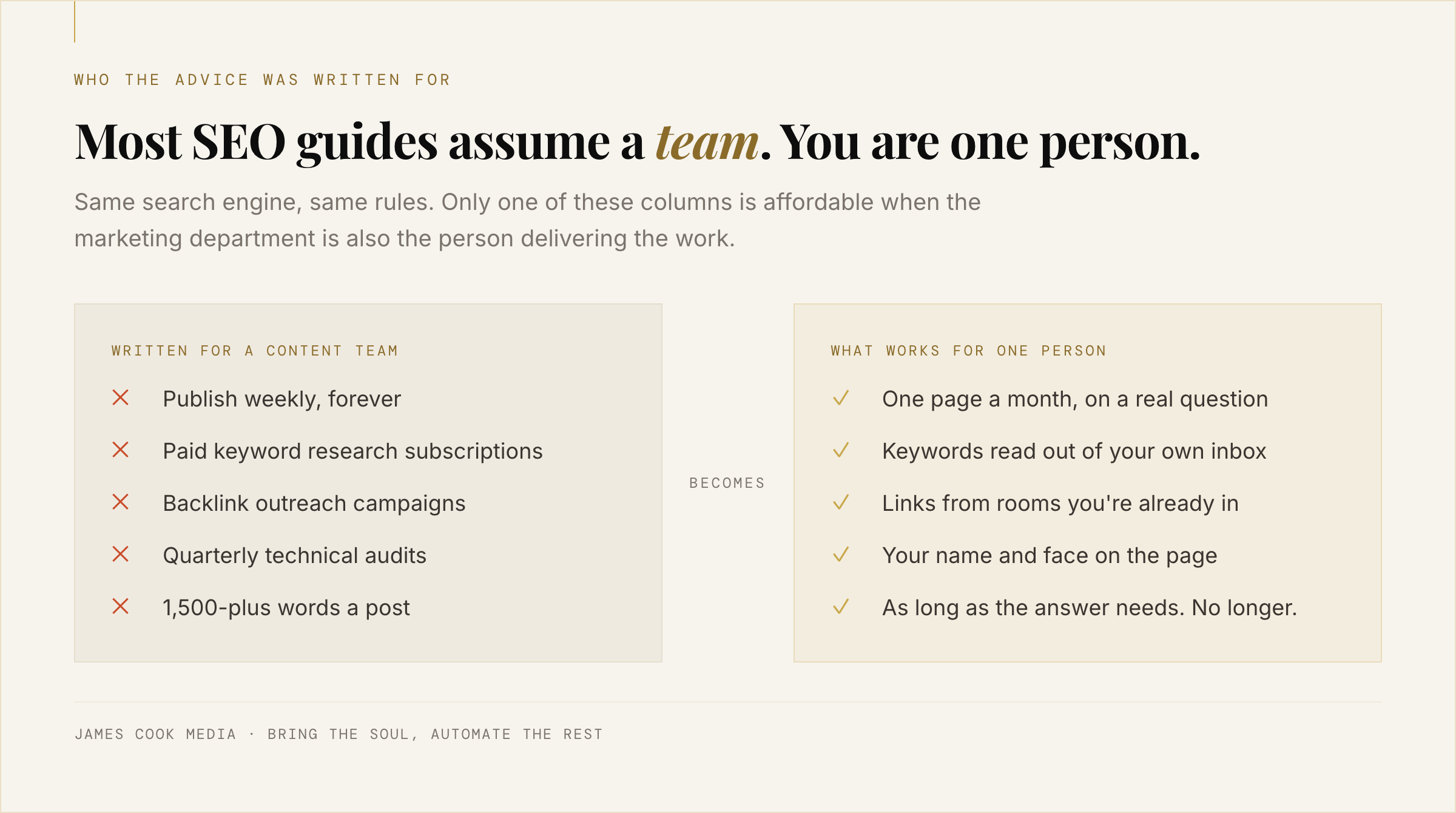
The second column isn't a watered-down version. It's the part that was doing the work all along.
The four things that actually move the needle
For a solo expert, four things carry almost all the weight: one clear page per problem you solve, written in the words your client would actually type, a site that makes obvious who you are, and links from the places you already show up. Do those four and you've done more real SEO than most coaching websites manage.
Everything here you can do yourself, in your own voice, without buying anything.
One page per problem you solve
Search is a question-answering machine. People type problems, not service categories. A "Services" page listing six offerings competes for nothing, while six pages each answering one specific problem can each be the best answer to something.
If you coach senior leaders through role changes, you don't need a page about executive coaching. You need one about what to do when you've been promoted past your own competence, and another about handing over a team you built. Concrete beats broad.
Start with the three questions your clients asked before they hired you: real people, real words, already interested. Findability beats more content makes the case for why volume isn't the problem. This piece is the mechanics underneath it.
Use the words your client would use
A keyword is just the phrase someone types into the search box. That's the entire concept. No tool required to understand it, and often none required to find them.
Your best source is your own inbox. Read the first message a prospect sent you and notice the words they used before they knew your framework existed. They wrote "my team has stopped telling me things." You wrote "psychological safety diagnostics." Only one is a search someone performs.
Use their phrase in the page title, the first sentence, and once in a heading. Then stop. Google treats repeating the same phrase over and over as a problem, not a signal.
Make it obvious who you are
This is the cheapest advantage a solo expert has and almost nobody uses it. Big content operations struggle to show a real person. You are a real person.
Put your name and face on your articles. Have an about page that says where you worked and what you've done. Name clients where you have permission and results where they're real. Google's helpful-content guidance asks readers to be able to tell who made a page and why, and one person answers that better than a content farm will.
If your site reads like a brochure with no author on it anywhere, that's the first fix, and it's an afternoon's work, not a rebuild.
Get linked from the rooms you're already in
A backlink is a link to your site from someone else's. It matters because it's how you get discovered, and because it reads as a small vote of confidence.
You don't need a link-building campaign. You need to stop leaving links on the table. The podcast you guested on, the association you belong to, the client who wrote your testimonial, the conference that listed you as a speaker. Ask each to link to a specific page, not your homepage.
That's twenty emails from relationships you already have, and it beats any outreach tool.
What you can safely ignore, and Google says so
You can ignore the keywords meta tag, word-count targets, heading-hierarchy rules, keyword-stuffed domain names, and any special file claimed to be needed for AI search. Google's own documentation says none of those affect how it ranks or presents your pages. Ignoring them frees the hours you need for writing.
Every one of these comes from Google's published guidance, not an opinion.
The keywords meta tag. A hidden list of keywords in your page's code. Google's starter guide states plainly that Google Search does not use it. If a plugin is nagging you to fill it in, it's nagging you about 1998.
Word count targets. The same guide says there's no magical word count, minimum or maximum. A 600-word page that answers the question fully beats a padded 2,000-word one.
Heading hierarchy as a ranking factor. Headings help humans skim, which is reason enough to use them. The order of your H1s and H2s is not a lever Google pulls.
Keywords in your domain name. Bestexecutivecoachlondon.com buys almost nothing beyond how it looks in a breadcrumb trail.
Special files for AI search. Google's page on AI features in Search is unusually blunt: no additional requirements, no special optimisations for AI Overviews or AI Mode, no machine-readable or AI text files. Getting cited by AI assistants is a real discipline, but it lives in how you structure an answer: generative engine optimisation for experts handles that, where this piece stays on classic search.
And one that isn't from Google: paid tools, at the start. Ahrefs and SEMrush are good products for people running SEO as a job. On day one they mostly give you a dashboard to feel guilty in front of. Your inbox and Google's free keyword planner will carry ten pages.
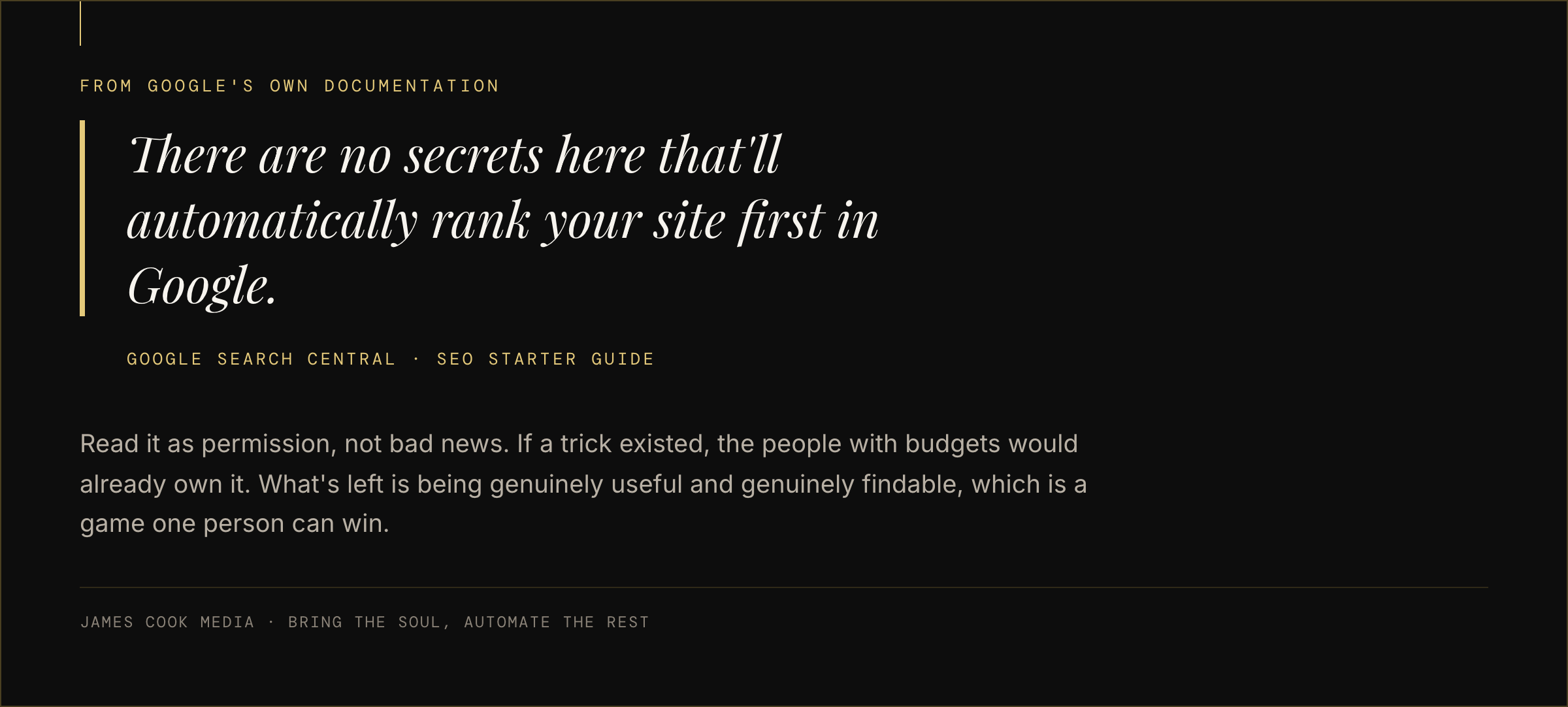
Read that as permission. If there were a trick, the people with budgets would already own it. What's left is being genuinely useful and genuinely findable, which is a game one person can win.
SEO for coaches with a small site and no name recognition
A small site is only a disadvantage on broad searches. You will not outrank a large publisher for "life coach," but you can be the best answer for the exact situation your clients arrive with. Narrow, specific and honestly written is the one strategy that doesn't require authority you haven't built yet.
The fear underneath most of this isn't technical. It's "this works for other people but not for me, because I'm too small."
On broad terms that fear is correct, so stop competing there. On specific ones it's simply wrong, because no big competitor is writing about the precise thing your client was googling at 11pm. That page doesn't exist yet, and you're the only person who could write it, because you've had the conversation forty times.
On timelines, don't let anyone sell you speed. Greg Faxon, a coach who built his practice on search, puts the honest answer at three to six months. I'd rather you hear that than a promise.
We've trained more than 100,000 experts in this material since 2018, and none of that scale is the point here: the ones who get found are almost never the ones who did the most. They published four honest, specific pages instead of forty vague ones.
One small next step
See the method before you buy anything bigger
The AI MasterClass walks through how we turn what you already know into pages that get found, including the prompts. It assumes one person with a laptop, because that is who it was built for.
Take the AI MasterClass → About 90 minutes · Watch at your own pace · No subscriptionThe plain-English glossary, in two minutes
Almost all SEO jargon collapses into a handful of ordinary ideas. Keyword means the phrase someone types. Indexing means Google knows your page exists. Backlink means someone linked to you. On-page means the words on your page. Once the words stop being intimidating, the work does too.
Keep this open the next time you read an SEO article.
| The term | What it actually means |
|---|---|
| Keyword | The phrase a person types into the search box |
| Search intent | What they were actually trying to do when they typed it |
| Crawling and indexing | Google reads your page, usually via a link, then files it |
| On-page SEO | The words, title and headings on the page itself |
| Off-page SEO | Everything outside your site, mostly other people linking to you |
| Backlink | A link to your page from someone else's site |
| Meta description | The short summary shown under your title in results |
| Technical SEO | Making sure nothing on your site stops Google reading it |
| E-E-A-T | Google's shorthand for experience, expertise, authority, trust |
| GEO | Being quoted by AI assistants rather than clicked in a list |
If a consultant uses a term not on this list and can't translate it in one sentence, that's information about the consultant.
Your first month, in four sittings
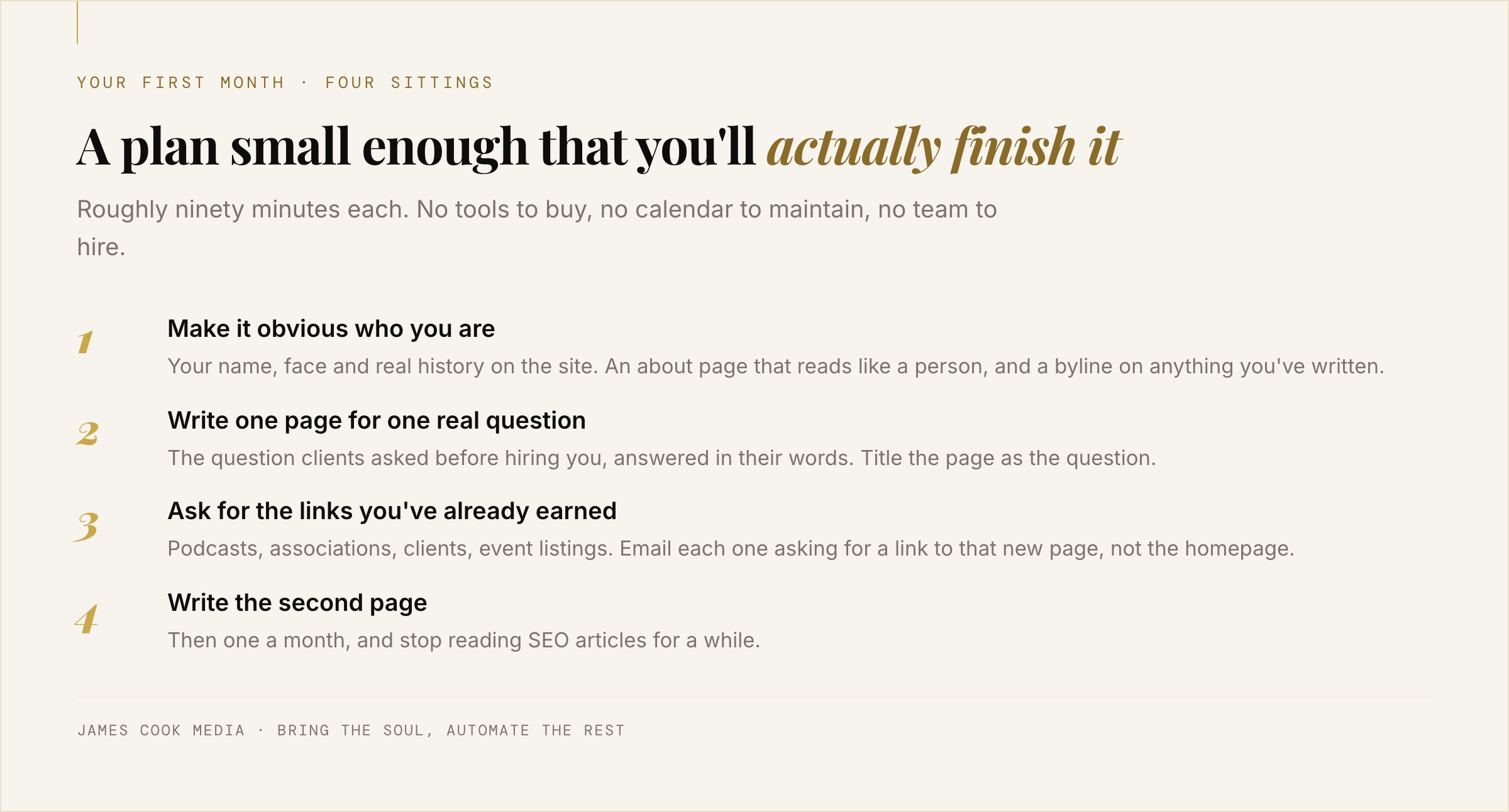
Four sittings of roughly ninety minutes each will put a solo consultant ahead of most coaching websites: make it obvious who you are, write one page for one real client question, ask for the links you've already earned, then write a second page. No tools, no calendar, no team.
The point of a plan this small is that you'll finish it. Ambition is what killed the last four attempts.
Sitting one. Put your name, face and real history on the site. An about page that reads like a person, and a byline on anything you've written.
Sitting two. Find the three questions clients asked before hiring you, pick the one you answer best, and write that page in their words. Title it as the question.
Sitting three. List every place that already knows you: podcasts, associations, clients, event pages. Email each one asking for a link to that new page.
Sitting four. Write the second page. Then keep writing one a month, and stop reading SEO articles for a while, including this one.
That's a real SEO strategy. It's smaller than you expected, which is why it'll get done. If the deeper problem is that your expertise is obvious in a room and invisible on a screen, best in the room, invisible online is the piece to read next.