
You are excellent with the clients in front of you, and completely unknown to everyone who has not met you. This piece is about that specific gap, and why closing it is a mechanical job rather than a talent one.
Put you in a room with a prospect and you win. You ask the question nobody else asked, you name the problem they had been describing badly, and by the end of the hour they trust you. That is not luck. It is years of pattern recognition doing its work in real time.
Now put that same prospect at a laptop, three weeks before they meet anyone. They type their problem into Google, or ask an AI assistant who they should talk to. You are not in the answer. Someone with a fraction of your judgement is, because they wrote the page you never wrote.
That is the whole gap. Not that you are less good. That you are less retrievable. Almost every conversation about how to get found online as an expert quietly assumes the opposite: that visibility is a reward for quality, and if you are invisible you must not be good enough yet.
Being good and being findable are two different systems
Being good and being findable run on different mechanisms. Excellence is judged by a human in a room, in real time, from evidence you provide live. Findability is judged by a retrieval system that reads text, before any human is involved. Your expertise is the input to the first system and almost invisible to the second, which is why quality alone never produces online clients.
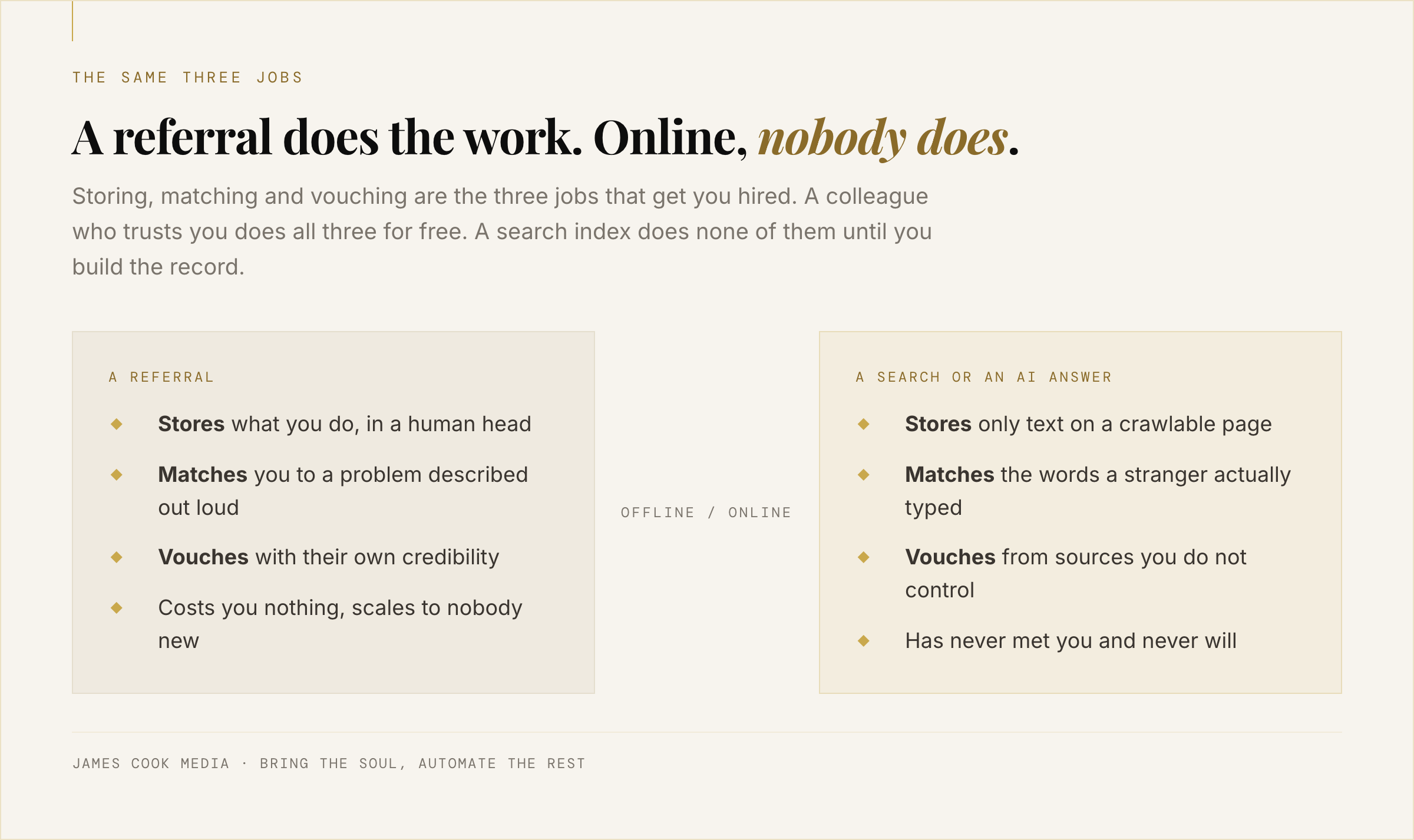
Think about how your referrals actually work. Someone who already trusts you holds your expertise in their head. When a colleague describes a problem, that person does the retrieval for you: they remember you, they vouch for you, they hand over your name with their own credibility attached.
That intermediary is doing three separate jobs. Storing what you do. Matching it to a stranger's problem. Vouching that you are real. You have never had to do any of them yourself, because a human network did all three for free.
Online there is no colleague in the loop. The storing, matching and vouching are done by a search index and a language model, and neither has ever met you.
Once you see it this way, the emotional charge drains out of the problem. You are not being rejected. You were never entered. There is a difference between losing a competition and not being on the list, and for most experts it is the second one.
A companion piece, the five reasons experts stay invisible, catalogues the specific failures. This article is about the layer underneath all five: the mechanism itself.
What a machine actually sees when it looks at you
Search engines and AI assistants read text on public pages. They do not watch your calls, read your PDFs, or infer your judgement from a beautiful design. Everything you know that has not been published as readable text on a crawlable page is, to them, evidence that does not exist. That is a supply problem, and supply problems have solutions.
This is the part I would rather you test than take on faith, because it is checkable in ten minutes. Open your own website and imagine it with every image, video, animation and stylesheet stripped away. What sentences are left? For a lot of expert sites the honest answer is: a headline about transformation, three service names, a line about passion, and a contact form. That is the entire evidence base a machine has for deciding whether to recommend you.
It gets more literal than that. Vercel's crawler analysis found that none of the major AI crawlers execute JavaScript, including OpenAI's GPTBot, Anthropic's ClaudeBot and PerplexityBot. If the substance of your page is loaded by script after the page arrives, those systems see an empty shell. Your best thinking can be on the page and still be unreadable to the thing deciding who gets named.
Notice what that finding is not. It is not a judgement about your work. It is a technical fact about a crawler. You can be the most qualified person in your field and lose to a worse practitioner on a plainer page, for reasons that have nothing to do with either of your abilities. That should be annoying. It should also be a relief, because facts like that get fixed.
The three things you need to get found online as an expert
To get found online as an expert you need three things in place: a published record, so the claim exists in text a machine can read; a readable structure, so the answer inside it can be extracted; and outside corroboration, so the claim can be verified against something you do not control. Miss any one and the other two stop working.
These map exactly onto the three jobs your referrer was doing for you. The writer of an Entrepreneur piece on the invisible layer of a website puts the first one bluntly: if it isn't published, it doesn't exist. Everything in your head, your slides, your unsent proposals and your private PDFs is, for this purpose, nowhere.
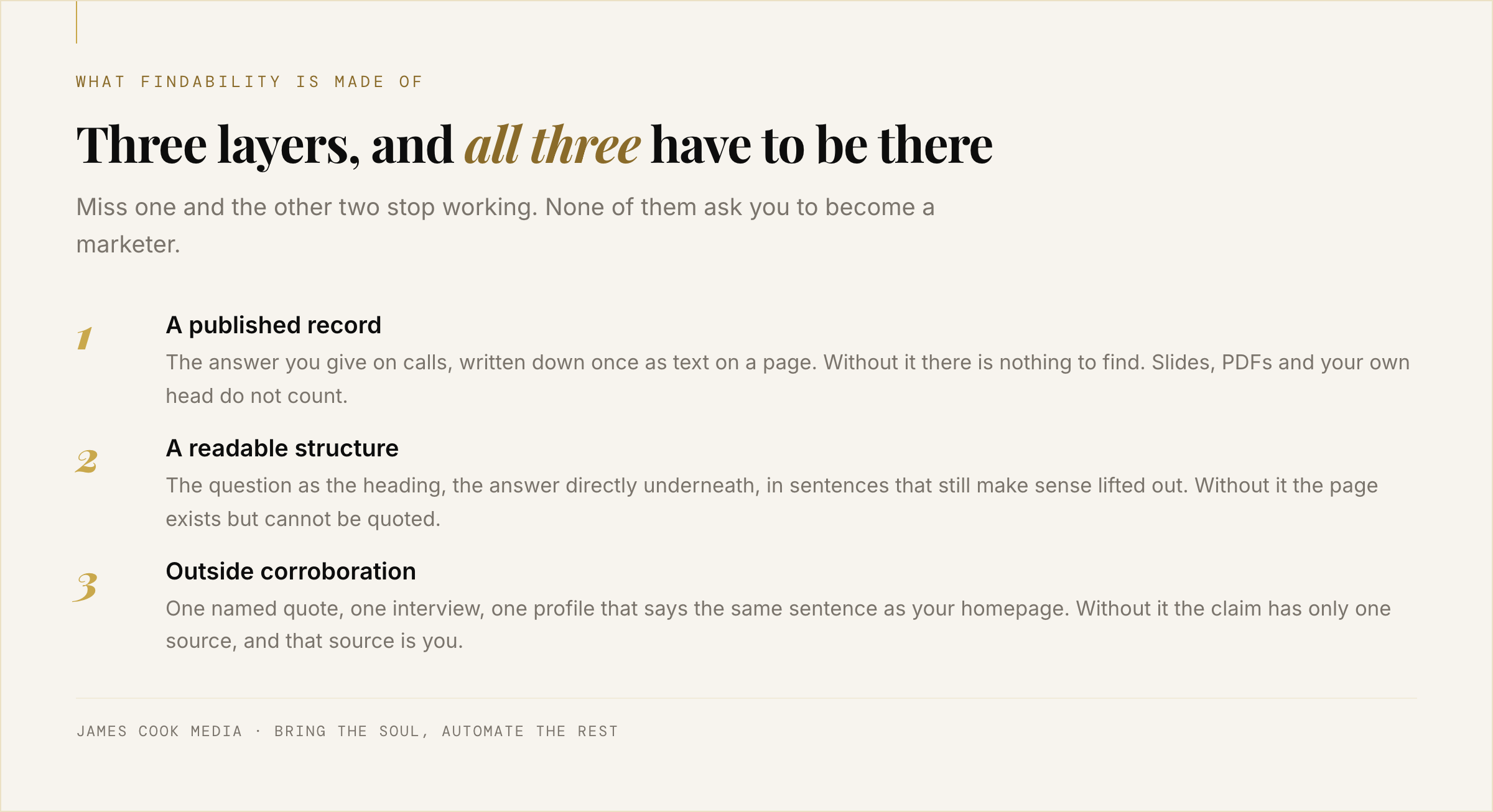
The published record is the answer you have given a prospect forty times, written down once on a page of its own. Not a brochure about your approach. The actual answer, with the specifics you would give in a call.
The readable structure turns that page into something quotable. A question as the heading. The answer immediately underneath, in plain sentences that survive being lifted out of context. Most expert writing buries its answer in paragraph six after establishing credentials, which reads fine to a patient human and is useless to a machine looking for a passage to cite.
The corroboration is the part solo experts skip, and it is the closest equivalent to a referral. A podcast appearance, a named testimonial on a page you don't own, a professional profile saying the same sentence as your homepage. It is how a system checks that the record is not just a person describing himself.
None of the three require you to become a marketer. They require you to write down what you already say, in a shape a machine can read, in more than one place.
A four-question test of your own findability
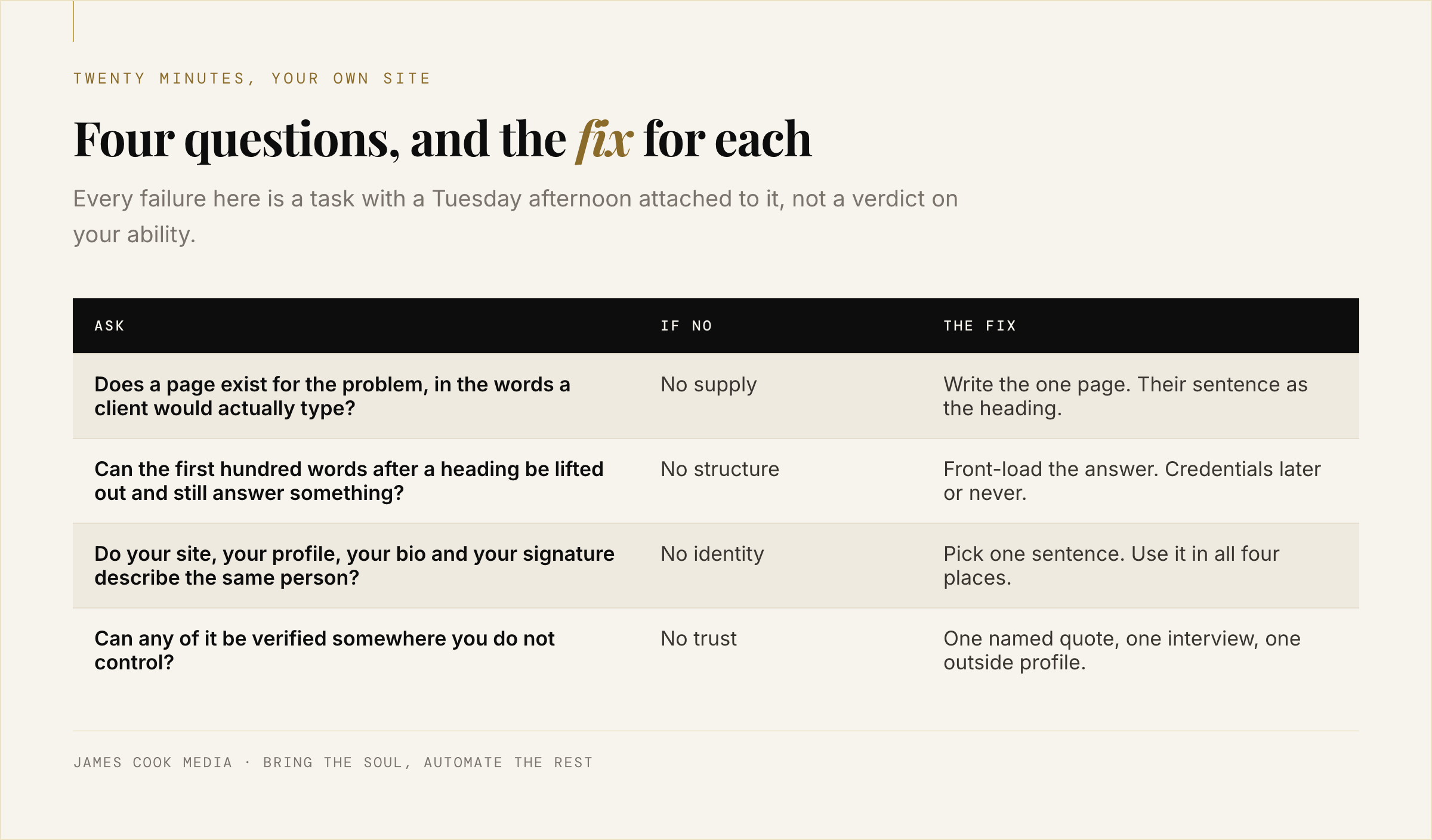
Four questions diagnose most invisibility. Does a page exist for the exact problem a client would search? Can the answer be lifted out of it and still make sense? Does one consistent sentence describe you everywhere online? Can any of it be verified somewhere you do not control? Each failure is a task, not a verdict.
Do this on your own site before you buy anything or hire anyone. It takes about twenty minutes and tells you whether your problem is supply, structure or trust.
One. Does a page exist for the problem, in their words? Write down the sentence a client would actually type. Not your service name. The sentence, with the frustration in it. Now search your own site for a page that answers it. Usually there is none, because your pages are organised around what you sell rather than what they are worried about.
Two. Can the answer be lifted out? Take your best page and copy the first hundred words after a heading. Do they answer anything on their own? If they only make sense after the two paragraphs above them, no engine will quote them and no reader in a hurry will reach them.
Three. Is one sentence about you consistent everywhere? Your homepage, your LinkedIn headline, your speaker bio, your email signature. If those four describe four slightly different people, no system can form a stable idea of what you are the person for. This is the single most common failure among genuinely senior experts, because breadth reads as inconsistency to a machine.
Four. Does anything outside your control confirm it? One named client quote, one interview, one profile on a partner site or directory. If the only source for your expertise is you, the claim is unverified.
Score yourself honestly. In my experience most experts fail three of the four, and every one of those failures is a specific afternoon of work rather than a personality transplant.
One small next step
Learn the method before you change anything
The MasterClasses walk through how we turn what an expert already says into pages people and AI engines can find. Same approach we run for clients, including the structure and the prompts.
See the MasterClasses → About 90 minutes · Watch at your own pace · No subscriptionWhy being better makes it worse
Real expertise actively works against findability. Deep experts qualify their answers, resist simple claims, distrust repetition and want to be ready before publishing. Every one of those instincts is correct in a client room and costly on a public page, where clarity, repetition and a stated position are what make you retrievable at all.
The novice says "I help you double your revenue" and is wrong. You say "it depends on where the constraint actually sits, and in most cases it is not where the client thinks", and you are right. Only one of those sentences can be matched to a search. Your accuracy costs you the match.
The same instinct shows up as reluctance. You do not want to be one more person on the internet announcing his own brilliance, and the alternative on offer looks like exactly that. Bobby McGee's line is the one I hear most often: "I'd rather not make sales than prostitute myself." That is not a flaw, it is taste. Left uncorrected, it is also what keeps the work invisible.
Then there is the readiness trap. The framework isn't finished. The site needs redoing. You would rather publish nothing than publish something you would revise. Meanwhile the machine has nothing to read, and a competitor's half-thought-out page is the one being cited. We go further into that delay in why "not ready yet" keeps you invisible.
Here is the reframe, stated once and plainly. Being invisible online is not a verdict on your ability. It is a report on your supply of readable evidence. One of those is an identity question you cannot fix. The other is a to-do list.

The smallest version that works
Start with one page, not a strategy. Take the question you answer most often, write the answer you would actually give on a call, publish it with the question as the heading and the answer directly underneath, and make one outside profile say the same sentence as your homepage. That is a complete first cycle of findability, and it takes an afternoon.
Most experts stall because the fix gets presented as a programme. Content calendar, keyword research, brand refresh, six-month runway. You are busy serving the clients you have, so you never begin, and the not-beginning gets stored as further evidence that this works for other people.
So make the first move absurdly small. One question, one page, one consistent sentence, one outside mention. Nothing else this month.
Pick the question by frequency, not by cleverness. The thing you have explained so often that you are slightly bored of it is almost always what strangers are searching for. Boredom is a reliable signal of demand.
Then write it the way you say it. Talk it into your phone if typing makes you formal. James Cook Media has trained more than 100,000 experts since 2018, and the pattern holds almost without exception: the ones who become findable are not the ones with better marketing instincts, they are the ones who wrote down the answer they already had. That is an agency-scale number describing a mechanism that works exactly the same with three clients and a laptop.
Volume is not the lever here, which is worth saying because "publish more" is the usual advice. Ten pages that each answer a real question outperform a hundred posts about your philosophy. We made the full case for that in findability beats volume.
What changes when the mechanism is in place
When findability works, the room advantage you already have finally gets used. Prospects arrive having read the answer, already half-convinced, and the conversation starts where it used to end. Nothing about how you sell has to change. The only difference is that people now reach the room, having found you before anyone introduced you.
The outcome is not that you become known. It is narrower and better: the right stranger reaches the conversation where you are strongest. You are not being asked to become a personality, build an audience or perform confidence on video, only to make the expertise you already have legible to systems that read.
Expect it to feel slow before it feels like anything. Pages accumulate quietly and then start producing conversations, and the first inbound message tends to arrive from a search you never targeted.
Being the best in the room is still the thing you have to be. This is only about making sure someone shows up to the room.