
You are better at this than the people winning the clients you should be winning. Here are the five reasons that gap exists, the symptom of each, and the smallest fix you can start this week.
Someone with half your experience just landed the engagement you'd have done properly. You watched it happen on LinkedIn, in a newsletter, in a podcast appearance you'd have been better on, and the only honest explanation you can find is that they market and you don't. That explanation is close, but it isn't useful, because "market more" isn't something you can do on a Tuesday between client calls.
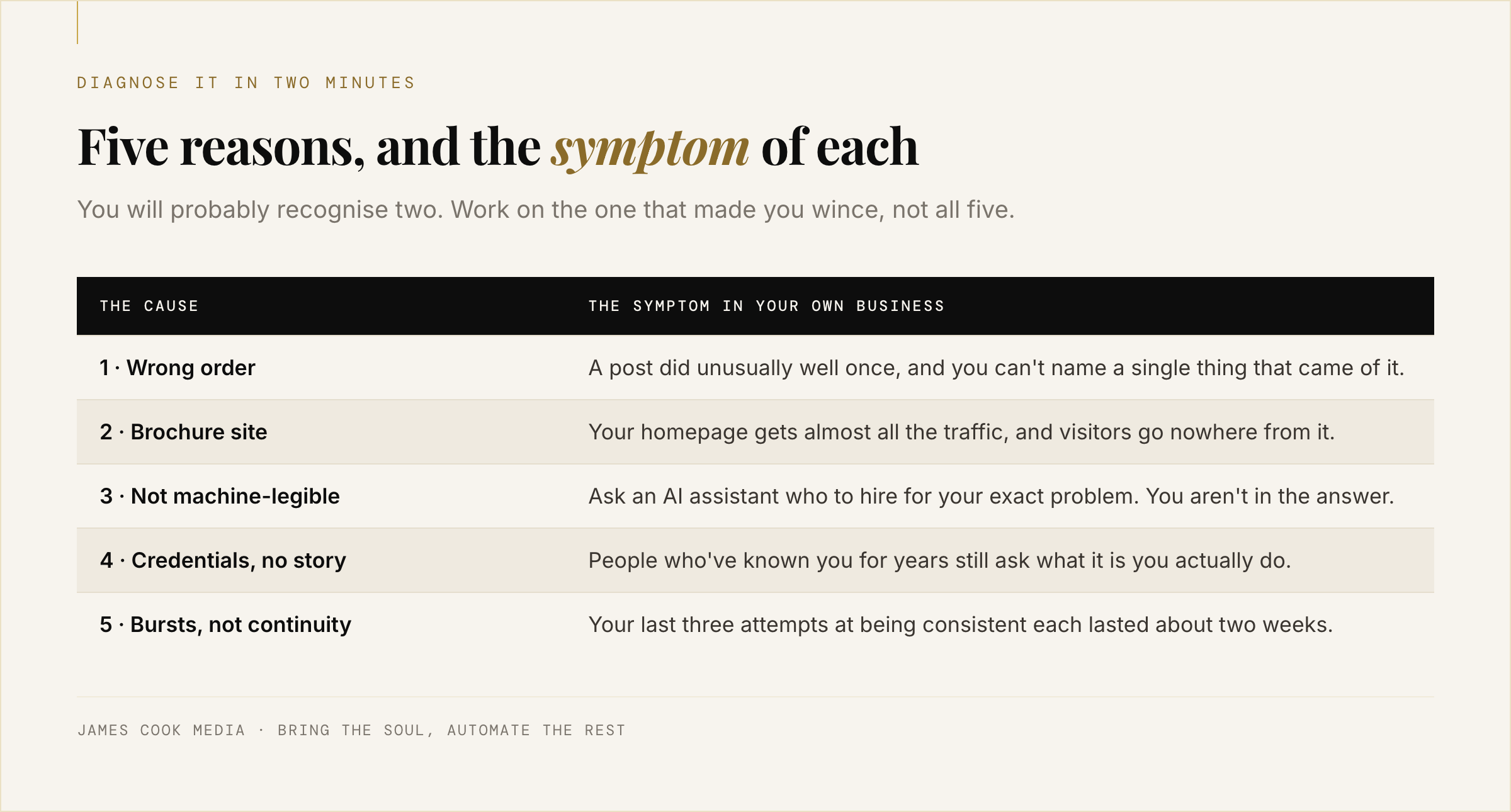
The useful version is narrower. Why experts are invisible online almost always comes down to five specific, diagnosable causes, and none of them is talent. Each one has a symptom you'll recognise from your own situation, and each one has a first move small enough to make this week.
Why experts are invisible online, in one sentence
Experts are invisible online because expertise and findability are two different assets, built in different ways. Being the best in the room is a competence problem you have already solved. Being found is an infrastructure problem: something readable has to exist, at an address, answering a question a stranger actually types. Most experts have never built that second thing.
The people out-marketing you are not smarter about your subject. They are usually worse at it. What they have is a page that answers a question, a story that survives being retold by someone who half-remembers it, and enough consistency that a machine has something to index.
That's the mechanism, and there's a fuller argument for it in why you can be the best in the room and invisible online. This piece does the other half of the job: not why the gap exists, but which of five specific causes is producing it in your case.
Read the five with a pen. You will probably have two.
Reason 1: you built it in the wrong order
Most experts try to build attention before they build a destination. They post, comment and appear on podcasts while there is nowhere for an interested stranger to land, nothing to read, and no next step. Attention arrives, finds nothing to do, and leaves. The order that works is destination first, then attention pointed at it.
The symptom: you can remember a week where a post did unusually well, and you cannot name a single thing that came of it. Or you can, and it's one connection request.
This is the quietest of the five because it feels like progress. Posting is visible activity. It produces likes, which produce the feeling of momentum, and none of that survives contact with a buyer who wants to know whether you can fix their specific problem before they'll email a stranger.
Attention is the last step, not the first. Before it you need one thing worth arriving at: a page that answers one real question, thoroughly, at a permanent address, with an obvious small next step at the bottom.
This week: take the question a client asked you most recently, the one you answered in eight minutes because you've answered it four hundred times, and write the answer down as one page. Not a post. A page, with a URL, that will still be there in two years.
Reason 2: your website is a brochure, not an answer
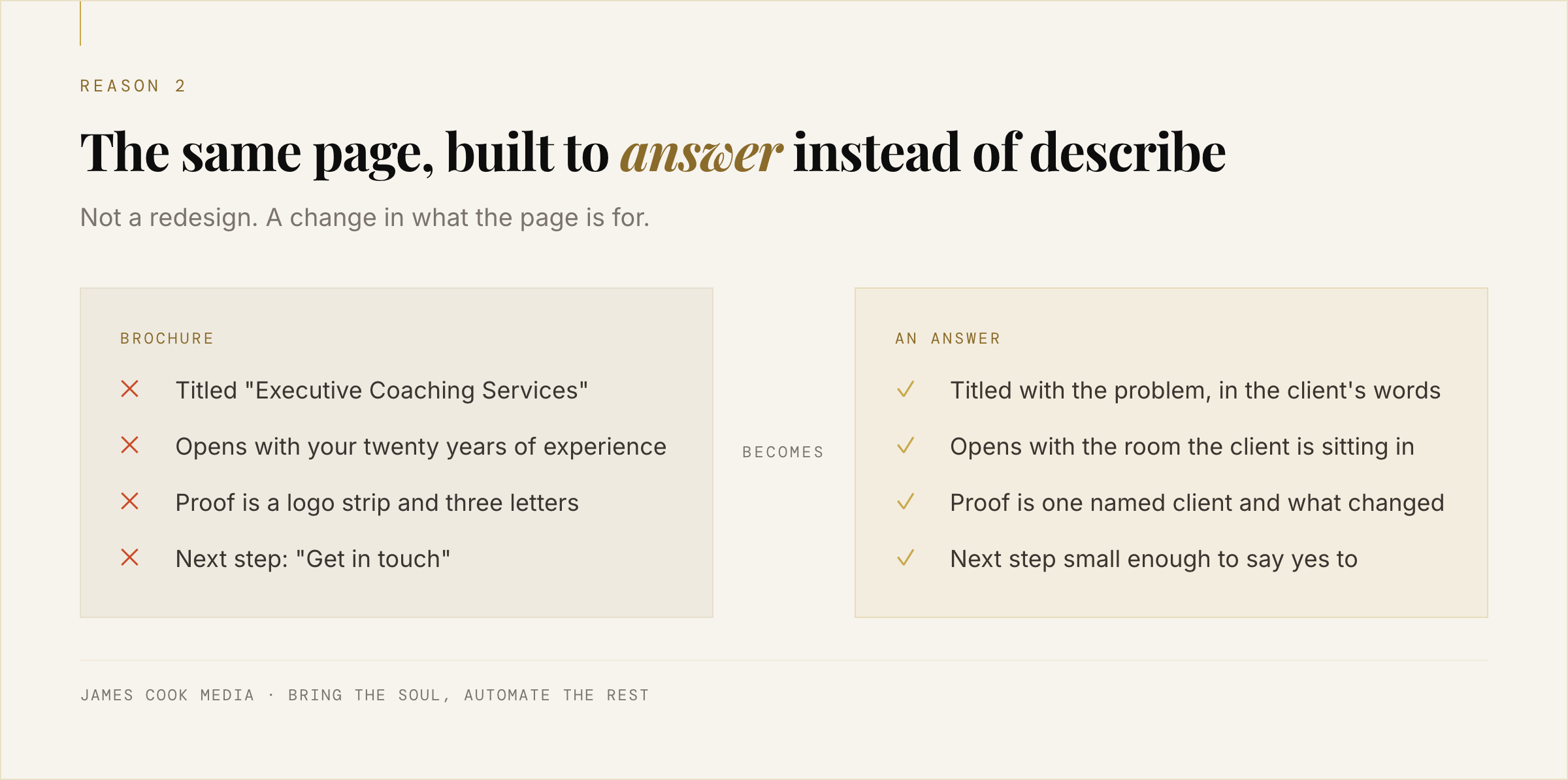
A brochure site describes the business: home, about, services, contact. Nobody searches for a description of a business they've never heard of. They search for their problem. A findable site is built the other way round, from the questions people type, and each page answers one of them well enough to be worth citing.
The symptom: your homepage is your most-visited page by a wide margin, and visitors don't go anywhere from it. That's not a traffic problem, it's a shape problem. Every page on the site depends on the reader already knowing who you are.
The window is shorter than most people believe. Nielsen Norman Group's analysis of over 205,000 pages found the first ten seconds of a visit decide whether someone stays, and that a page has to make its value clear inside that window. A brochure homepage spends those ten seconds introducing itself.
The fix is not a redesign. It's a change in what the pages are for. There's a longer treatment of the difference in your website is a brochure, not a funnel, including what to do with the brochure pages you already have.
This week: pick your strongest service page. Retitle it with the words a client would use for the problem, not the words your industry uses for the solution, and rewrite the first paragraph so it describes their situation rather than your credentials.
Reason 3: nothing you publish is legible to a machine
Search engines and AI assistants can only recommend what they can read, understand and verify. That means plain answers near the top of a page, specific claims rather than adjectives, your name and specialism stated in text rather than implied by a logo, and corroboration somewhere other than your own site. Most expert sites give a machine almost nothing to work with.
The symptom, and it takes two minutes: open an AI assistant and ask it who it would recommend for the exact problem you solve, in the region you serve. Then search your own name plus your specialism. If you don't appear, and nothing you've written appears, this is your reason.
This is a genuinely separate cause from the two above. You can have a well-ordered site full of real answers and still be unreadable, because the answers are buried in prose that never states them plainly, the video has no transcript, and there is no sentence anywhere that says who you are and what you do in a form something can quote.
It also matters more each year, because a growing share of buyers now ask an assistant before they ask a search box. Getting cited by AI search covers the mechanics; the short version is that legibility is a writing habit, not a plugin.
This week: add one 50-word plain-answer paragraph to the top of your best page. State the answer, not a promise of the answer. Then put your name, your specialism and where you work in readable text on your about page, in one sentence a stranger could quote.
Reason 4: you have credentials where a story should be
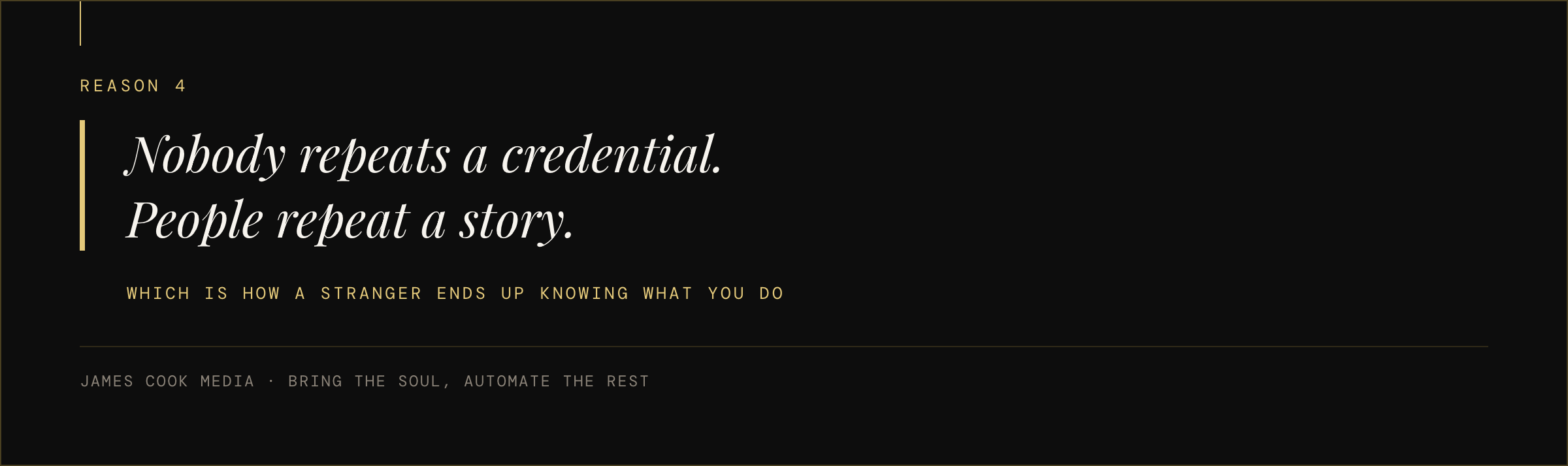
Credentials establish that you are qualified. They do not travel. Nobody repeats a certification to a colleague over coffee, and nobody remembers a list of years. A single specific story about one person you helped does both jobs: it proves competence and it survives being retold badly by someone who only half-listened.
The symptom: people who have known you for years still ask "remind me exactly what you do?" If your own network can't reproduce your positioning, a stranger has no chance.
Most expert sites lead with the wrong asset. Twenty years of experience, three letters after your name, a client logo strip. All true, all inert. The reason it feels safer is that it's defensible. A story is exposed: it names a person, a mess, a decision, and a result you either got or didn't.
Story is also what buyers use to judge you. The consultant positioning breakdown at Websites for Experts cites Edelman's B2B research finding that most decision-makers judge an organisation's competence by the quality of its thinking rather than its stated credentials. They read how you think about a problem, then decide.
This week: write 200 words about the client you helped most. Where they were when they called, what you found, what you changed, what happened. Put it on the page a stranger reads first, above the credentials.
Reason 5: you show up in bursts, so nothing compounds
Findability is cumulative. Six weeks of publishing followed by four months of silence resets almost everything: the index goes stale, the audience forgets, and the reader who found you in March has nothing new to read in July. Volume is not the point. Continuity is, which is why an honest small cadence beats an ambitious one you'll abandon.
The symptom: your last three attempts at "being consistent online" each lasted about two weeks. You know exactly which two weeks.
This is the reason most likely to be misdiagnosed as a discipline failure. It usually isn't. It's a design failure: the plan required you to be interesting on demand, several times a week, forever, while running a business single-handed. Nobody sustains that, and the people who appear to are not doing it the way you think.
What survives is a system where the human part happens once and the mechanical part happens without you. You talk for an hour, because talking is the thing you're already excellent at, and the editing, the formatting, the scheduling, the repurposing all run downstream of that hour. Bring the soul, automate the rest. That's the whole idea, and it's the only version of consistency a one-person business can actually keep.
This week: put one recurring hour in your calendar for the next three months and label it with the format you'll actually do. One hour a month that happens beats four a week that doesn't.
What to do in the next seven days
Don't fix all five. Run the diagnosis, pick the one whose symptom made you wince, and do only that reason's small fix this week. The five causes are ordered roughly by leverage: a destination before attention, an answer before a brochure, legibility before volume. Fixing one properly changes more than starting all five.
Everything above is deliberately small, and that's not modesty about what it takes. It's the shape of the only approach that works for someone with a full client load. The larger version of this is the machine we build for clients: over $10M generated since 2013, and a client site that went from a brochure to a story-driven page at +50.4% revenue per visitor. Those are agency numbers with agency budgets behind them, and the mechanism underneath them is the same one that works with three clients and a laptop, because the mechanism is just answers, story and continuity.
The part that is hard to do alone is the diagnosis. You are too close to your own site to see which of the five is actually biting, and if you pick wrong you spend three months on the second-most-important thing.
One small next step
Bring the one you can't diagnose yourself
Tell us which of the five made you wince and we'll look at your situation with you: what to fix first, what to leave alone, and what order the rest goes in. A conversation, not a pitch.
Book an AI System Design Sprint → One conversation · Nothing to prepare · No obligationWe've trained over 100,000 experts on this since 2018, and the pattern almost never varies: the thing keeping a good expert invisible is boring, specific, and fixable in weeks once it's named. It was never the talent. You had that part before you started reading.