
You have listed the modules, the hours, the framework and the bonus workbook, and the page still converts nobody. The problem is not that your description is unclear. It is that it describes what you will do, and says nothing about who your buyer becomes.
Somewhere on your site there is a section you are quietly proud of. Six modules. A named framework. Weekly calls, a workbook, lifetime access to the recordings. Everything in it is true, and it took you years to be able to offer it.
And it lands on nobody. People read it, nod, say "this looks really valuable, let me think about it," and never come back. So you assume you undersold it, and you add a seventh module.
Here is the part most guides skip. Every line of that list answers the question what do I get. Not one line answers the question the buyer is actually asking, which is: who do I get to be on the other side of this? That is why people buy, and it is the question your page never touches.
What your module list is actually telling him
A feature list describes the seller's labour, not the buyer's future. Modules, hours and frameworks tell someone what you will do to them, which is information they cannot use to picture themselves. Before anyone weighs your curriculum, they are checking whether the person who finishes it is someone they want to be. Nothing on a module list answers that.
Read your own sales section as a stranger and count two things: how many sentences are about your work, and how many are about your buyer's life afterwards. On most expert pages the second number is zero.
This is not a copywriting flaw, it is a point-of-view flaw. You built the thing, so you describe the thing. You know how much craft is inside module four; he has no way of knowing and no reason to care yet.
What he is doing on your page is far less analytical than you imagine. He is trying to picture a version of himself he can live with: the consultant who finally has a waiting list, the founder who stopped being the bottleneck, the writer who actually finished. Your module list gives him nothing to picture. So he stalls, and calls the stall "let me think about it."
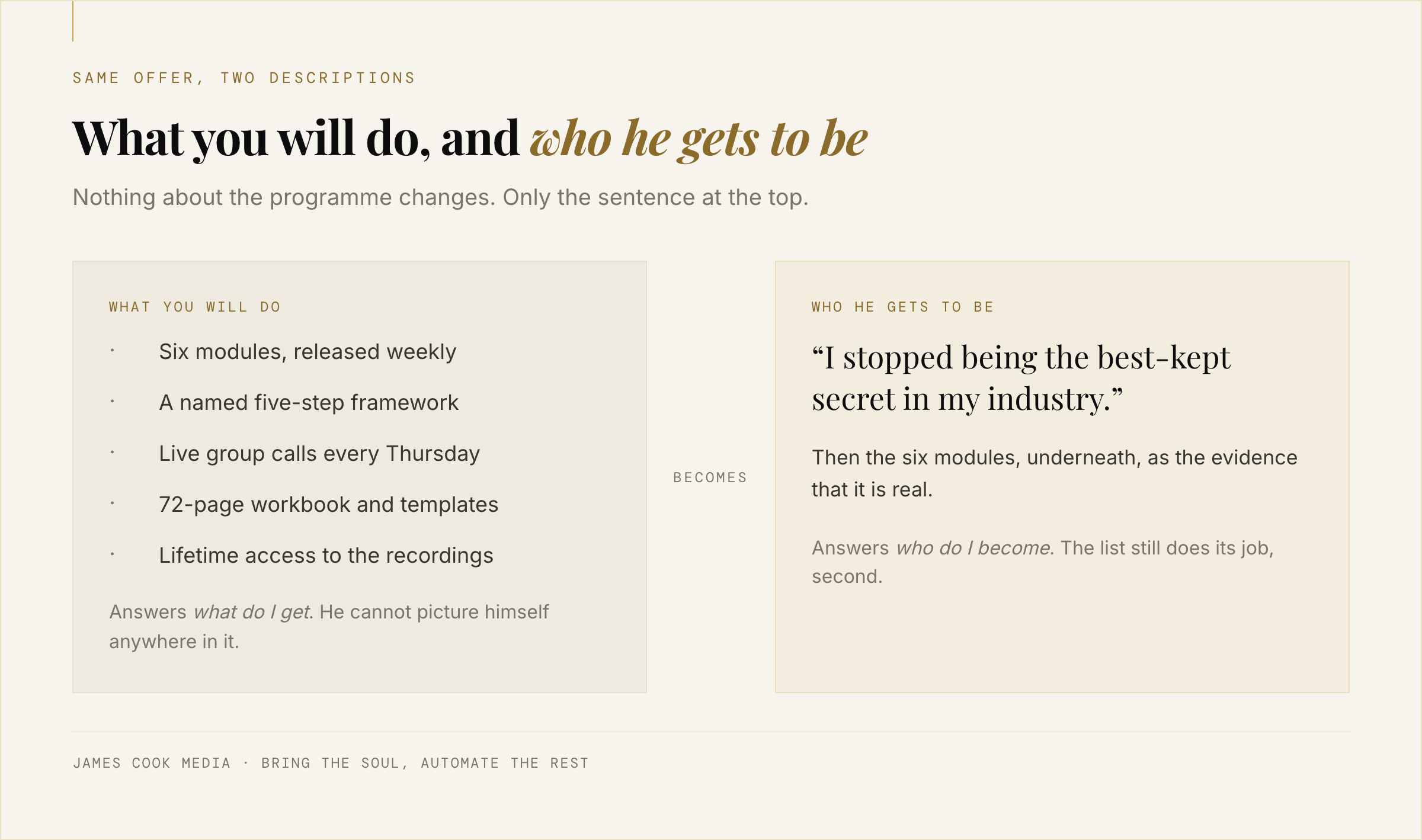
The uncomfortable version: two people can sell an almost identical programme, and the one who names the identity wins, even when the other is better at the work. You have watched that happen and concluded the winner was just louder.
Why people buy: the identity is the product
People buy the version of themselves they get to become. Every purchase carries a small claim about who the buyer is, and the offer that gets chosen is the one whose story the buyer already wants to tell. The programme is the mechanism. The identity is the product. Features only matter once the identity question is settled.
Think about the last thing you bought that cost real money and was not strictly necessary. A course, a coach, a certification. You can probably reconstruct the rational case you made, and you can probably also remember the sentence underneath it: "I'm the kind of person who takes this seriously."
That sentence is the purchase. The rational case was the receipt.
This is not new in the research literature. The Journal of Consumer Research summarises decades of work with the flat statement that consumers use possessions and brands to create their self-identities and to communicate those identities both to other people and to themselves. That last part matters most for you. Some of the audience for his purchase is other people. Most of it is him.
Sharon Shavitt, Carlos Torelli and Jimmy Wong, writing in the Journal of Consumer Psychology, describe how a salient identity can trigger mental processes that guide subsequent action. Make an identity vivid and available, and behaviour follows it. That is the whole mechanism, stated plainly by people with no funnel to sell.
For a solo expert, this is good news of a specific kind. You do not need a bigger programme. You need to name a person. That costs nothing and takes an afternoon.
What the research actually says, and where it stops
Identity-based buying is real and well studied, but it is not a universal law. Research suggests it works most strongly for purchases that carry visible meaning, and barely at all for functional ones. And the famous claim that 95% of buying decisions are subconscious is a misquoted estimate about all human thought, not a finding about purchases.
I want to be careful here, because this idea is usually sold with more certainty than it has earned.
Two honest limits. First, identity does not drive every purchase equally. Shavitt and her co-authors are explicit that the product itself constrains which motives operate: a wedding ring or a hybrid car engages identity readily, dental floss does not. If what you sell is genuinely commodity plumbing for someone's business, identity framing will feel pasted on, and it will read as pasted on.
Second, the statistic you have seen quoted everywhere is not what it claims. The line "95% of purchase decisions are subconscious" traces back to Gerald Zaltman's How Customers Think, which actually says that about 95 percent of thought, emotion and learning occur in the unconscious mind, and which took that in turn from Lakoff and Johnson as a cognitive-science rule of thumb about all thought. One careful trace of the claim points out it was never a measurement of purchases at all.
The real evidence nearby is more modest. The consumer psychologist Peter Noel Murray, writing in Psychology Today, reports that emotional response to an advertisement influences reported intent to buy far more than the ad's content, by roughly three to one for television and two to one for print. And Stanford's Baba Shiv has shown in wine-tasting experiments that believing a wine is expensive changes how much pleasure people report, which suggests feeling shapes perception rather than merely following it.
That is enough to act on. Not enough to claim you have found a law.
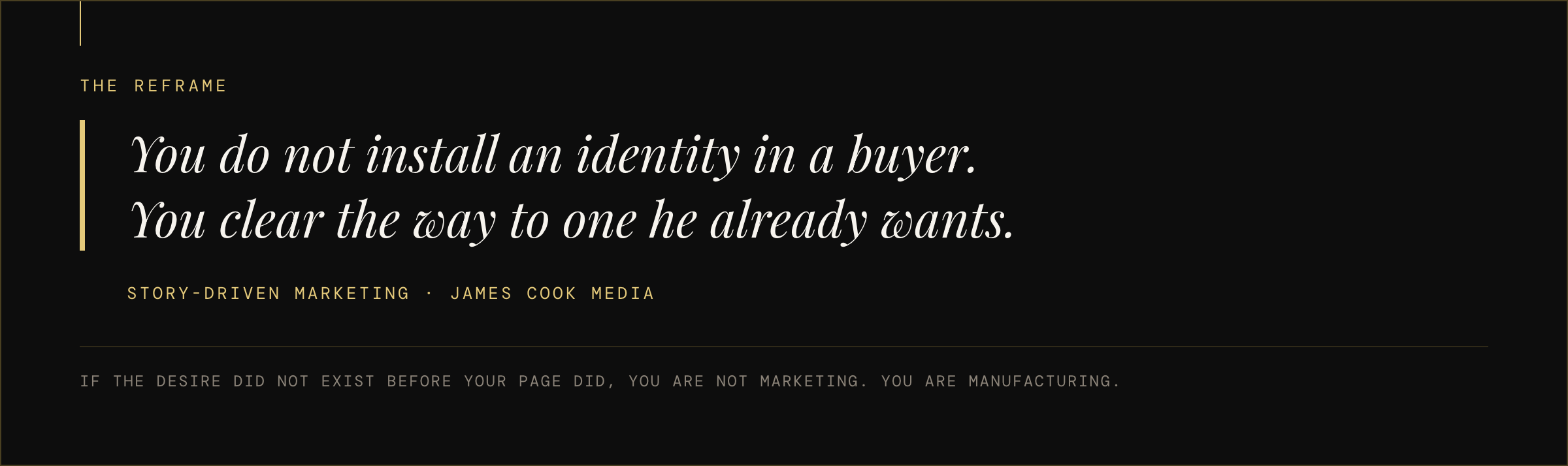
Holding the idea loosely has one practical consequence: you stop trying to manufacture desire and start trying to find it. Which is the only honest version of this anyway.
The line between identity and manipulation
Identity language becomes manipulation the moment it creates the insecurity it then offers to fix. Honest identity marketing names an aspiration the buyer already holds and shows a real path to it. Manipulative identity marketing invents a deficiency, attaches shame to it, and sells relief. The words often look identical. The direction of the arrow does not.
This is the failure the idea invites, and almost nobody writing about it draws the line. Read a dozen "sell identity, not features" posts and you will find Rolex, Apple and CrossFit, and not one paragraph about where it goes wrong.
It goes wrong quickly. The sentence "you are already the best in the room and nobody online can tell" can be twisted into "you are invisible because you are not enough yet." The first names a gap between his competence and his visibility, which is true and which he already feels. The second manufactures a gap in his worth, which is not true, and which he will now carry.
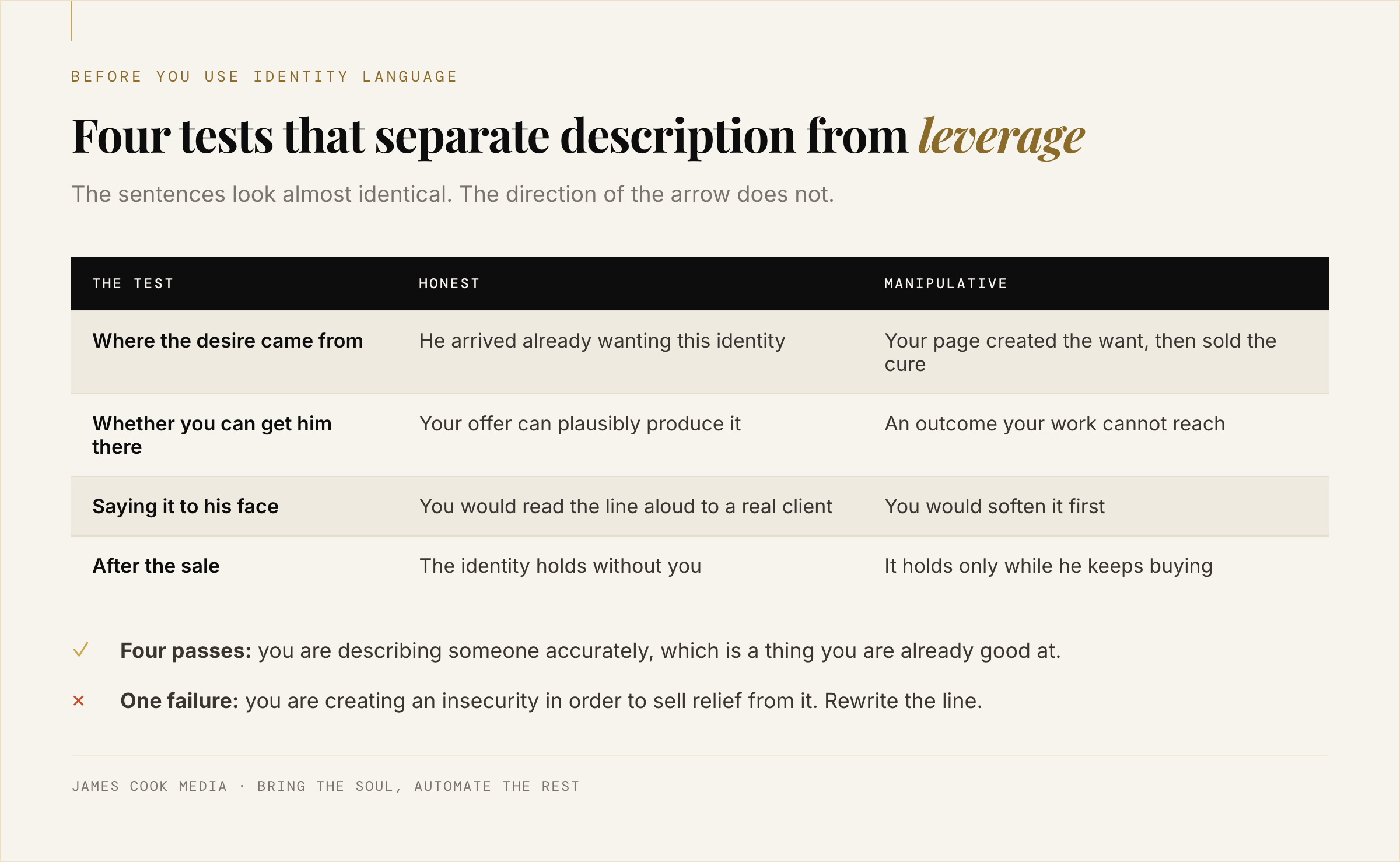
Four tests, and they are not subtle.
Does he already want this identity, or did you install the want? If he arrived wanting it, you are helping. If your page had to create the desire before it could sell the cure, stop.
Is the identity reachable by the thing you sell? Naming an outcome your programme cannot plausibly produce is not aspiration, it is a lie with better grammar.
Would he recognise your description of him if you read it aloud to his face? Say it to an actual client. If you would soften it before saying it out loud, it is not a description, it is leverage.
Does the identity survive the sale? If it only holds while he keeps buying, you have built dependence and called it transformation.
This distinction is also, bluntly, why you flinch at marketing in the first place. If you have only ever seen the manipulative version, you reasonably conclude that is what selling is, and your refusal to do it is a correct instinct aimed at the wrong target. The honest version asks you to describe one person accurately, which is a thing you are already good at, and which costs you nothing you would miss.
How to find the story he is already telling himself
You do not invent your buyer's identity, you collect it. The exact words are already in your sales calls, your onboarding notes and the first ten minutes of every discovery conversation. Listen for the sentence a client says about who he was before and who he wants to be after, then write it down verbatim and put it on the page.
This part is research, not creativity, which is good news if writing copy makes you tense.
Open the notes from your last five client conversations. You are looking for three specific things, and they are almost always there.
The before sentence: how he described himself when he arrived. "I'm basically the best-kept secret in my industry." "I feel like a fraud charging this much." Not the problem, the self-description.
The after sentence: what he said he wanted, in his words, not the outcome you would have written. Often it is smaller and stranger than a marketing outcome. "I want to stop feeling anxious every time I check my inbox."
The witness: who he wanted to see the change. A spouse, a former boss, a peer who has been condescending for years. Identity is partly social, and the research bears this out. Work by Chan, Berger and Van Boven, summarised by the Journal of Consumer Research, found that people pursue group belonging and personal uniqueness at the same time, conforming on the attributes that signal membership while differentiating on others.
Then the only mechanical step. Put his before sentence and his after sentence on your page above the module list, in his words, with no polish. The module list stays. It just stops being the argument and becomes the evidence.
Two close cousins, so you know which problem you are solving. Your customer is the hero, not you is about casting, who occupies the lead role. The five feelings a funnel creates is about sequence, the order of emotional states a page moves someone through. This one is neither. It is the sentence he says about himself in the car afterwards.
One real number, for calibration. A page rewritten this way for a client produced +50.4% revenue per visitor, on the same traffic and the same offer. That was an agency engagement with an agency budget behind it, and your afternoon will not do the same thing. The mechanism costs nothing, though: same programme, described as a person instead of a curriculum.
Rewrite one paragraph, not your whole business
Do not rebuild your website. Take the single paragraph that introduces your main offer and rewrite it so the first sentence is about who the reader becomes and the second is about what you will do. Leave every other page alone. It takes about twenty minutes and it is the cheapest test of this idea available to you.
The temptation with a belief shift is to act on it everywhere at once, which is how the belief shift becomes another abandoned project.
So: one paragraph, the one directly above your buy button or your contact form. First sentence, the person he gets to be. Second sentence, the mechanism that gets him there. The module list stays exactly where it is, underneath, doing the job it is good at, which is reassurance after the decision rather than the argument for it.
Then leave it six weeks and see whether more of the "let me think about it" conversations come back. Being wrong costs you nothing.
One small next step
See how a story gets built before you rewrite anything
The MasterClass walks through the same story structure we use to build client offers, including how to find the identity your buyer is already reaching for and how to say it without hype.
Watch the MasterClass → About 90 minutes · Watch at your own pace · No subscriptionIf you would rather talk it through than watch something, tell us what you are stuck on. One paragraph is usually enough for us to see where the identity is missing.